Lesson 06 — Performing a Response: The Body Speaks
Learners create a short performance — movement, voice, and space — that responds to their chosen issue, then explain its intended effect on an audience. They learn that gesture, posture, spacing, and level are a language without words, and that the moving body can carry a message as deliberately as any image or song.
Objectives
Objectives
- D07.S3.11.01 Create a performance that responds to a social or environmental issue and explain its intended effect on an audience.
Essential question
How do I create a performance that responds to a social or environmental issue, using movement, voice, and space, and explain its intended effect on an audience?
Key vocabulary
Materials
Standard materials
- Performance-planning sheet · 1 per learner or small group A guide for choosing one movement idea and one other element (voice, music, prop) to carry the message
- Open floor space Enough room to move safely
- Art journal · 1 per learner
Low-tech / no-cost
- Bodies and voices only Gesture, posture, spacing, and sound need no equipment
- A found prop or piece of cloth One simple object can anchor a whole performance
Enriched / lab & device
- A simple lighting or music cue (optional) · 1 per group A phone light or a single recorded sound can heighten the staging
- Video recording (optional) To watch the performance back and revise timing, expression, and ensemble
Works in different contexts
- large-group Learners devise in small ensembles; each performs 60–90 seconds, then states the intended effect in one sentence to the class
- multi-age Younger learners build one clear gesture or posture for the issue; older learners shape a full sequence with levels, spacing, and timing
- self-directed A learner devises a solo piece, records or notates it, and self-checks the intended effect against what the body actually showed
- level-grouped Group by performance confidence; a ready group adds a second element and refines ensemble, others work from a movement scaffold
- outdoor-only Perform in the open air, using the ground's levels, the wind, and found objects as the stage and set
Lesson 6 — Performing a Response: The Body Speaks
Summary
Learners create a short performance — movement, voice, and space — that responds to their chosen issue, then explain its intended effect on an audience. They learn that gesture, posture, spacing, and level form a language without words, and that the moving body can carry a message as deliberately as any image or song.
Objectives
- Create a performance that responds to a social or environmental issue and explain its intended effect on an audience. (D07.S3.11.01)
Connection
Think of a moment you understood something with no words at all: someone’s shoulders dropping when they heard bad news, a whole crowd going still and silent, two people standing far apart on a stage so you could feel the distance between them. The body is always speaking — in posture, in space, in stillness. A performer does not wait for that speech to happen by accident; they choose it, the way a composer chooses a tempo.
Materials
- Performance-planning sheet
- Open floor space
- Art journal
Preparation
- Clear a safe open space.
- Retrieval: from Grade 10 (D07.S3.10.01), devising an original piece with a clear concept and craft; from Lesson 1, each learner’s issue and intention.
- Prepare one demonstration: the same simple movement at three levels (high, middle, low) so the class can see how level and posture change meaning.
Facilitator note
This lesson is written to the learner (“you”). The ideas to land: gesture, posture, spacing, and level are the body’s vocabulary; a devised performance arranges them as deliberately as an image arranges line and color; the written explanation names the intended effect. Teach the move with a worked example and guided practice (S-011), drawing on devised-performance practice (S-260) and movement pedagogy that presents traditions with respect (S-189).
The physical lens: the body is the instrument — learners attend to how a movement feels from inside as well as how it reads from outside. The critical-thinking lens: learners separate observation (“she stands still, then falls to a low level”) from judgment (“the fall reads as grief”). The global lens: performance carries memory and meaning across cultures — the West African griot carries genealogies and histories through oral performance (S-446); the Māori haka is a living posture-and- chant tradition expressing identity, welcome, and remembrance (S-447). Meet these as living traditions to honor with respectful questions, never to imitate carelessly. The community lens: performance is made for someone — learners name their audience and perform for the room, not just the mirror.
Procedure
- Recall (5 min). From Lesson 1, your issue and intention. Today the body carries the same intention.
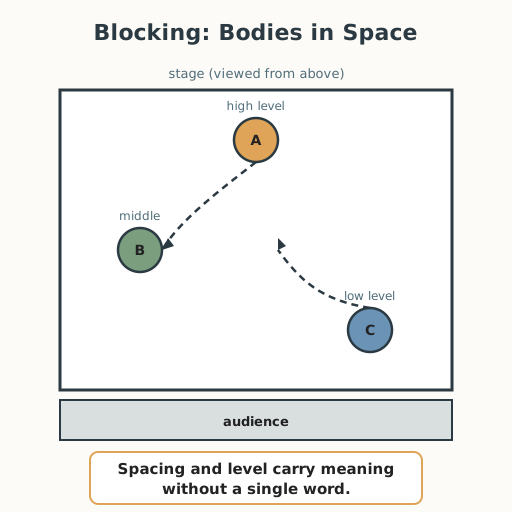
- Meet the body’s words (12 min). Gesture (a hand, a reach, a fist), posture (open, closed, upright, collapsed), spacing (near, far, together, apart), and level (high, middle, low) all carry meaning. Worked example: a performer showing a community divided walks two figures slowly apart across the space, then one figure sinks to the ground while the other stays standing — spacing plus level make the distance felt.
- Choose and plan (8 min). On your sheet, choose one movement idea and one other element (voice, a sound, a prop) to carry your message. Sketch where bodies begin, move, and end.
- Devise it (15 min). In your group (or alone), build a short performance of 60–90 seconds that answers your issue. Rehearse it twice, watching for timing, spacing, and stillness — silence and stillness are as loud as movement.
- Explain the intended effect (8 min). In your journal, write two sentences: what you chose the body to do, and what you intended the audience to feel or think.
- Perform and check (7 min). Perform for the class or a partner. Ask: what did the body say, and what did it make you feel? Compare their answer to your intention.
Differentiation
- Support: Build one clear gesture or posture for the issue, then say in one sentence what it should make an audience feel.
- Extension: Add a second element and refine the ensemble — how the performers move relative to one another — and write how that relationship changes the meaning.
Assessment
- Formative (peer + self): Can the learner name the movement idea and second element they chose, point to where each appears, and explain how each produces the intended effect?
- Portfolio artifact (unit): The performance (performed or recorded/described) plus its written intended-effect explanation, saved for the Lesson 10 gallery.
Home connection
Watch any moment of performance — a game, a dance, a greeting, a ritual — and name one thing the body is saying without words. Write down the gesture, posture, spacing, or level you saw, and what it meant.
Resources
- On devised performance: IDEA — International Drama/Theatre and Education Association (S-260); The Kennedy Center — Education (S-189).
- On performance carrying memory across cultures: Britannica, Griot (S-446); Te Ara, Haka (S-447).
- On worked examples and guided practice: Kirschner, Sweller & Clark (2006), https://doi.org/10.1207/s15326985ep4102_1 (S-011).