Lesson 07 — Directing a Program: Selection & Staging
Learners direct or curate a short performance program: they select and order acts, then make staging choices — who stands where, facing what, in what light or sound — and write the reasoning behind the selection and staging. They learn that directing is curation in time and space at once.
Objectives
Objectives
- D07.S3.11.02 Direct or curate a short performance program and write the reasoning behind the selection and staging.
Essential question
How do I direct or curate a short performance program, and write the reasoning behind the selection and staging?
Key vocabulary
Materials
Standard materials
- Program-and-staging planning sheet · 1 per learner or small group A grid for selecting acts, ordering them, and recording staging choices (who stands where, facing what) with reasons
- A set of short performance pieces · 3–6 pieces The learners' Lesson-6 performances, plus optional remembered or described pieces from other traditions
- Art journal · 1 per learner
Low-tech / no-cost
- A sketched floor plan Paper and pencil to map the stage, audience, and sightlines
- Bodies and found objects as stage markers No lighting rig needed — chalk, stones, or tape mark the space
Enriched / lab & device
- A simple lighting or music cue (optional) · 1 per group To shape entrances, exits, and transitions between acts
- Video recording (optional) To watch the program back and revise the order and staging
Works in different contexts
- large-group Small directing teams each stage a 2–3 act program and present it, with the director stating the reason for each choice
- multi-age Younger learners order acts by one simple effect (quiet to lively); older learners argue for a sequence and staging that build an argument
- self-directed A learner directs a solo program of their own pieces, writes the staging reasoning, and self-checks sightlines from the audience's position
- level-grouped Group by directing readiness; a ready team adds transitions and sightline reasoning, others work from a staging scaffold
- outdoor-only Stage the program using the terrain — a slope, a tree, a clearing — as the venue, and reason about where the audience stands
Lesson 7 — Directing a Program: Selection & Staging
Summary
Learners direct or curate a short performance program: they select and order acts, then make staging choices — who stands where, facing what, in what light or sound — and write the reasoning behind the selection and staging. They learn that directing is curation in time and space at once.
Objectives
- Direct or curate a short performance program and write the reasoning behind the selection and staging. (D07.S3.11.02)
Connection
A wedding order of events, a talent show, a festival stage, a play with an intermission — someone directed each one: decided that this act opens and that one closes, that this performer stands center and that one waits in the wings, that the lights go down here and the music swells there. Those choices are invisible until you look for them, but they are the difference between a list of acts and a show. Today you make them on purpose.
Materials
- Program-and-staging planning sheet
- A set of short performance pieces (3–6)
- Art journal
Preparation
- Gather the pieces: learners’ Lesson-6 performances, plus optional remembered or described pieces from other traditions (with attribution and respect).
- Retrieval: from Lesson 3 and Lesson 5, the two moves of curation; from Lesson 6, how spacing and level carry meaning.
- Model one worked example: a two-act program with a stated reason for the order and for one staging choice.
Facilitator note
This lesson is written to the learner (“you”). The ideas to land: directing = curation applied to performance; it has two deliberate layers — selection/order (which acts, in what sequence) and staging (blocking, sightlines, levels, light, sound); the written reasoning names both. Teach the layers with a worked example and guided practice (S-011), using devised-performance and movement pedagogy that presents traditions with respect (S-260, S-189).
The intellectual lens: every staging choice is a reason — “she faces the audience so we see her reaction” is an argument about where attention should go. The critical-thinking lens: learners test choices against the audience’s actual view (sightlines), not just the director’s intention. The global lens: the performance program is a worldwide form — festivals, rituals, and ceremonies all select and stage acts; the Philippine tinikling (dancers stepping between bamboo poles in imitation of the tikling bird) is one living tradition to honor with respectful questions, not to borrow carelessly (S-116). The community lens: a program is for an audience — learners name who they are directing for and make the staging serve that audience’s eyes and ears.
Procedure
- Recall (5 min). From Lessons 3 and 5, what were the two moves of curation? Today you add a third: staging.
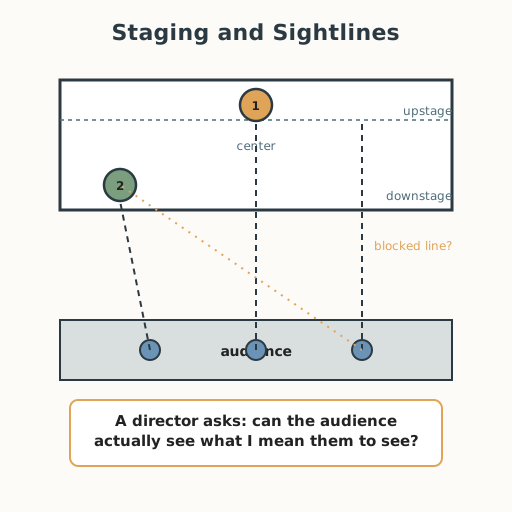
- Meet selection, order, and staging (12 min). Selection = which acts earn a place. Order = what sequence they run in. Staging = where each performer stands, faces, moves, and what light or sound surrounds them. Worked example: a two-act program on “welcome.” The director opens with the loudest, most inviting act (selection + order) and places its performers downstage center, facing the audience, while the quieter closing act begins upstage and walks forward — so the audience’s eyes are met first and led last.
- Select and order (12 min). Choose 2–4 acts that serve one theme, and put them in a sequence. On your sheet, write one line on why each act earns its place and why this order.
- Stage it (12 min). Sketch a floor plan of the space and the audience. Mark where each performer stands and faces, and note one staging choice (a level, a position, a silence, a light or sound cue) that serves the theme. Check the sightlines: can the audience actually see what you want them to see?
- Write the reasoning (9 min). In your journal, write the program’s title, a two-sentence theme, and one sentence on the reason for the selection, the order, and one staging choice.
- Show the plan (5 min). Tell a partner your program, then point to your floor plan and explain the one staging choice you are proudest of.
Differentiation
- Support: Direct a two-act program with sentence frames (“this act opens because…”), and make one staging choice (front vs. back) with a stated reason.
- Extension: Add a transition between acts (a shared silence, a walk, a sound) and write how it links the two, plus a note on any sightline you adjusted for the audience.
Assessment
- Formative (peer + self): Can the learner justify the selection and order, and explain one staging choice with a reason tied to the theme and the audience’s view?
- Portfolio artifact (unit): The floor plan plus the written reasoning, saved for the Lesson 10 gallery.
Home connection
Watch any arranged sequence of performance — a ceremony, a match’s opening, a festival program. Name one staging choice you noticed (who stood where, who faced whom, what sound or light framed it) and write one sentence on what it was meant to do.
Resources
- On devised performance and movement pedagogy: IDEA (S-260); The Kennedy Center — Education (S-189).
- On a living performance tradition: NCCA Philippines, Tinikling (S-116).
- On worked examples and guided practice: Kirschner, Sweller & Clark (2006), https://doi.org/10.1207/s15326985ep4102_1 (S-011).