Lesson 08 — Designing for Impact: Prototype & Test
Learners design a solution to a social or environmental problem: they name the problem, imagine and plan, build a working prototype, test it, and improve it — then explain the intended impact and who it serves. They design with accessibility in mind, asking who a design leaves out and how to widen its reach.
Objectives
Objectives
- D07.S4.11.01 Design a solution to a social or environmental problem, building and testing a prototype and explaining its intended impact.
Essential question
How do I design a solution to a social or environmental problem, build and test a prototype, and explain its intended impact?
Key vocabulary
Materials
Standard materials
- Design-cycle worksheet · 1 per learner or small group A sheet with the steps — name the problem, imagine, plan, create, test, improve — and space to record the prototype and its test
- Building materials · shared Cardboard, paper, string, tape, clay, bottles, cloth — anything reusable that can be assembled and changed
- Art journal · 1 per learner
Low-tech / no-cost
- Found and scrap materials The prototype can be made from anything at hand — a folded-paper model, a twig-and-string rig, a clay form
- A simple test setup Water, a slope, a weight, or a willing user — whatever is needed to try the prototype for real
Enriched / lab & device
- Digital fabrication or simple tools · shared Where a makerspace or fab lab is available, tools make the prototype more precise (S-451)
- Drawing or CAD-style free tool (optional) To plan the prototype more precisely before building
Works in different contexts
- large-group Small design teams each build and test one prototype, then report the problem, the test result, and one improvement
- multi-age Younger learners build and test one simple version; older learners run two test iterations and document how each improved the design
- self-directed A learner works the full cycle alone, tests the prototype against its intended impact, and writes up the result
- level-grouped Group by making and writing readiness; a ready group adds a second user's needs and re-tests, others work from a scaffold
- outdoor-only Build with natural and found materials on site, and test against a real local condition (shade, wind, water flow, slope)
Lesson 8 — Designing for Impact: Prototype & Test
Summary
Learners design a solution to a social or environmental problem: they name the problem, imagine and plan, build a working prototype, test it, and improve it — then explain the intended impact and who it serves. They design with accessibility in mind, asking who a design leaves out and how to widen its reach.
Objectives
- Design a solution to a social or environmental problem, building and testing a prototype and explaining its intended impact. (D07.S4.11.01)
Connection
Every object around you was once someone’s answer to a problem: the ramp as well as the stair, the shade tree planted by a market as well as the roof, the water jug with the wide mouth, the bag that folds small. Design is the discipline of on purpose: you see a need, imagine a thing that meets it, build a rough version, try it, and fix what fails. The difference between an idea and a design is that a design has been tested against reality.
Materials
- Design-cycle worksheet
- Building materials
- Art journal
Preparation
- Gather building materials and clear a build-and-test area.
- Retrieval: from Grade 10 (D07.S4.10.01), designing for a community need with sustainability and fairness; from Lesson 1, each learner’s issue — now a problem to solve.
- Model one worked example: a small problem, a quick prototype, a test, and one improvement.
Facilitator note
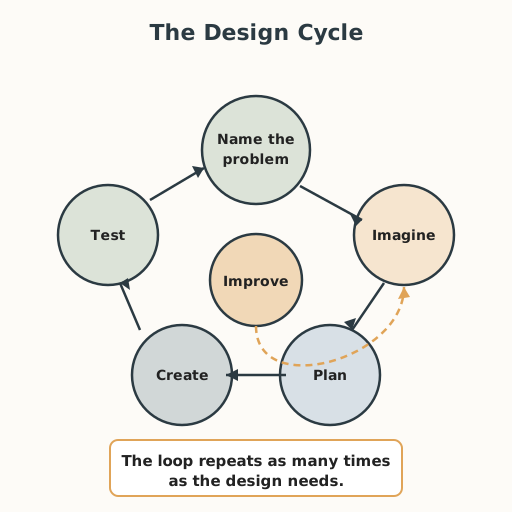
This lesson is written to the learner (“you”). The ideas to land: the design process is an iterative cycle — name the problem, imagine, plan, create, test, improve — repeated as needed (S-370); a prototype is a rough, changeable first version, and its test against real conditions (and real users) is what turns an idea into a design. Teach the cycle explicitly with a worked example and guided practice (S-011); the problem and the solution stay the learner’s own.
The intellectual lens: a test is a small experiment — does the prototype do what it was meant to, for the person it was meant for? The egalitarianism lens: design either includes or leaves out. The seven principles of universal design — equitable use, flexibility in use, simple and intuitive use, perceptible information, tolerance for error, low physical effort, and size and space for approach and use — are a fairness frame: ask who can’t use this, and how do I widen the door (S-369). The environment lens: a good solution does not just work today; it considers its materials and footprint (previewing Lesson 9’s life-cycle lens). The community lens: real design is with users, not at them — learners test with a partner or a real person and listen.
Procedure
- Recall (5 min). From Lesson 1, your issue. Today it becomes a problem with a solution you can build and test.
- Meet the design cycle (10 min). The cycle is name the problem → imagine → plan → create → test → improve, then repeat (S-370). A prototype is a rough, changeable first version. Worked example: the problem is “rain pools at the door.” The learner imagines a sloped channel, plans it, builds a folded-cardboard channel, pours water to test, sees the water overflow at the bend, and improves by raising the edge — then tests again.
- Name the problem (8 min). Write one sentence that names the problem, who it affects, and what a good solution would do for them. Keep it small enough to prototype today.
- Imagine, plan, create (18 min). Sketch two ideas, choose one, then build a rough prototype from the materials at hand. Speed beats polish — a prototype you can test is worth more than a model you can only admire.
- Test and improve (12 min). Test the prototype against the real condition or a real user. Ask: does it do what I intended, for the person I intended? Change one thing and test again.
- Explain the intended impact (7 min). In your journal, write: the problem, the prototype, what the test showed, the one improvement you made, and the intended impact — who is better off, and how.
Differentiation
- Support: Prototype one simple idea and run one test, then say in one sentence what the test showed and what you would change.
- Extension: Run two full test-improve iterations, and write how each test changed the design — including one accessibility question: who might still be left out?
Assessment
- Formative (peer + self): Can the learner name the problem and intended user, show a working prototype, report a test result, and explain one improvement and the intended impact?
- Portfolio artifact (unit): The completed design-cycle worksheet plus the written impact statement, saved for the Lesson 10 gallery.
Home connection
Find one everyday object that doesn’t quite work for someone — a handle too high, a step without a ramp, a label too small. Write one sentence naming the problem, and sketch one small improvement.
Resources
- On the engineering design process: TeachEngineering (S-370).
- On designing for access and fairness: The Center for Universal Design, The Principles of Universal Design (S-369).
- On fabrication access: The Fab Foundation (S-451).
- On worked examples and guided practice: Kirschner, Sweller & Clark (2006), https://doi.org/10.1207/s15326985ep4102_1 (S-011).