Lesson 01 — What Counts as Significant Change?
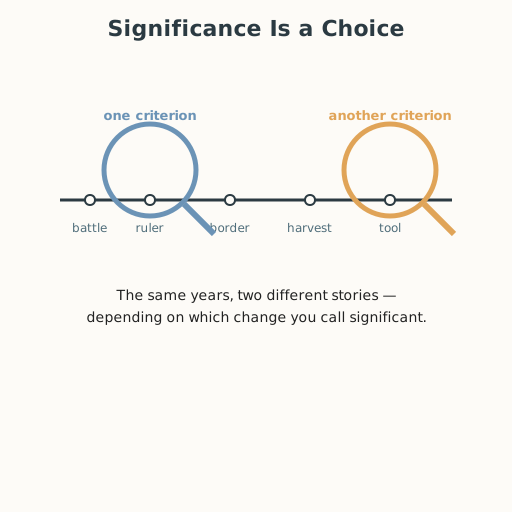
Learners discover that "significant" is a choice, not a fact of nature. They build two timelines of the same span of years using two different criteria for what matters — one centered on rulers and wars, one centered on everyday people, land, and ideas — and see how the same years produce two different stories. This opens the unit's central discipline: history is told from many perspectives, and the choice of what counts as change shapes every account.
Objectives
Objectives
- D08.S1.11.02 Evaluate how the choice of what counts as significant change shapes historical accounts, using contrasting examples.
Essential question
How does the choice of what counts as significant change shape the historical accounts we tell?
Key vocabulary
Materials
Standard materials
- Timeline strips (paper or board) · 1 per learner or pair Long blank line for placing events; one for each of two contrasting "significance" choices
- History journal · 1 per learner
Low-tech / no-cost
- A length of string or a line drawn in the earth Lay events as knots, pebbles, or marks — one line per contrasting account
- Found objects (pebbles, seeds, sticks) Stand in for events on the timeline
Enriched / lab & device
- Digital timeline tool or shared document · 1 per pair To build and compare two parallel timelines with images and links
Works in different contexts
- large-group Build one shared class timeline for the first account, then pairs build the contrasting account and present the difference
- multi-age Younger learners choose events by "what mattered most to our family"; older learners weigh rival criteria for significance and defend one
- self-directed A learner builds both timelines alone, then writes a short paragraph naming the criterion each account used
- level-grouped A ready group reads a short historiography excerpt (S-314) and names the periodization choices inside it
- outdoor-only Lay two timelines on the ground with found objects and walk them, noting where the two accounts diverge
Lesson 1 — What Counts as Significant Change?
Summary
Every history book, film, and lesson makes a hidden choice: which changes count as important enough to include? In this opening lesson, learners make that choice visible. They build two timelines of the same years — one that marks rulers, battles, and borders, and one that marks harvests, migrations, tools, and ideas — and notice that the same span of time yields two different stories. Historians call this act of choosing significance, and dividing time into named eras is periodization (S-314).
Objectives
- Evaluate how the choice of what counts as significant change shapes historical accounts, using two contrasting examples built from the same years. (D08.S1.11.02)
Connection
Think of your own life in two tellings. One version lists the “big” things: a move, a first day, a win or a loss. Another version lists the small daily things that quietly shaped you: a habit, a friendship, a place you returned to. Both are true; neither is complete. The same is true of whole peoples and centuries — what we decide to call “significant” changes which story gets told.
Materials
- Timeline strips (or string and pebbles)
- History journal
Preparation
- Prepare the two sets of “event cards” for a shared recent span (see Procedure step 2).
- Retrieval: from Grade 10, the idea that historians divide time into periods and that periodization is a convention, not a fact of nature (S-314), and that historical thinking rests on sourcing and multiple causation (S-316).
Facilitator note
The idea to land: significance is a selection, and every selection favors some people and some events over others. The critical-thinking lens: learners name the criterion behind each account (“why this and not that?”). The egalitarianism lens: accounts centered only on rulers and wars leave out most people; centering ordinary people, land, and ideas is a choice toward fairness. The global lens: different peoples periodize their own pasts differently, and no single calendar or era is “natural” (S-314). The ethics lens: who is remembered, and who is forgotten, is a question with moral weight. Hold this lesson light — it is an opening frame, not a verdict on any one nation’s story.
Procedure
- Recall (5 min). From earlier grades: why do historians divide time into periods, and who decides where the dividing lines fall? (S-314) Say one thing you remember about “whose story gets told.”
- Meet significance (10 min). Significance means “important enough to be part of the account.” Worked example: for the year a learner was born, list three different events — a national election, a family arrival, a new technology that changed daily life. Each is “significant” to a different story.
- Build the first timeline (12 min). On a strip, place a set of events chosen by one criterion — rulers, battles, and borders. Label the criterion at the top: “What rulers and states did.”
- Build the contrasting timeline (12 min). On a second strip, place events from the same years chosen by a different criterion — harvests and climate, migrations, tools, and ideas. Label it: “What ordinary people and the land lived through.”
- Compare (10 min). Set the two timelines side by side. Discuss with a partner: which events appear on both? Which appear on only one? What does each account make invisible?
- Journal (4 min). Write: “The two timelines tell different stories because…”
- Close (2 min). Say in one sentence why “significant” is a choice, not a fact.
Differentiation
- Support: Work from a single, familiar span (this school year); give a fixed menu of events to sort rather than generating them.
- Extension: Add a third criterion (e.g., changes to the environment) and compare all three; name what a criterion cannot capture.
Assessment
- Formative (peer + self): Can the learner state the criterion behind each account and identify at least one event each account leaves out?
- Portfolio artifact (unit): The two contrasting timelines with the one-sentence “because…” journal entry, kept as the opening frame of the unit portfolio.
Home connection
Retell one family story twice — once “big events only,” once “small daily things only.” Ask a family member which version feels truer and why.
Resources
- Periodization as a human convention, not a fact of nature: Encyclopaedia Britannica, “Historiography” (S-314).
- Sourcing, contextualization, corroboration, and causality as core historical-thinking skills: Stanford History Education Group (S-316).
- The danger of a single story: Chimamanda Ngozi Adichie, TEDGlobal 2009 (S-417).