Lesson 15 — Power, Inequality, and Technology
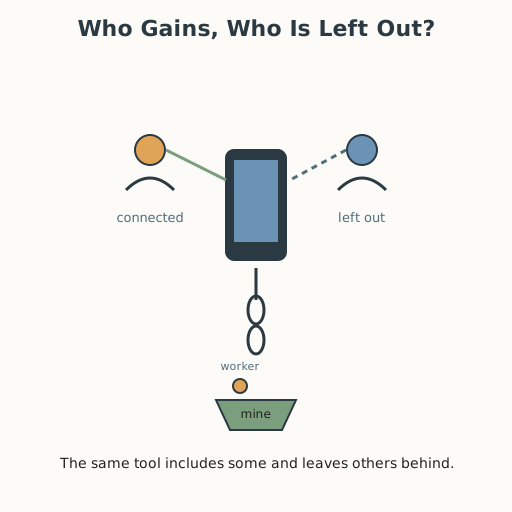
In the unit's final lesson, learners analyze technology's double edge: the same tools that connect and include also concentrate power and leave people out. They trace the supply chain of a phone, whose minerals are sometimes mined in conditions that harm and exploit workers, including children (S-398); weigh the digital divide — benefits spread fast but unevenly (S-281); and meet mobile money (M-Pesa), which grew where bank branches were scarce and let people send, save, and pay by phone (S-210). They answer the unit's recurring question one last time: *who gained, and who was left out?*
Objectives
Objectives
- D08.S4.11.02 Analyze the relationship between power, inequality, and technology in past and present struggles, and who gained and who was left out.
Essential question
How has technology reordered power and inequality in past and present struggles — and who gained, and who was left out?
Key vocabulary
Materials
Standard materials
- Power-and-technology case sheet · 1 per learner Columns for the technology, who gained, who was left out, and the struggle it touched
- History journal · 1 per learner
Low-tech / no-cost
- A traced supply chain on paper Draw a simple object's journey — mine, factory, port, hand — and mark who gains at each step
Enriched / lab & device
- World Bank Digital Dividends summary and a mobile-money explainer (if available) To ground the two modern cases in data (S-281, S-210)
Works in different contexts
- large-group Trace one case whole-class, then pairs trace the second and share who gained and who was left out
- multi-age Younger learners name "who got it and who didn't"; older learners analyze the power and inequality in each case
- self-directed A learner completes both cases and writes one paragraph on the double edge of technology
- level-grouped A ready group weighs the digital divide (S-281) against mobile money's inclusion (S-210) and reconciles the two
- outdoor-only Lay out a supply chain with found objects and walk it, naming who gains at each stop
Lesson 15 — Power, Inequality, and Technology
Summary
Technology is never neutral: it reorders who can act, who profits, and who is left out. Learners trace a phone’s supply chain — the minerals inside it are sometimes mined in conditions that harm and exploit workers, including children, far from the user (S-398) — and weigh two faces of digital technology: the digital divide, where benefits spread rapidly but unevenly (S-281), and mobile money, which grew where banks were scarce and brought banking to people the old system had left out (S-210). The unit closes by repeating its central question: who gained, and who was left out?
Objectives
- Analyze the relationship between power, inequality, and technology in past and present struggles, and who gained and who was left out. (D08.S4.11.02)
Connection
The device in your hand connects you to the world — and, through a long chain, to a mine, a factory, and a worker far away. The same technology that includes you also carries a chain of power behind it. Tracing that chain is how we see technology honestly: both its gift and its cost.
Materials
- Power-and-technology case sheet
- History journal
Preparation
- Copy the case sheet; prepare the phone-supply-chain description (step 2).
- Retrieval: from earlier units, how technology’s benefits and harms are distributed unevenly, and the life cycle of a designed object.
Facilitator note
Hold technology in the unit’s balance — neither worship nor fear. The technology lens: tools reorder power; they do not erase it. The egalitarian lens: the benefits of digital technology have spread fast but unevenly, and the digital divide is real (S-281). The ethics lens: the minerals in our devices are sometimes mined in conditions that harm and exploit workers, including children (S-398) — a harm borne far from the user, which fairness requires us to see and act on. The global lens: mobile money (M-Pesa) grew where bank branches were scarce and included people the old system left out (S-210) — proof that technology can also widen access when designed for it. The critical-thinking lens: the same tool can exclude and include at once; the question is always who and under what design. Close the unit with agency: design, governance, and fair access are choices, still open.
Procedure
- Recall (5 min). From the unit so far: name one movement’s strategy and one climate response. Today we close with the tool that runs through all of them: technology.
- Trace a phone (12 min). A phone’s minerals — including cobalt — are sometimes mined in conditions that harm and exploit workers, including children (S-398). On the case sheet, trace the chain: mine → factory → port → hand. Mark who gains and who is left out at each stop.
- The digital divide (12 min). Digital technologies have spread rapidly, but their benefits are unevenly distributed, and a digital divide in access remains (S-281). Fill the sheet: who gained access and who was left out, and what that difference means for power.
- Mobile money: technology that includes (12 min). Where bank branches were scarce, mobile money such as M-Pesa let people send, save, and pay by phone — including people the old system had left out (S-210). Fill the sheet: who gained, and how design made the difference.
- Reconcile the two faces (10 min). With a partner: how can the same technology both exclude and include? What decides which way it tips?
- Journal (4 min). Answer the unit’s question one last time: “Technology reorders power — who gained, and who was left out?” — with one example for each side.
Differentiation
- Support: Use a two-column “gained / left out” sheet for a single case before writing.
- Extension: Argue one change in design or governance that would make a technology you use more inclusive, naming who it would help.
Assessment
- Formative (peer + self): Can the learner name who gained and who was left out in each case, and explain how design decides which way technology tips?
- Portfolio artifact (unit): The completed case sheet and journal answer, as the power-inequality-technology analysis closing the unit portfolio.
Home connection
Trace one object at home back a single step — where it came from, who likely made it, what it cost them. Write one sentence on who gained and who was left out in that one step.
Resources
- Cobalt and other minerals sometimes mined in conditions that harm and exploit workers, including children: Amnesty International (2016) (S-398).
- Digital benefits spread rapidly but unevenly, and the digital divide: World Bank, World Development Report 2016 (S-281).
- Mobile money (M-Pesa) growing where bank branches were scarce: CGAP / World Bank (S-210).