Lesson 14 — Strategies and Effects: Comparing Movements
Learners deepen the comparison of movements by focusing on *strategy*: the 1930 Salt March, a nonviolent act of civil disobedience against the British salt tax (S-390); the 1952 Defiance Campaign in South Africa against the pass laws (S-146); and the Chipko movement of 1970s India, where villagers — especially women — embraced trees to stop them being cut (S-328). They compare each strategy's aim, risk, and effect, and judge when a strategy fits its struggle.
Objectives
Objectives
- D08.S4.11.01 Compare social movements for civil rights, labor, and liberation across different countries and analyze their strategies and effects.
Essential question
How do different strategies of resistance — protest, boycott, and defense of the land — compare in aim and effect?
Key vocabulary
Materials
Standard materials
- Strategy comparison chart · 1 per learner Columns for strategy, movement, aim, risk, and effect, across three cases
- History journal · 1 per learner
Low-tech / no-cost
- Three strategy story cards One-paragraph tellings of the Salt March, the Defiance Campaign, and the Chipko movement
Enriched / lab & device
- Short footage or photos of the Salt March or Chipko (if available) To see nonviolent direct action in practice
Works in different contexts
- large-group Jigsaw the three cases, then each group teaches its strategy to the class
- multi-age Younger learners act out each strategy; older learners compare risk and effect
- self-directed A learner completes the chart and writes which strategy they would choose and why
- level-grouped A ready group weighs civil disobedience (S-390) against embracing trees (S-328) and names when each fits
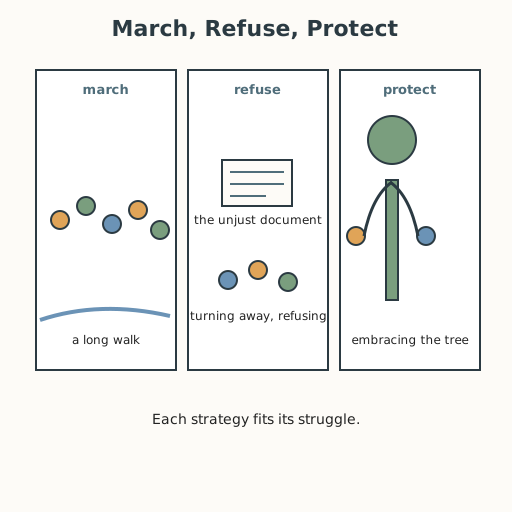
- outdoor-only Rehearse each strategy's gesture — a long walk, a refusal line, a protective embrace — and name its aim
Lesson 14 — Strategies and Effects: Comparing Movements
Summary
Movements choose their tools deliberately: a long walk, a mass refusal, a protective embrace. Learners compare three strategies — the 1930 Salt March, a nonviolent act of civil disobedience against the British salt tax in India (S-390); the 1952 Defiance Campaign in South Africa, which defied unjust pass laws (S-146); and the Chipko movement of 1970s India, where villagers, especially women, embraced trees to stop them being felled (S-328). They weigh each strategy’s aim, risk, and effect, and judge when a strategy fits its struggle.
Objectives
- Compare the strategies and effects of social movements across countries, and judge when a strategy fits its aim. (D08.S4.11.01)
Connection
The same injustice can be met many ways: you can walk out, sit down, refuse to buy, refuse to obey, or stand between the thing you love and the force that would take it. Each has a different cost and a different reach — and choosing among them is the art of resistance.
Materials
- Strategy comparison chart
- History journal
Preparation
- Copy the chart; prepare the three strategy story cards.
- Retrieval: from Lesson 13, the shared pattern of aim, strategy, and effect.
Facilitator note
The skill to land: judge a strategy by its fit — aim, risk, and effect together. The ethics lens: nonviolent civil disobedience accepts a cost (arrest, punishment) to expose an unjust law — a choice, not an accident. The egalitarian lens: the Chipko movement was led in large part by village women defending the forests their communities depended on (S-328) — a reminder that resistance has many faces, not only famous leaders. The environment lens: Chipko links the struggle for dignity to the defense of the land itself. The global lens: three continents, one shared repertoire. The critical-thinking lens: no single strategy is “best” in the abstract; learners argue fit for a specific struggle.
Procedure
- Recall (5 min). From Lesson 13: name the three movements and what they shared. Today we zoom into how — the strategy.
- The Salt March (12 min). In 1930, Mohandas Gandhi led a long march to the sea to make salt in defiance of the British salt tax — a nonviolent act of civil disobedience within India’s independence movement (S-390). Fill the chart: strategy (march and civil disobedience), aim (defy an unjust tax, build independence), risk (arrest), effect (galvanized the movement).
- The Defiance Campaign (12 min). In 1952, South Africans deliberately broke unjust pass laws and accepted arrest, in a mass campaign of noncooperation (S-146). Fill the chart: strategy (mass defiance), aim (repeal the pass laws), risk (arrest), effect (grew the movement against apartheid).
- Chipko (12 min). In 1970s India, villagers — especially women — embraced the trees to stop them being cut, protecting the forests their communities lived by (S-328). Fill the chart: strategy (direct action, embrace), aim (save the forest), risk (confrontation), effect (forests protected; a model of environmental defense).
- Judge the fit (10 min). With a partner: when does a march fit better than a mass arrest campaign or a protective embrace? Judge each strategy against its aim.
- Journal (4 min). Write: “I would choose… strategy for… struggle because…”
Differentiation
- Support: Use a sorting activity matching strategy to aim before writing.
- Extension: Compare a fourth strategy — the peaceful resistance of Parihaka in 1881 (S-144) — and place it in the chart.
Assessment
- Formative (peer + self): Can the learner name each strategy, its aim and risk, and argue when a strategy fits its struggle?
- Portfolio artifact (unit): The completed strategy chart, completing the social-movements comparison.
Home connection
Think of one change you want in your community. Choose a strategy — a walk, a refusal, a protective act — and write one sentence on why it fits.
Resources
- The 1930 Salt March: Encyclopaedia Britannica (S-390).
- The 1952 Defiance Campaign in South Africa: South African History Online (S-146).
- The Chipko movement (India, 1970s): Encyclopaedia Britannica (S-328).
- Peaceful resistance at Parihaka (1881): NZHistory (S-144).