Lesson 01 — The Shape of Our Choices
Learners name the difference between the choices a person can *imagine* and the choices actually open to them, and trace the social and economic structures — rules, resources, and roles — that shape that gap. They begin the unit's first argument: how much of what we do is chosen freely, and how much is shaped by structures we did not build ourselves.
Objectives
Objectives
- D09.S1.11.01 Analyze how social and economic structures shape which choices people can make, and argue about responsibility.
Essential question
How do social and economic structures shape which choices I actually get to make?
Key vocabulary
Materials
Standard materials
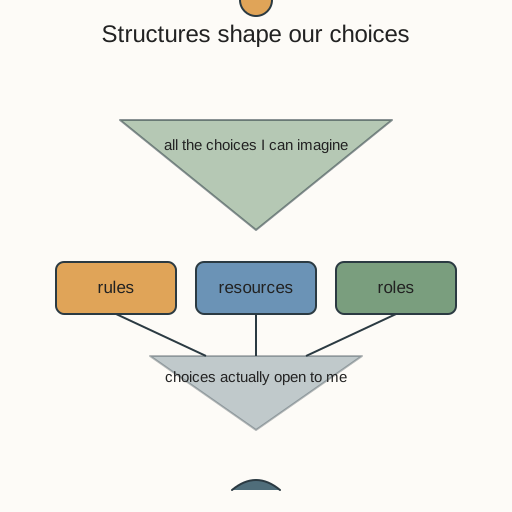
- Structure-and-choice map · 1 per learner A two-part organizer — 'choices I can imagine' widening into 'choices actually open to me' — with a space to name the forces in between
- Justice journal · 1 per learner The unit-long notebook for reflections, arguments, and portfolio artifacts
Low-tech / no-cost
- Example slips on paper Everyday moments (what to study, how to travel to school, whether to work or rest, who to live with) to sort by how much structure shapes them
- Paper and pencil To draw the map by hand when no printed organizer is available
Enriched / lab & device
- One page of inequality data (UNDP or World Inequality Report summary) · 1 per pair To ground the claim that resources are distributed unevenly within and across countries
Works in different contexts
- large-group Brainstorm examples whole-class into two columns, then pairs each draw one personal example with the forces that shaped it
- multi-age Younger learners name one choice they made today; older learners map the rules, resources, and roles behind several choices and argue about edge cases
- self-directed A learner sorts the slips alone, then draws their own structure-and-choice map and writes two sentences on the biggest shaper of their choices
- level-grouped A ready group also distinguishes "constraint" from "influence" and argues where the line falls
- outdoor-only Stand in a wide space and physically walk from "all I can imagine" through labeled stations (rules, resources, roles) to "what I actually choose"
Lesson 1 — The Shape of Our Choices
Summary
Learners name the difference between the choices a person can imagine and the choices actually open to them, and trace the social and economic structures — rules, resources, and roles — that shape that gap. They begin the unit’s first argument: how much of what we do is chosen freely, and how much is shaped by structures we did not build ourselves.
Objectives
- Analyze how social and economic structures shape which choices people can make, and begin to argue about responsibility. (D09.S1.11.01)
Connection
Think of one real choice you made this week — what to eat, how to get somewhere, whether to study or rest. You made it, but you did not make it in a void. What you could afford, what your family and school expected, what the law allowed, what your body could do, and who was around you all narrowed the menu before you chose. Some people face a wide menu; others a short one. Naming what shapes the menu is the first step of this unit — because you cannot change a structure you cannot see.
Materials
- Structure-and-choice map
- Justice journal
- Example slips (low-tech: paper)
Preparation
- Copy or draw the structure-and-choice map; prepare the example slips.
- Retrieval: from Grade 10 (D09.S1.10.01), applying ethical reasoning to a technology or environment question; from Unit 3 this year (D02), empathy for distant others. Today we add the word structure.
- Prepare a plain definition: a structure is a stable pattern — a law, a market, a family form, a school — that makes some choices easy and others hard (worked example first: Kirschner, Sweller & Clark, S-011).
Facilitator note
This lesson is written to the learner (“you”). The idea to land: we choose, but we choose inside structures — rules, resources, and roles — that shape the menu of options (concept, held as description, not as a claim that choice is an illusion). Then the egalitarian turn: those structures distribute resources unevenly, so the menu is not the same length for everyone (UNDP Human Development Report, S-283). Keep the two ideas held together — agency and structure — rather than collapsing into “everything is determined” or “everything is free choice.” Both extremes are false and both are tempting at this age; hold the tension as the learning.
The ethics lens: who is responsible for an outcome when choice is shaped is exactly the open question we carry into Lesson 2. The egalitarianism lens: notice whose menu is longer and whose is shorter. The global lens: structures differ from place to place (a farm’s rules, a city’s market, a small island’s transport) — none is the default. The critical-thinking lens: distinguishing the choices I can imagine from the choices actually open to me is an act of careful description, not opinion. Preview: Lesson 2 takes up responsibility head-on.
Procedure
- Recall (5 min). From Grade 10: when you reasoned about a technology or environment question, what did you weigh — consequences, duties, or virtues? Today we add a new lens: structure.
- Meet “structure” (10 min). A structure is a stable pattern that makes some choices easy and others hard. Work a model example first (S-011): a teenager in a small village and a teenager in a large city both want to keep learning. What rules, resources, and roles shape how each one actually can? Name the three: rules (laws, customs), resources (money, time, transport, health), and roles (student, worker, caregiver, eldest sibling).
- Sort the slips (12 min). With a partner, sort each everyday moment by how much structure shapes it: “mostly my free choice,” “mostly shaped by structure,” or “both.” Argue the borderline ones and be ready to say why.
- Argue an edge case (8 min). Is who you can be friends with shaped by structure? Is whether you go hungry? Choose one, argue, then agree on a place.
- Draw the map (12 min). In your justice journal, draw the wide fan of choices you can imagine, then the narrower set actually open to you — and label the rules, resources, and roles that narrow it. Write one sentence on which force shapes your choices most.
- Close (4 min). Say, in your own words, why “I chose it” is not the whole story — and what is missing.
Differentiation
- Support: Sort only the clearest slips and name the three forces with one word each, leaving the edge cases aside.
- Extension: Investigate one structure (e.g., schooling, transport, or land ownership) in two different places and compare how it widens or narrows choices.
Assessment
- Formative (peer + self): Can the learner name rules, resources, and roles, sort examples with reasons, and draw the gap between imagined and actual choices?
- Portfolio artifact (unit): The completed structure-and-choice map with the written reflection, opened in the justice journal.
Home connection
Ask someone at home about one choice they wanted to make but could not, and what structure — a rule, a cost, a role — stood in the way. Write one sentence about what they told you and one about what surprised you.
Resources
- On structures distributing resources unevenly (general data authority): UNDP Human Development Reports (S-283); World Inequality Report (S-464).
- On worked examples and guided practice for a new analytical skill: Kirschner, Sweller & Clark (2006) (S-011).
- On retrieval practice and spacing across the unit: Dunlosky et al. (2013) (S-039).