Lesson 02 — Responsibility When Choices Are Shaped
Learners take the structure-shapes-choice insight from Lesson 1 and turn it into an argument about responsibility. They weigh individual responsibility against structural responsibility, meet the idea of "moral luck" (being credited or blamed for things not fully in our control), and defend a reasoned position on where responsibility falls — holding the question open rather than settling it.
Objectives
Objectives
- D09.S1.11.01 Analyze how social and economic structures shape which choices people can make, and argue about responsibility.
Essential question
When structures shape our choices, who is responsible — the person or the structure?
Key vocabulary
Materials
Standard materials
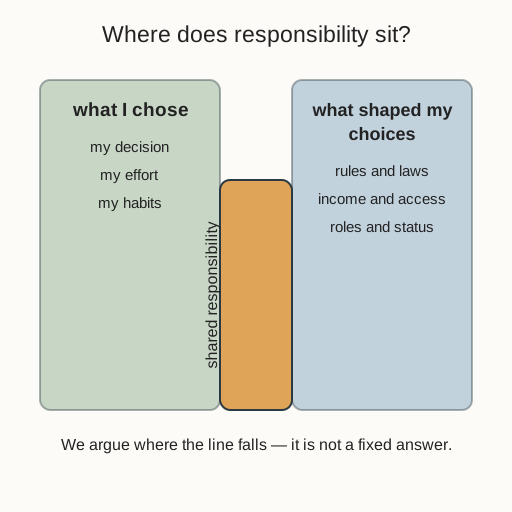
- Responsibility organizer · 1 per learner Two columns — "what the person chose" and "what shaped the choice" — meeting in a shared band labeled "responsibility"
- Justice journal · 1 per learner
Low-tech / no-cost
- Case slips on paper Short cases (a worker paid below a living wage; a driver without insurance; a student without a place to study) to argue about
- Paper and pencil To draw the two-column organizer by hand
Enriched / lab & device
- One short supply-chain report (Amnesty cobalt report summary, S-398) · 1 per group A real case where individual and structural responsibility are hard to untangle
Works in different contexts
- large-group Argue one case whole-class with a "person / structure / both" continuum drawn on the floor, then pairs write their own verdict
- multi-age Younger learners say who they think is responsible and why; older learners weigh individual against structural responsibility and defend a position
- self-directed A learner reads two cases, places each on the continuum, and writes a short argument with a counterargument they concede
- level-grouped A ready group reads the cobalt case and argues whether the far-away consumer bears any responsibility
- outdoor-only Mark a line outdoors from "the person" to "the structure" and have learners stand where they think responsibility falls, then explain
Lesson 2 — Responsibility When Choices Are Shaped
Summary
Learners take the structure-shapes-choice insight from Lesson 1 and turn it into an argument about responsibility. They weigh individual responsibility against structural responsibility, meet the idea of moral luck (being credited or blamed for things not fully in our control), and defend a reasoned position on where responsibility falls — holding the question open rather than settling it.
Objectives
- Analyze how social and economic structures shape which choices people can make, and argue about responsibility. (D09.S1.11.01)
Connection
A worker takes a job with long hours and low pay because it is the only work in town. A driver without insurance causes an accident after missing a payment they could not afford. A student fails a test for which they had no quiet place to study. In each case, someone chose — and something shaped the choice. When we ask “who is responsible?”, we are really asking two questions at once: what did this person do, and what did the world around them set in motion? Most real answers sit in the middle, and arguing well means holding both questions at once.
Materials
- Responsibility organizer
- Justice journal
- Case slips (low-tech: paper)
Preparation
- Copy or draw the responsibility organizer; prepare the case slips.
- Retrieval: from Lesson 1, the three forces (rules, resources, roles) and the gap between imagined and actual choices.
- Prepare a plain definition of moral luck: we are credited or blamed for things that were partly outside our control — a useful concept, not a verdict on anyone (worked example first: S-011).
Facilitator note
This lesson is written to the learner (“you”). The idea to land: responsibility has (at least) two seats — the person who chose and the structure that shaped the choice — and mature moral argument refuses to reduce a case to only one (a conceptual distinction, not a claim about any specific case). The egalitarian turn: the question “who is responsible?” is not neutral; it is often used to blame the poor for poverty or to excuse the powerful. Naming both seats is a fairness move (UNDP, S-283). Hold the question open: the lesson’s point is not to reach one answer but to argue well and notice what each answer assumes.
The ethics lens: responsibility is the heart of moral judgment — who answers for what. The egalitarianism lens: watch where “responsibility” talk lands — does it fall harder on people with shorter menus? The global lens: a far-away consumer and a far-away worker are linked by a supply chain neither fully controls (Amnesty cobalt report, S-398). The critical-thinking lens: test each argument for the hidden assumption that the chooser was free. Distinguish evidence from value: what happened is evidence; who should answer for it is a value judgment.
Procedure
- Recall (5 min). What are the three forces from Lesson 1 — rules, resources, and roles? Give one example of each shaping a choice.
- Meet moral luck (10 min). Work a model case (S-011): two drivers both look away for a second; one hits a child, the other does not. The act is the same; the outcome differs. Are they equally to blame? Introduce moral luck: what we are credited or blamed for is partly shaped by what we did not control.
- Argue the cases (15 min). In pairs, place each case slip on a continuum from “the person is responsible” to “the structure is responsible,” with “both” in the middle. For each, name what the person chose and what shaped the choice.
- Weigh the two seats (10 min). For one case, write an argument for the person’s responsibility and an argument for the structure’s — then say where you would place the line, and why.
- Watch the power (8 min). Who in your case has more power to change the structure? Who is more likely to be blamed? Notice how the word “responsible” moves between them.
- Close (4 min). Say, in your own words, why “who is responsible?” is not a question with one fixed answer — and what you would need to know to answer it well.
Differentiation
- Support: Argue only the clearest case and use the two-column organizer to list “person” and “structure” facts before choosing.
- Extension: Analyze the cobalt supply chain (S-398) and argue whether a consumer far down the chain bears responsibility, conceding a counterargument.
Assessment
- Formative (peer + self): Can the learner name both seats of responsibility, place a case on the continuum with reasons, and concede a counterargument?
- Portfolio artifact (unit): The two-sided written argument with a stated line and reason, opened in the justice journal.
Home connection
Ask someone at home about a time they were blamed (or credited) for something partly outside their control. Write one sentence on what they said and one on whether you think the blame or credit was fair.
Resources
- On structures and unequal outcomes (general data authority): UNDP Human Development Reports (S-283); World Inequality Report (S-464).
- On a supply chain where responsibility is hard to untangle: Amnesty International cobalt report (S-398).
- On worked examples and guided practice for argument: Kirschner, Sweller & Clark (2006) (S-011); on spacing and retrieval: Dunlosky et al. (2013) (S-039).