Lesson 05 — Justice, Power, and Law
Learners map the relationship between justice, power, and law — three things that usually travel together but can come apart. They see that law is power made into rules, that justice is the standard by which law and power are judged, and that power can serve justice or defy it. They meet structural violence — harm built into systems — and begin the argument about how to change an unjust law or system.
Objectives
Objectives
- D09.S2.11.01 Analyze the relationship between justice, power, and law, and argue for how an unjust law or system should be changed.
Essential question
How do justice, power, and law relate — and where do they come apart?
Key vocabulary
Materials
Standard materials
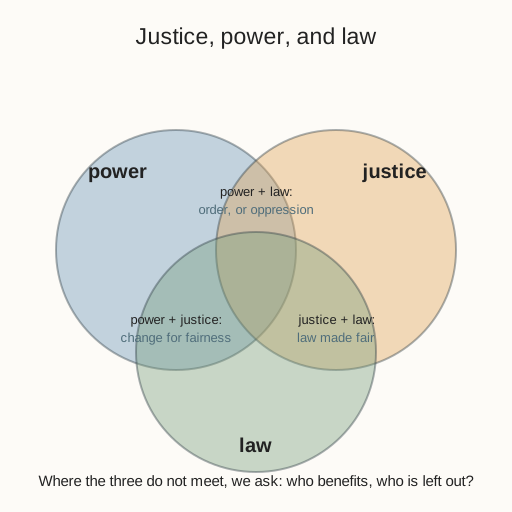
- Justice-power-law diagram · 1 per learner Three overlapping circles (justice, power, law) with the overlaps to label
- Justice journal · 1 per learner
Low-tech / no-cost
- Three circles drawn on paper or the ground To sort example slips into "justice", "power", "law", and their overlaps
- Example slips Moments like a fair trial, a bribe, a protest against a law, a law that protects the weak, a law that protects the strong
Enriched / lab & device
- V-Dem democracy-measurement summary (S-461) · 1 per pair To ground the claim that power is distributed unevenly across societies, without ranking any above another
Works in different contexts
- large-group Draw the three circles large on the floor and have learners place themselves where an example belongs, then explain
- multi-age Younger learners sort clear examples (a fair rule, a bully, a helpful law); older learners argue the overlaps and the gaps
- self-directed A learner sorts the slips into the diagram, labels the overlaps, and writes where the three "come apart" in one real case
- level-grouped A ready group also analyzes structural violence — harm built into systems, not done by one hand (Galtung, S-462)
- outdoor-only Draw three overlapping circles in the dirt or with stones; place slips physically and argue placement
Lesson 5 — Justice, Power, and Law
Summary
Learners map the relationship between justice, power, and law — three things that usually travel together but can come apart. They see that law is power made into rules, that justice is the standard by which law and power are judged, and that power can serve justice or defy it. They meet structural violence — harm built into systems — and begin the argument about how to change an unjust law or system.
Objectives
- Analyze the relationship between justice, power, and law. (D09.S2.11.01)
Connection
Every school, every home, and every country runs on some mix of three things: power (who can make others do things), law (the written and unwritten rules), and justice (whether the rules and the power are fair). Usually the three overlap — a fair rule, backed by legitimate power, gives us justice. But they come apart more often than we like: a law can be unjust, power can serve itself instead of the law, and justice can demand something the law has not yet written down. Seeing how the three fit — and where they split — is how you learn to tell “this is the law” from “this is right.”
Materials
- Justice-power-law diagram
- Justice journal
- Three circles + example slips (low-tech: paper/ground)
Preparation
- Copy or draw the three-circle diagram; prepare the example slips.
- Retrieval: from Lesson 4, visions of a good society. Today we look at the machinery — how power and law actually work, and how justice judges them.
- Prepare plain definitions: power (the capacity to make things happen, including over others); law (rules with authority and, usually, enforcement); justice (the standard of fairness by which power and law are judged).
Facilitator note
This lesson is written to the learner (“you”). The idea to land: justice, power, and law are three distinct things that usually overlap but can come apart — and the overlaps are where the interesting trouble is. Then the critical turn: law is not the same as justice; power is not the same as right. A law can be unjust, and power can serve itself (a conceptual point, illustrated with cases, not a claim about any specific state). Introduce structural violence — harm built into systems rather than done by one hand (Galtung, S-462) — and note that power is distributed unevenly across societies (V-Dem, S-461), without ranking any society above another.
The ethics lens: “is this law just?” is the moral question at the center. The egalitarianism lens: ask of every law and power — who does it serve, and who does it leave out? The global lens: different societies organize the three differently; none is the default. The critical-thinking lens: distinguishing “what the law is” (fact) from “what it ought to be” (value). Preview: Lesson 6 argues for changing an unjust law.
Procedure
- Recall (5 min). From Lesson 4, what holds a good society together? Today: what actually makes rules stick — and what makes them fair?
- Meet the three (10 min). Define power, law, and justice. Note the usual picture: fair rules + legitimate power = justice. Then ask where the three can come apart.
- Sort the slips (15 min). Place each example into the three-circle diagram: “justice alone,” “power alone,” “law alone,” or an overlap. Argue the hard ones: is a protest against an unjust law lawful? just? powerful?
- Label the overlaps (10 min). With a partner, label each overlap: power + law can be order — or oppression; justice + law is law made fair; power + justice is change for fairness.
- Meet structural violence (8 min). Some harm is not done by one hand but built into systems — a rule that quietly keeps some people out (S-462). Name one example from the slips and say what makes it structural.
- Close (4 min). Say, in your own words, why “it is the law” does not settle the question “is it just?”
Differentiation
- Support: Sort only the clearest slips and label one overlap; leave structural violence for later.
- Extension: Analyze one real law, past or present, and argue whether it is just, naming who it serves and who it leaves out.
Assessment
- Formative (peer + self): Can the learner distinguish the three, place examples in the overlaps with reasons, and explain structural violence in one case?
- Portfolio artifact (unit): The labeled three-circle diagram with a written example where the three come apart, opened in the justice journal.
Home connection
Ask someone at home about a rule they must follow that they think is unfair. Write one sentence on the rule and one on whether it is a question of power, law, justice — or all three.
Resources
- On structural violence and the conflict/peace distinction: Galtung (1969) (S-462); on uneven distribution of power across societies: V-Dem Institute (S-461).
- On worked examples and guided practice for analysis: Kirschner, Sweller & Clark (2006) (S-011).