Lesson 06 — Changing an Unjust Law
Learners argue for how an unjust law or system should be changed, using real cases from three continents: the 1930 Salt March and 1881 Parihaka, South Africa's 1952 Defiance Campaign, the 1955–56 Montgomery bus boycott, and the 1966 Wave Hill walk-off. They map each onto a path of notice → organize → act → change, weigh nonviolent action against working only within the law, and defend a reasoned position.
Objectives
Objectives
- D09.S2.11.01 Analyze the relationship between justice, power, and law, and argue for how an unjust law or system should be changed.
Essential question
How should an unjust law or system be changed?
Key vocabulary
Materials
Standard materials
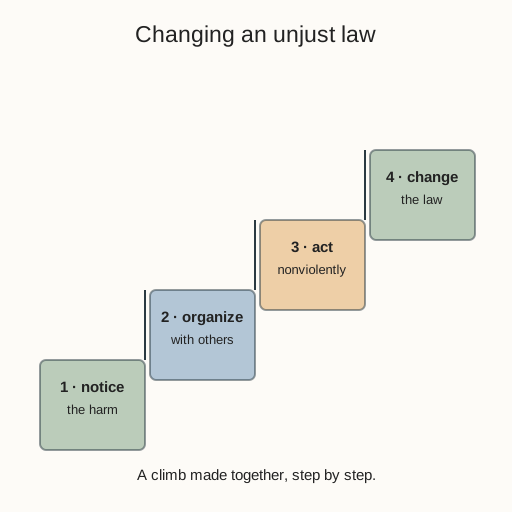
- Change-path organizer · 1 per learner A four-step path (notice, organize, act, change) with space to fill in a real historical case
- Justice journal · 1 per learner
Low-tech / no-cost
- Case cards on paper One card each for the Salt March (1930), the Defiance Campaign (1952), the Montgomery bus boycott (1955–56), the Wave Hill walk-off (1966), and Parihaka (1881)
- Paper and pencil To draw the path by hand
Enriched / lab & device
- Short primary accounts of one campaign (Gandhi's salt protest, the Defiance Campaign) · 1 per group Faithful, brief renderings so learners meet the cases in their own terms
Works in different contexts
- large-group Jigsaw the cases — each group masters one and teaches the class how it moved from notice to change
- multi-age Younger learners retell one case as a story; older learners map the four steps and argue which step mattered most
- self-directed A learner reads two case cards, maps each onto the four steps, and writes a short argument for changing an unjust law in a case they choose
- level-grouped A ready group also weighs civil disobedience against working only through the courts, and defends a position
- outdoor-only Mark four stations outdoors (notice, organize, act, change); walk each case through the stations and talk at each step
Lesson 6 — Changing an Unjust Law
Summary
Learners argue for how an unjust law or system should be changed, using real cases from three continents: the 1930 Salt March and 1881 Parihaka, South Africa’s 1952 Defiance Campaign, the 1955–56 Montgomery bus boycott, and the 1966 Wave Hill walk-off. They map each onto a path of notice → organize → act → change, weigh nonviolent action against working only within the law, and defend a reasoned position.
Objectives
- Analyze the relationship between justice, power, and law, and argue for how an unjust law or system should be changed. (D09.S2.11.01)
Connection
An unjust law is not an abstract idea; it is a rule you can feel — a pass people must carry, a bus seat they must not take, a wage they must accept, a land they may not return to. People in every part of the world have faced such rules and asked the same question you are asking now: how do we change it? Some worked only through the courts and the ballot; others broke the law openly and accepted the consequences, forcing the rest of society to see the law’s unfairness. There is no single right way — but there are real paths, and this lesson walks them.
Materials
- Change-path organizer
- Justice journal
- Case cards (low-tech: paper)
Preparation
- Copy or draw the change-path organizer; prepare the case cards.
- Retrieval: from Lesson 5, the justice-power-law diagram and where they come apart. Today we ask how to change an unjust law.
- Prepare the cases accurately: the Salt March (India, 1930, Gandhi’s nonviolent march to make salt in defiance of the salt tax, S-390); Parihaka (Aotearoa New Zealand, 1881, peaceful village resistance under Te Whiti-o-Rongomai and Tohu Kākahi, S-144); the Defiance Campaign (South Africa, 1952, deliberate nonviolent defiance of unjust pass laws, S-146); the Montgomery bus boycott (USA, 1955–56, S-324); the Wave Hill walk-off (Australia, 1966, Gurindji stockworkers led by Vincent Lingiari, S-206).
Facilitator note
This lesson is written to the learner (“you”). The idea to land: changing an unjust law or system is a path with identifiable steps — notice the harm, organize with others, act (often nonviolently), and press for change — illustrated by documented cases (Salt March S-390; Parihaka S-144; Defiance Campaign S-146; Montgomery S-324; Wave Hill S-206). The methodological point: these are cases to learn the steps from, not a single template to copy — each people chose its own way, and each paid real costs. Hold the ethical question open: is it right to break an unjust law openly? Let learners argue both sides; do not answer for them.
The ethics lens: the question of civil disobedience — when breaking a law is the right thing to do — is a live moral question, opened not closed. The egalitarianism lens: in every case, the law protected some and burdened others; ask who benefited and who paid. The global lens: the five cases span India, Aotearoa, South Africa, the USA, and Australia — many peoples, one recurring human problem, no single nation’s triumph. The critical-thinking lens: distinguishing the facts of each case (evidence) from the judgment of which strategy was right (value). Preview: Lesson 7 turns to the theories of justice behind these struggles.
Procedure
- Recall (5 min). From Lesson 5: where do law and justice come apart? Give one example. Today: how do people close that gap?
- Meet the path (8 min). Change has steps: notice the harm, organize with others, act — through courts, votes, protest, or nonviolent law-breaking — and press for change. No step is guaranteed; the path is climbed, not given.
- Jigsaw the cases (15 min). Each small group takes one case card and maps it onto the four steps: what was noticed? how did people organize? what did they do? what changed? Teach your case to the class.
- Compare strategies (10 min). Which cases worked within the law, and which broke it openly? What did the law-breakers accept in return (arrest, risk)?
- Argue the ethics (8 min). With a partner, argue: is it right to break an unjust law openly and accept the penalty? State a reason for and a reason against, then your own position.
- Close (4 min). Say, in your own words, why changing an unjust law takes both courage and company — and what makes a change last.
Differentiation
- Support: Retell one case as a story and mark only the “notice” and “act” steps.
- Extension: Compare two cases and argue which strategy fit its situation better, naming what each risked and gained.
Assessment
- Formative (peer + self): Can the learner map a case onto the four steps, compare legal and nonviolent strategies, and defend a position on civil disobedience?
- Portfolio artifact (unit): The mapped case with the two-sided argument on law-breaking, opened in the justice journal.
Home connection
Ask someone at home whether they have ever seen a rule changed — at work, in a community, or in a country. Write one sentence on what changed and one on how it was changed.
Resources
- On the cases: Encyclopaedia Britannica, Salt March (S-390); NZHistory, Parihaka (S-144); South African History Online, Defiance Campaign (S-146); Britannica, Montgomery bus boycott (S-324); National Museum of Australia, Wave Hill walk-off (S-206).
- On worked examples and guided practice for argument: Kirschner, Sweller & Clark (2006) (S-011).