Lesson 04 — What Makes a Society Good?
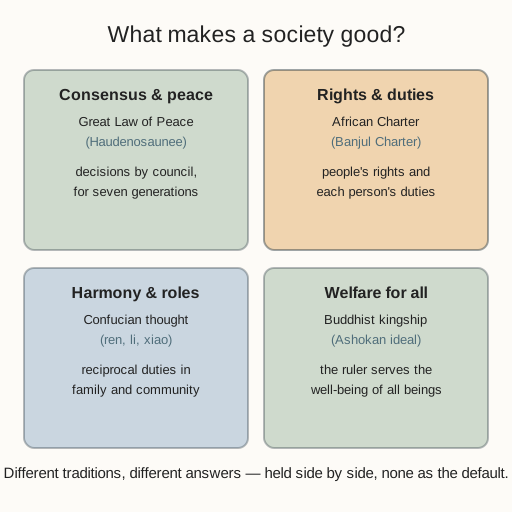
Learners move from the good *life* to the good *society*, comparing four visions: the Haudenosaunee Great Law of Peace (consensus and the long view), the African Charter on Human and Peoples' Rights (collective rights and duties), Confucian harmony through roles and ritual, and the Buddhist ideal of a ruler who serves the welfare of all beings. They evaluate how each decides, whom it includes, and what holds it together — held side by side, none the default.
Objectives
Objectives
- D09.S1.11.02 Evaluate competing accounts of what a good life or a good society means, drawing on more than one cultural tradition.
Essential question
What does a good society look like, and how do different traditions answer?
Key vocabulary
Materials
Standard materials
- Good-society comparison chart · 1 per learner Four columns (tradition, how it decides, who is included, what it holds together) to compare four visions
- Justice journal · 1 per learner
Low-tech / no-cost
- Four vision cards on paper One card each for consensus (Haudenosaunee), collective rights and duties (African Charter), harmony through roles (Confucian), and welfare for all (Buddhist)
- Paper and pencil To draw the chart by hand
Enriched / lab & device
- Short excerpts from the Great Law of Peace and the African Charter's preamble · 1 per group Faithful, brief renderings so learners meet each vision in its own words
Works in different contexts
- large-group Small groups each take one vision and teach it back; the class then builds a shared wall chart of the four
- multi-age Younger learners say what a good group needs; older learners compare the four visions and note who each includes and leaves out
- self-directed A learner reads the four cards, fills the chart, and writes which vision they find most just and why
- level-grouped A ready group also evaluates whether any vision handles difference and dissent well, and argues
- outdoor-only Four stations outdoors; learners rotate, jot one phrase from each vision, and share in a circle
Lesson 4 — What Makes a Society Good?
Summary
Learners move from the good life to the good society, comparing four visions: the Haudenosaunee Great Law of Peace (consensus and the long view), the African Charter on Human and Peoples’ Rights (collective rights and duties), Confucian harmony through roles and ritual, and the Buddhist ideal of a ruler who serves the welfare of all beings. They evaluate how each decides, whom it includes, and what holds it together — held side by side, none the default.
Objectives
- Evaluate competing accounts of what a good society means, drawing on more than one cultural tradition. (D09.S1.11.02)
Connection
A good society is harder to picture than a good life, but you already carry a picture of it: the kind of world you hope to grow old in, where people are treated a certain way and decisions are made a certain way. Is it a world of peaceful agreement, of guaranteed rights, of harmony between roles, or of care for everyone’s well-being? Different peoples have built their shared life on different answers. This lesson sets four of those answers beside each other — so you can see, and question, the picture you have been carrying.
Materials
- Good-society comparison chart
- Justice journal
- Four vision cards (low-tech: paper)
Preparation
- Copy or draw the comparison chart; prepare the four vision cards.
- Retrieval: from Lesson 3, four accounts of the good life. Today we scale up to the good society.
- Prepare plain descriptions: the Great Law of Peace (Haudenosaunee Confederacy — decisions by council, with care for future generations); the African Charter (adds peoples’ and collective rights and individual duties to the human-rights idea); Confucian harmony (a society ordered by reciprocal duties in family and community); Buddhist welfare (the ideal of a ruler who serves all beings’ well-being).
Facilitator note
This lesson is written to the learner (“you”). The idea to land: visions of a good society are real, old, and diverse — consensus and the long view (Haudenosaunee Great Law of Peace, S-142), collective rights with duties (African Charter / Banjul Charter, S-465), harmony through roles (Confucius, S-468), and welfare for all (Buddhist kingship ideal). The methodological point: these are visions to evaluate by who they include and how they decide — the egalitarian question — not to rank by which is “most advanced.” Guard against treating any one (especially a Western one) as the standard; the lesson deliberately centers non-Western and Indigenous visions.
The ethics lens: each vision is a claim about how people ought to live together. The egalitarianism lens: ask of every vision — whom does it include, whom does it leave out, and who actually gets to decide? The global lens: the four are drawn from North America, Africa, and Asia — three continents, many centuries, all living traditions. The critical-thinking lens: distinguishing “what a tradition says” (evidence) from “what I think is just” (value). Preview: Lesson 5 turns from visions to the machinery of justice, power, and law.
Procedure
- Recall (5 min). What four accounts of the good life did you meet in Lesson 3? Now: what would a good society built on each look like?
- Meet four visions (15 min). Read the four vision cards. Consensus and peace — the Haudenosaunee Confederacy decides by council, holding the good of the seventh generation in view (S-142). Rights and duties — the African Charter pairs people’s and collective rights with each person’s duties to family and community (S-465). Harmony and roles — Confucian society orders itself through reciprocal duties in family and community (S-468). Welfare for all — the Buddhist ideal of a ruler whose first duty is the well-being of all beings.
- Fill the chart (12 min). For each vision, write how it decides, whom it includes, and what holds it together.
- Ask the fairness question (10 min). With a partner, for each vision ask: who gets a voice, and who might be left out? Which vision most clearly protects the weakest members?
- Evaluate (8 min). In your justice journal, write which vision you find most just, and one limit or risk of that same vision — no vision is perfect.
- Close (4 min). Say, in your own words, why there is no single “good society,” and what that means for how we build one together.
Differentiation
- Support: Work with two visions and name how each decides and whom it includes.
- Extension: Read the African Charter’s addition of duties and argue whether pairing rights with duties strengthens or weakens the idea of rights.
Assessment
- Formative (peer + self): Can the learner name the four visions, state how each decides and whom it includes, and identify a limit of each?
- Portfolio artifact (unit): The completed comparison chart with the “most just / its limit” reflection, opened in the justice journal.
Home connection
Ask someone at home what their picture of a good society is — who decides, and who is cared for. Write one sentence on their answer and one on how it compares to the four visions.
Resources
- On consensus and the long view: Haudenosaunee Confederacy / Great Law of Peace (S-142); on collective rights and duties: African Charter on Human and Peoples’ Rights (S-465); on harmony through roles: SEP, Confucius (S-468).
- On worked examples and guided practice for comparison: Kirschner, Sweller & Clark (2006) (S-011).