Lesson 07 — Justice as Freedom
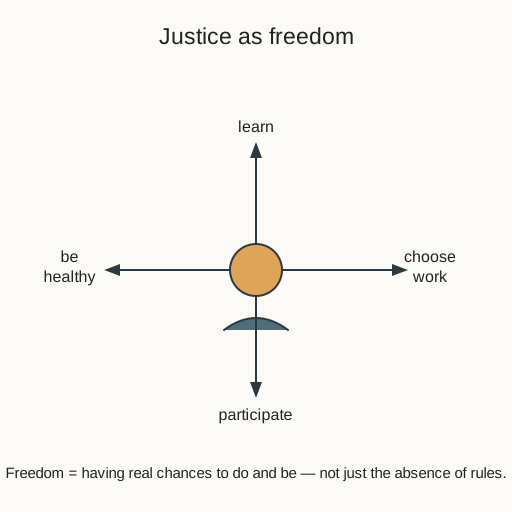
Learners evaluate a freedom-centered theory of justice: that a just society protects liberty, and that freedom means having real capabilities — actual chances to learn, be healthy, participate, and choose work — not merely the absence of interference. They meet liberal justice (Rawls) and the capabilities approach (Sen), test the lens against scenarios where someone is "free on paper" but not in practice, and weigh its strengths and limits.
Objectives
Objectives
- D09.S2.11.02 Evaluate competing theories of justice (such as those centered on freedom, equality, or care) and apply them to a current issue.
Essential question
What does it mean to say justice is freedom?
Key vocabulary
Materials
Standard materials
- Freedom-lens organizer · 1 per learner A person-centered diagram with arrows to real opportunities (learn, be healthy, participate, choose work) to label
- Justice journal · 1 per learner
Low-tech / no-cost
- Scenario slips on paper Short scenarios (a person free on paper but unable to read, to travel, or to afford medicine) to test the freedom lens against
- Paper and pencil To draw the diagram by hand
Enriched / lab & device
- One-page summaries of Rawls and Sen (S-459, S-460) · 1 per group Brief, faithful renderings of liberal justice and the capabilities approach
Works in different contexts
- large-group Build the freedom diagram on the board whole-class, then pairs test it against two scenarios
- multi-age Younger learners name one freedom they value; older learners distinguish "freedom from" (no interference) from "freedom to" (real capability)
- self-directed A learner reads the summaries, fills the diagram, and writes how the freedom lens would judge one scenario
- level-grouped A ready group also weighs Rawls's "difference principle" against a pure free-market view, and argues
- outdoor-only Physically map "freedom from" and "freedom to" as two stations; walk a scenario between them and argue where real freedom lies
Lesson 7 — Justice as Freedom
Summary
Learners evaluate a freedom-centered theory of justice: that a just society protects liberty, and that freedom means having real capabilities — actual chances to learn, be healthy, participate, and choose work — not merely the absence of interference. They meet liberal justice (Rawls) and the capabilities approach (Sen), test the lens against scenarios where someone is “free on paper” but not in practice, and weigh its strengths and limits.
Objectives
- Evaluate a freedom-centered theory of justice. (D09.S2.11.02)
Connection
“Freedom” is a word everyone reaches for, but it hides two different ideas. Freedom from is the absence of interference — no one stops you. Freedom to is the presence of real chances — you actually can read, travel, work, be well. A person can be “free from” a great deal and still be unable to do much, if they lack money, health, or education. A freedom-centered theory of justice says: a just society is measured by whether people are really able to do and be the things that make a life — not just by whether no one is stopping them. That distinction changes everything.
Materials
- Freedom-lens organizer
- Justice journal
- Scenario slips (low-tech: paper)
Preparation
- Copy or draw the freedom-lens organizer; prepare the scenario slips.
- Retrieval: from Lesson 6, how people changed unjust laws — struggles often fought in the name of freedom. Today we ask what freedom means as a theory of justice.
- Prepare plain summaries: Rawls’s liberal justice — basic liberties for all, and inequalities allowed only if they help the least advantaged (S-459); Sen’s capabilities approach — development and justice as what people can actually do and be (S-460).
Facilitator note
This lesson is written to the learner (“you”). The idea to land: a freedom-centered theory of justice has two readings — “freedom from” (no interference) and “freedom to” (real capability) — and the capability reading is what makes freedom a test of justice rather than a slogan (Sen, S-460; Rawls’s liberal account, S-459). The methodological point: this is one theory among several, to be evaluated, not the answer. The distinction between “freedom from” and “freedom to” is a conceptual tool, not a political verdict; present both readings fairly.
The ethics lens: what people are owed — freedom — is a moral claim, opened not closed. The egalitarianism lens: the capability test exposes where “equal freedom” is not equal in practice, because resources and health are uneven (UNDP, S-283). The global lens: capability thinking arose partly from comparing development across countries (Sen); no one society is the default model of freedom. The critical-thinking lens: distinguishing “what the theory says” (evidence) from “what I think a just society owes” (value). Preview: Lesson 8 adds equality and care as rival answers.
Procedure
- Recall (5 min). From Lesson 6, why did people break unjust laws? Many said: “for freedom.” Today: what is the freedom justice demands?
- Meet the two freedoms (10 min). Freedom from = no one interferes. Freedom to = real chances to do and be. Work a model case (S-011): a person is “free to travel” but has no money for the fare — free from, but not free to.
- Meet the theories (12 min). Rawls: a just society secures basic liberties for all and lets inequalities stand only when they help the least advantaged (S-459). Sen: justice is what people are actually able to do and be — their capabilities (S-460).
- Test the lens (12 min). For each scenario slip, ask: is this person free from or free to? What capability is missing? What would a just society owe them?
- Weigh the limits (8 min). With a partner, name one thing the freedom lens explains well and one thing it may miss. (Clue: can freedom alone capture care for the vulnerable?)
- Close (4 min). Say, in your own words, why “you are free” can be true on paper and false in practice — and what justice would add.
Differentiation
- Support: Distinguish only “freedom from” and “freedom to” with clear examples, leaving the theories aside.
- Extension: Apply Rawls’s difference principle to one current policy and argue whether it meets the test.
Assessment
- Formative (peer + self): Can the learner distinguish the two freedoms, apply the capability test to a scenario, and name a limit of the freedom lens?
- Portfolio artifact (unit): The completed freedom-lens diagram with the scenario judgment and limit, opened in the justice journal.
Home connection
Ask someone at home about a time they were “free from” something but still could not do what they wanted. Write one sentence on their story and one on what was missing.
Resources
- On liberal justice and the difference principle: Rawls, A Theory of Justice (S-459); on capabilities: Sen, Development as Freedom (S-460); on uneven resources: UNDP Human Development Reports (S-283).
- On worked examples and guided practice for analysis: Kirschner, Sweller & Clark (2006) (S-011).