Lesson 08 — Justice as Equality and Care
Learners evaluate two further theories of justice: equality (fair shares, with the question of whether equal means identical) and care (meeting needs and honoring relationships). They see where equal treatment and meeting needs pull apart, meet the idea that justice may be about relationships and dignity rather than distribution alone, and weigh the strengths and limits of each lens against the freedom lens from Lesson 7.
Objectives
Objectives
- D09.S2.11.02 Evaluate competing theories of justice (such as those centered on freedom, equality, or care) and apply them to a current issue.
Essential question
What do equality and care add to our idea of justice?
Key vocabulary
Materials
Standard materials
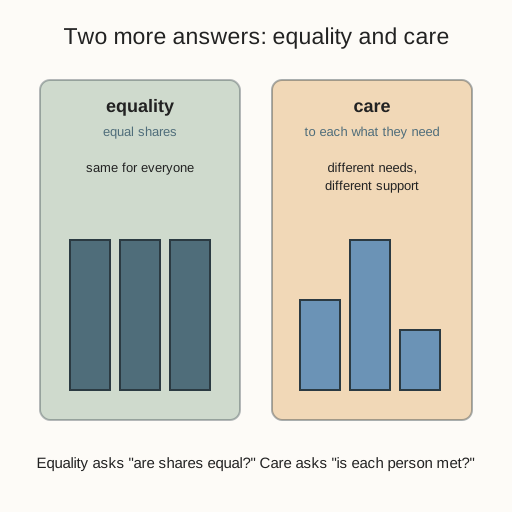
- Equality-and-care organizer · 1 per learner Two panels — "equal shares" and "to each what they need" — with space to sort examples
- Justice journal · 1 per learner
Low-tech / no-cost
- Scenario slips on paper Cases where equal treatment and meeting needs pull apart (a shared meal, classroom support, medicine, a ramp)
- Paper and pencil To draw the two panels by hand
Enriched / lab & device
- One-page summary of distributive justice and of care ethics · 1 per group Brief, faithful renderings of the equality and care traditions
Works in different contexts
- large-group Sort examples into the two panels whole-class, then pairs argue one case where the two pull apart
- multi-age Younger learners say whether sharing should be equal or by need; older learners evaluate equality and care as theories of justice
- self-directed A learner reads the summaries, sorts the slips, and writes which lens — equality or care — better fits one real case and why
- level-grouped A ready group also debates whether care can be a *theory of justice* or only a virtue, and defends a position
- outdoor-only Draw two circles in the dirt ("equal shares" and "by need"); place slips physically and argue placement
Lesson 8 — Justice as Equality and Care
Summary
Learners evaluate two further theories of justice: equality (fair shares, with the question of whether equal means identical) and care (meeting needs and honoring relationships). They see where equal treatment and meeting needs pull apart, meet the idea that justice may be about relationships and dignity rather than distribution alone, and weigh the strengths and limits of each lens against the freedom lens from Lesson 7.
Objectives
- Evaluate equality-centered and care-centered theories of justice. (D09.S2.11.02)
Connection
Two children are given the same sandwich. One is full; the other has not eaten all day. Equal — but is it just? A classroom gives every student the same book; one student cannot read it without help. Equal — but is it just? Equality says “the same for everyone.” Care says “to each what they need.” These two answers usually point the same way, but sometimes they pull apart — and when they do, we are forced to ask what justice is really about: identical shares, or people whose needs and relationships are actually met?
Materials
- Equality-and-care organizer
- Justice journal
- Scenario slips (low-tech: paper)
Preparation
- Copy or draw the two-panel organizer; prepare the scenario slips.
- Retrieval: from Lesson 7, the freedom lens and its limits. Today we add two rival answers: equality and care.
- Prepare plain summaries: equality/egalitarian justice — fair shares, with the debate over whether equal means identical or proportional (SEP Distributive Justice, S-388); care ethics — justice as meeting needs and honoring relationships and dignity, rooted in the experience of caregiving.
Facilitator note
This lesson is written to the learner (“you”). The idea to land: equality and care are two more theories of justice, and they can pull apart from each other and from freedom — equality asks “are shares fair?” and care asks “is each person met?” (SEP Distributive Justice, S-388; care ethics as a distinct tradition). The methodological point: these are lenses to evaluate, not answers to adopt. Note carefully: care ethics names a tradition associated with feminist moral philosophy (Gilligan, Noddings) and with caregiving experience, and it is presented as one serious account among several — not as a “women’s” or “soft” alternative, but as a full theory of what justice owes.
The ethics lens: each theory is a claim about what people are owed. The egalitarianism lens: the equality-vs-need tension is the egalitarian question — notice that “the same” can quietly favor the already-advantaged. The global lens: different societies have weighed equality and need differently in distributing land, water, schooling, and medicine; none is the default. The critical-thinking lens: distinguishing “what the theory says” (evidence) from “what I think is just” (value). Preview: Lesson 9 puts all three lenses — freedom, equality, care — on one current issue.
Procedure
- Recall (5 min). From Lesson 7, what was the freedom lens’s limit? Today we meet two answers to that limit.
- Meet the two lenses (12 min). Equality — justice as fair shares, with the open question of whether equal means identical or proportional (S-388). Care — justice as meeting needs and honoring relationships and dignity, not distribution alone.
- Sort the slips (12 min). Place each scenario in the “equal shares” panel, the “to each what they need” panel, or both. Argue the cases where the two pull apart.
- Argue an edge case (10 min). Is giving everyone “the same” sometimes unfair? Take the classroom-support or the ramp case and argue, then agree on a placement.
- Weigh all three (8 min). In your justice journal, line up the three lenses — freedom, equality, care — and write one thing each explains that the others miss.
- Close (4 min). Say, in your own words, why “equal” and “just” are not the same word — and what care adds that equality alone cannot.
Differentiation
- Support: Sort only the clearest slips and state each lens in one sentence.
- Extension: Argue whether care can be a full theory of justice or only a virtue, using a concrete case and conceding a counterargument.
Assessment
- Formative (peer + self): Can the learner state each lens, sort cases where they pull apart, and name what each lens explains that the others miss?
- Portfolio artifact (unit): The three-lens comparison written in the justice journal, opened as part of the unit’s theories-of-justice work.
Home connection
Ask someone at home whether sharing should always be equal, or by need. Write one sentence on their answer and one on a time they saw the two pull apart.
Resources
- On distributive justice and the equal-shares debate: SEP, Distributive Justice (S-388); on care as a tradition of moral and political thought (framing): the care ethics tradition as discussed in SEP virtue ethics and related entries (S-458).
- On worked examples and guided practice for analysis: Kirschner, Sweller & Clark (2006) (S-011).