Lesson 03 — Who Benefits, Who Is Harmed?
Learners trace one everyday technology from extraction to disposal and map where its benefits land and where its harms land — usually not the same people, and usually not the same places. They analyze how this unevenness is distributed across the world, naming extraction, supply chains, the digital divide, and externalized costs.
Objectives
Objectives
- D10.S1.11.02 Analyze how the benefits and harms of technology are distributed unevenly across the world, and argue for fairer access.
Essential question
How are the benefits and harms of technology distributed unevenly across the world?
Key vocabulary
Materials
Standard materials
- Footprint map · 1 per learner A two-column organizer — where the benefits land, where the harms land — for tracing one product's life
- Stewardship journal · 1 per learner
Low-tech / no-cost
- Product-chain cards on paper (the minerals, the factory, the buyer, the e-waste site) · 1 set per group Cards naming each stop in one product's life, to arrange into a who-benefits/who-is-harmed chain
- Paper and pencil To draw the map by hand
Enriched / lab & device
- One page of access data (internet or electricity access by region, OWID or World Bank) · 1 per pair To ground the claim that even the *benefit* side is distributed unevenly
Works in different contexts
- large-group Trace the product chain whole-class on a wall, then pairs each map one harm and one benefit to the places they land
- multi-age Younger learners name one thing a phone gives them; older learners trace the full chain and argue where the harms and benefits are uneven
- self-directed A learner arranges the cards, draws the footprint map, and writes one paragraph on the biggest gap they found
- level-grouped A ready group also distinguishes "uneven by accident" from "uneven by design" and argues where the line falls
- outdoor-only Lay the chain cards on the ground in order; learners stand at each stop and call out who benefits and who is harmed there
Lesson 3 — Who Benefits, Who Is Harmed?
Summary
Learners trace one everyday technology from extraction to disposal and map where its benefits land and where its harms land — usually not the same people, and usually not the same places. They analyze how this unevenness is distributed across the world, naming extraction, supply chains, the digital divide, and externalized costs.
Objectives
- Analyze how the benefits and harms of technology are distributed unevenly across the world. (D10.S1.11.02)
Connection
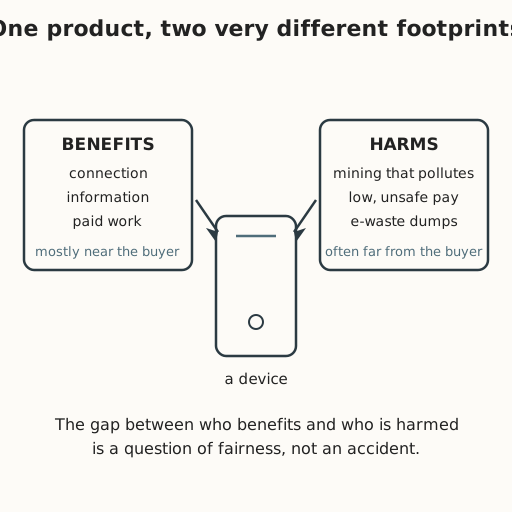
The object in your pocket is a map of the world, folded up small. The minerals in it were pulled from one place, assembled in another, sold in a third, and may be dumped in a fourth. The good of it — connection, information, work — usually lands close to the buyer. The cost of it — polluted mines, low and unsafe pay, piles of electronic waste — usually lands far away, on people who never chose it. This lesson unfolds the map and asks the honest question it raises: who gets the benefit, and who carries the harm?
Materials
- Footprint map
- Stewardship journal
- Product-chain cards (low-tech: paper)
Preparation
- Copy or draw the footprint map; prepare the product-chain cards.
- Retrieval: from Lesson 1, governance; from Grade 10, media ownership and data. Today we ask a distribution question: not “does the technology work?” but “for whom does it work, and at whose cost?”
- Prepare the worked example: the phone. Its cobalt is sometimes mined in the Democratic Republic of the Congo under conditions that harm and exploit workers, including children (Amnesty International, S-398). Its benefit — connection, information, work — lands with the buyer. Model tracing this chain step-by-step before learners do their own (S-011).
Facilitator note
This lesson is written to the learner (“you”). The idea to land: a technology’s benefits and harms are not distributed evenly — the benefits tend to land near buyers and the harms near the extraction and disposal ends of the chain, far from those who buy (Amnesty, S-398). Even the benefit side is uneven: hundreds of millions still light the dark with flame and lamp while others carry instant light and instant information in a pocket (Our World in Data, S-052); the “digital divide” is a documented global pattern, not a phrase (World Bank, S-281). Hold the point as description and analysis, not yet prescription — arguing for fairer access is Lesson 4.
Keep the tone honest but not hopeless: the point is that the unevenness is made by choices (who pays, where factories go, what is subsidized), and what is made can be remade. Guard against two temptations at this age: guilt about owning things (the lesson is about systems, not individual blame) and numbness (“it’s all bad, so nothing matters”). Neither is true; both are ways of looking away.
The ethics lens: who is responsible for a harm they never see? The egalitarianism lens is the core here: the gap between who benefits and who is harmed is a fairness question. The global lens: the chain crosses borders, but accountability often stops at them. The technology and environment lenses: the same device that connects people also mines, burns, and dumps. The critical-thinking lens: distinguishing what the chain is (evidence) from what we owe the people on its far end (value).
Procedure
- Recall (5 min). From Lesson 1, what were the three forces that govern a technology? Today we ask a different question: for whom does a technology work?
- Unfold the map (12 min). Work the phone example step-by-step (S-011). List the stops: extraction, factory, sale, use, disposal. At each stop, name one benefit and one harm — and where each lands. The cobalt: sometimes mined in conditions that exploit workers, including children (S-398). The benefit: connection, information, work — with the buyer.
- Trace your own product (15 min). Choose an everyday technology (a piece of clothing, a battery, a food, a device). Arrange the product-chain cards in order, then draw the footprint map: benefits in one column, harms in the other, with the place each lands.
- Find the pattern (10 min). With a partner, compare your maps. Where do the benefits cluster? Where do the harms? Write one sentence that states the general pattern you see.
- Name the divide (8 min). Even benefits are uneven: some places have instant light and information; others still light the dark with flame and lamp (S-052). How does this second unevenness deepen the first?
- Close (5 min). Say, in your own words, why “who benefits, who is harmed?” is a different question from “does it work?”
Differentiation
- Support: Trace only two stops (extraction and use) and name one benefit and one harm at each.
- Extension: Research the access divide for one technology (internet or electricity) and add a data point to your map with its source.
Assessment
- Formative (peer + self): Can the learner trace a product’s chain, place benefits and harms, state the general pattern, and name the digital divide?
- Portfolio artifact (unit): The completed footprint map with the written pattern statement, opened in the stewardship journal.
Home connection
Choose one object at home and, with someone there, guess its chain: where was it likely made, from what, and where will it go when it breaks? Write one sentence on your guess and one on what surprised you.
Resources
- On harms in the cobalt supply chain: Amnesty International (2016), This Is What We Die For (S-398).
- On the uneven spread of even basic benefits (light, energy access): Our World in Data, “Light at Night” (S-052).
- On the digital divide: World Bank, World Development Report 2016: Digital Dividends (S-281).
- On worked examples and guided practice: Kirschner, Sweller & Clark (2006) (S-011).