Lesson 04 — Arguing for Fairer Access
Learners turn analysis into argument: they construct a claim–evidence–proposal argument for fairer access to a technology, drawing on documented global inequality. They meet three levers that change access — policy, price, and public infrastructure — and learn to answer the hard question "who pays?" without collapsing into resignation or slogan.
Objectives
Objectives
- D10.S1.11.02 Analyze how the benefits and harms of technology are distributed unevenly across the world, and argue for fairer access.
Essential question
What would fairer access to technology look like, and how do we argue for it?
Key vocabulary
Materials
Standard materials
- Argument builder · 1 per learner A three-part organizer — the claim, the evidence, the proposal — for constructing an argument for fairer access
- Stewardship journal · 1 per learner
Low-tech / no-cost
- Three lever cards on paper (policy, price, public infrastructure) · 1 set per pair Cards naming three ways access is changed, to sort and apply to a chosen technology
- Paper and pencil To build the argument by hand
Enriched / lab & device
- One page of access and inequality data (UNDP Human Development Report or World Bank) · 1 per pair To anchor the argument's evidence in documented global inequality
Works in different contexts
- large-group Build one model argument whole-class on a shared technology, then pairs each build their own for a different one
- multi-age Younger learners name one thing everyone should be able to access; older learners build the full claim–evidence–proposal argument and critique a partner's
- self-directed A learner sorts the lever cards, builds the three-part argument, and writes who might object and how they would answer
- level-grouped A ready group also tests each proposal against the objection "who pays?" and revises
- outdoor-only Three stations — policy, price, infrastructure; learners rotate, gather one idea at each, then assemble the argument in a circle
Lesson 4 — Arguing for Fairer Access
Summary
Learners turn analysis into argument: they construct a claim–evidence–proposal argument for fairer access to a technology, drawing on documented global inequality. They meet three levers that change access — policy, price, and public infrastructure — and learn to answer the hard question “who pays?” without collapsing into resignation or slogan.
Objectives
- Argue for fairer access to technology, drawing on evidence about unequal distribution. (D10.S1.11.02)
Connection
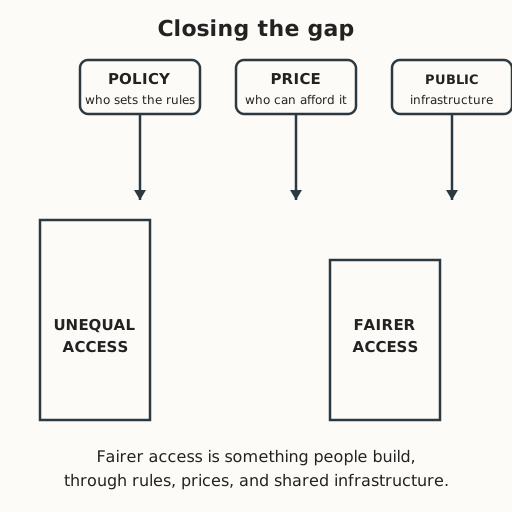
Yesterday you mapped where a technology’s harms and benefits land. Today you do something harder and more useful: you argue about what to do. Fairer access is not a mood — it is a set of specific changes to rules (policy), to cost (price), and to the shared systems everyone relies on (public infrastructure, like roads, grids, and networks). The argument has a shape: here is the unfairness, here is the evidence, here is the change, and here is who it helps. That shape is learnable, and it is how ordinary people have won fairer access to water, electricity, medicine, and information before you.
Materials
- Argument builder
- Stewardship journal
- Three lever cards (low-tech: paper)
Preparation
- Copy or draw the argument builder; prepare the lever cards.
- Retrieval: from Lesson 3, the footprint map and the pattern of uneven distribution. Today we answer “so what should change?”
- Prepare the evidence base: global inequality in resources and access is driven largely by structural factors — where one is born, how work and pay are organized, inherited wealth, health, conflict — rather than individual worth (World Bank, S-234; UNDP Human Development Reports, S-283; World Inequality Report, S-464). Model one claim–evidence–proposal argument before learners build their own (S-011).
Facilitator note
This lesson is written to the learner (“you”). The idea to land: arguing for fairer access is a skill with a shape — claim, evidence, proposal — and the proposal moves one of three levers: policy, price, or public infrastructure. The evidence that inequality is structural (not a measure of worth) is well documented (World Bank, S-234; UNDP, S-283; World Inequality Report, S-464). A useful concept to offer: Johan Galtung’s structural violence — harm that comes not from a person’s blow but from the way systems are arranged (S-462). This is not a claim that any one policy is correct; it is a name for why harms persist without a single villain.
Two things to hold with care. First, distinguish the value commitment — that fairer access matters — from the factual claim — that access is uneven, which the data show. Second, keep “who pays?” as a real question, not a dismissal: every proposal has a cost, and a mature argument says who bears it and why that is fair. Guard against slogan (empty) and against nihilism (paralyzing); the skill is a concrete proposal with a cost named.
The ethics lens: an argument for fairness is a claim about what we owe each other. The egalitarianism lens is core: fairer access is the direct answer to uneven distribution. The global lens: the same proposal lands differently in different places. The technology lens: the design of a technology shapes what “access” even means. The critical-thinking lens: distinguishing evidence from value, and testing a proposal against its costs.
Procedure
- Recall (5 min). From Lesson 3: what pattern did you find in who benefits and who is harmed? Today we argue about what to change.
- Meet the shape of an argument (10 min). An argument for fairer access has three parts: the claim (what is unfair and what should change), the evidence (the documented pattern), and the proposal (a specific change, with who it helps and who pays). Read a model: the evidence that access is uneven is structural (S-234; S-283; S-464) — a claim that “where you are born decides too much” is a description of systems, not a verdict on any person.
- Meet three levers (10 min). Policy — who sets the rules. Price — who can afford it. Public infrastructure — the shared roads, grids, and networks everyone relies on. For each, name one real example that changed access to something people needed.
- Build your argument (15 min). Choose a technology and a place. In your journal, write the claim, cite one piece of evidence (S-234; S-283; or S-464), and propose a change that moves at least one lever. Name who it helps and who pays.
- Stress-test it (10 min). With a partner, take turns raising the strongest objection — “who pays?”, “will it work here?”, “who decides?” — and answering it. Revise one part of your argument as a result.
- Close (5 min). Say, in your own words, what makes an argument for fairer access strong rather than just loud.
Differentiation
- Support: Use the claim and proposal parts only, with one piece of evidence supplied, leaving the objection exchange aside.
- Extension: Write the argument in full with a second proposal, and compare the two proposals’ costs and benefits explicitly.
Assessment
- Formative (peer + self): Can the learner build a claim–evidence–proposal argument, name the lever it moves, and answer a “who pays?” objection?
- Portfolio artifact (unit): The completed argument builder (with the revision after stress-testing), opened in the stewardship journal.
Home connection
Ask someone at home about a time access to something essential (water, power, schooling, medicine, a phone) was hard for them or their family, and what made it easier — a rule, a lower price, or shared infrastructure. Write one sentence on their answer.
Resources
- On structural drivers of inequality: World Bank, Poverty and Inequality (S-234); UNDP Human Development Reports (S-283); World Inequality Report (S-464).
- On structural violence as a concept: Galtung (1969), “Violence, Peace, and Peace Research” (S-462).
- On worked examples and guided practice for argument: Kirschner, Sweller & Clark (2006) (S-011).