Lesson 05 — How Propaganda Works
Learners name the mechanisms of propaganda and information manipulation — dehumanization, repetition, scapegoating, fear, and false equivalence — and analyze them in a historical case, learning to see manipulation as a set of identifiable techniques rather than a mysterious force.
Objectives
Objectives
- D10.S2.11.01 Analyze propaganda and information manipulation in a historical or current case, and how a free press and literacy resist it.
Essential question
How does propaganda and information manipulation work, and what techniques does it use?
Key vocabulary
Materials
Standard materials
- Technique tracker · 1 per learner A five-row organizer — dehumanization, repetition, scapegoating, fear, false equivalence — with a space to record an example of each
- Stewardship journal · 1 per learner
Low-tech / no-cost
- Technique cards on paper · 1 set per group One card per technique with a plain definition, to read and sort against short example sentences
- Paper and pencil To draw the tracker by hand
Enriched / lab & device
- A short, carefully framed historical case summary (radio propaganda in the lead-up to the 1994 genocide in Rwanda) · 1 per pair Presented age-appropriately and as analysis of a mechanism, following the USHMM teaching-guidelines frame (S-495), not as spectacle
Works in different contexts
- large-group Introduce the techniques whole-class with one example each, then small groups sort example sentences to techniques and defend the borderline cases
- multi-age Younger learners name one message that made them feel afraid; older learners analyze the full case and argue which technique does the heaviest work
- self-directed A learner reads the technique cards, sorts the examples, and writes one paragraph on how they have seen one technique used around them
- level-grouped A ready group also asks which techniques depend on fear versus on repetition, and argues which is harder to resist
- outdoor-only Five stations outdoors, one per technique; learners rotate and jot a real-world example of each, then share in a circle
Lesson 5 — How Propaganda Works
Summary
Learners name the mechanisms of propaganda and information manipulation — dehumanization, repetition, scapegoating, fear, and false equivalence — and analyze them in a historical case, learning to see manipulation as a set of identifiable techniques rather than a mysterious force.
Objectives
- Analyze propaganda and information manipulation in a historical case, naming the techniques it uses. (D10.S2.11.01)
Connection
You have almost certainly felt a message try to make you feel something before you had a chance to think — fear, disgust, anger, loyalty. That is not an accident and not new. Propaganda is old technology: the same handful of techniques have been used for centuries to move people against their own better judgment. The good news is that techniques can be named, and a named technique is one you can resist. This lesson gives you the names and the habit of asking the three questions that break the spell: who made this, what do they want me to feel, and what is left out?
Materials
- Technique tracker
- Stewardship journal
- Technique cards (low-tech: paper)
Preparation
- Copy or draw the technique tracker; prepare the technique cards.
- Retrieval: from Grade 10, source evaluation and media ownership. Today we add the mechanisms of manipulation.
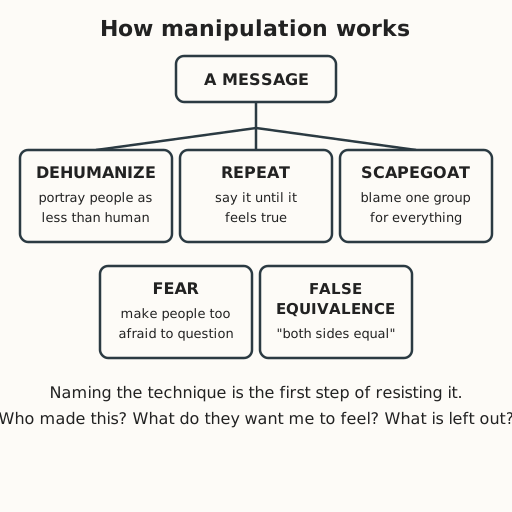
- Prepare plain definitions, with a worked example of each (S-011): dehumanization (portraying people as less than human, so harming them feels permissible), repetition (saying it until it feels true), scapegoating (blaming one group for everything), fear (making people too afraid to question), and false equivalence (treating unequal things as if they were equal). These are standard media-literacy categories (Center for Media Literacy, S-442; NAMLE, S-151).
- For the historical case, use radio propaganda leading up to the 1994 genocide in Rwanda (Britannica, S-494). Teach it with care, following the USHMM teaching guidelines: do not sensationalize, focus on the mechanism of persuasion, and protect the dignity of victims (S-495).
Facilitator note
This lesson is written to the learner (“you”). The idea to land: propaganda is not magic; it is a small set of identifiable techniques — dehumanization, repetition, scapegoating, fear, false equivalence (Center for Media Literacy, S-442; NAMLE, S-151) — and naming the technique is the first act of resistance. The historical case (radio propaganda in Rwanda, 1994) is a documented, well-attested instance of these techniques doing real, catastrophic harm (Britannica, S-494). Teach it as analysis of a mechanism, never as spectacle, and follow the USHMM teaching guidelines: avoid gratuitous detail, center the humanity of victims, and hold questions as questions (S-495).
Emotional safety: this is a heavy topic. The curriculum’s stance is that the hardest
truths can be faced honestly when met with intellectual tools and a sense of agency
(see docs/development.md). The “agency” half is the point: learners leave with a
checklist they can use, not with fear. Preview Lesson 6 as the answer to “what
resists this?” — a free press and literacy.
The ethics lens: manipulation works by short-circuiting moral judgment. The egalitarianism lens: propaganda’s most common move is to single out a group — noticing who is being scapegoated is a fairness skill. The global lens: the techniques recur across cultures and eras; the case is one instance, not an exception. The technology lens: new media accelerate the same old techniques. The critical-thinking lens is the core here.
Procedure
- Recall (5 min). From Grade 10, how did you check whether a source was reliable? Today we study the reverse: how people are made not to check.
- Meet five techniques (15 min). Read the technique cards. Dehumanization — portraying people as less than human. Repetition — saying it until it feels true. Scapegoating — blaming one group for everything. Fear — making people too afraid to question. False equivalence — treating unequal things as equal (S-442; S-151). Work one example of each together (S-011).
- Sort examples (10 min). With a partner, sort the example sentences to their technique. Argue the borderline ones: some messages use two techniques at once.
- Analyze the case (15 min). Read the case summary: in the lead-up to the 1994 genocide in Rwanda, radio broadcasts repeatedly dehumanized one group and urged violence against them (S-494). In your tracker, find and record each technique you can see at work. Which one does the heaviest work, and why?
- Name the antidote (8 min). For each technique, write the question that resists it — for repetition, “is it true, or just familiar?”; for fear, “who benefits from my fear?”; for false equivalence, “are these two things actually equal?”
- Close (2 min). Say, in your own words, why a named technique is a weakened technique.
Differentiation
- Support: Work with three techniques only (dehumanization, repetition, scapegoating) and match one example each, leaving the case analysis aside.
- Extension: Find a current message and identify which techniques it uses, writing the resisting question for each.
Assessment
- Formative (peer + self): Can the learner name the techniques, sort examples with reasons, and identify the techniques in the historical case?
- Portfolio artifact (unit): The completed technique tracker with the written antidote questions, opened in the stewardship journal.
Home connection
Ask someone at home about a message — an ad, a rumor, a broadcast — that they once believed and later found was misleading. Write one sentence on which technique it used, if they can say.
Resources
- On media-literacy analysis questions: Center for Media Literacy, Five Core Concepts (S-442); NAMLE, Key Questions (S-151).
- On the Rwanda case: Encyclopaedia Britannica, “Rwanda genocide of 1994” (S-494).
- On teaching this topic with care: USHMM, Guidelines for Teaching about the Holocaust (S-495).
- On worked examples and guided practice: Kirschner, Sweller & Clark (2006) (S-011).