Lesson 06 — A Free Press and Literacy
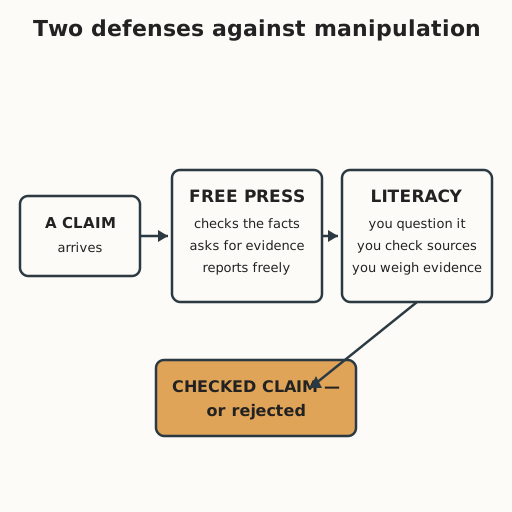
Learners map the two defenses against manipulation — an independent press that checks facts, and a literate public that questions what it reads — and practice the verification habits of each. They analyze how these two defenses work together, and what happens when either is missing.
Objectives
Objectives
- D10.S2.11.01 Analyze propaganda and information manipulation in a historical or current case, and how a free press and literacy resist it.
Essential question
How do a free press and a literate public resist propaganda and manipulation?
Key vocabulary
Materials
Standard materials
- Defense map · 1 per learner A two-column organizer — what a free press does, what a literate reader does — for mapping the two defenses against manipulation
- Stewardship journal · 1 per learner
Low-tech / no-cost
- Two defense cards on paper (free press, literate reader) · 1 set per pair Cards naming the two defenses and their practices, to sort against a sample claim
- Paper and pencil To draw the map by hand
Enriched / lab & device
- One page on press freedom (V-Dem's measure of media freedom across countries) · 1 per pair To ground the claim that press freedom varies, and matters, across the world
Works in different contexts
- large-group Model checking one claim whole-class (who made it, what's the evidence, what's left out), then pairs practice on another
- multi-age Younger learners practice one verification habit (ask "who made this?"); older learners map both defenses and evaluate a real claim
- self-directed A learner takes a claim, applies the verification steps, and writes a short verdict with reasons
- level-grouped A ready group also asks where the two defenses fail independently (a free press without a reading public; readers without a free press) and argues which gap is worse
- outdoor-only Two stations — free press, literate reader; learners rotate and record one practice at each, then assemble a shared defense map in a circle
Lesson 6 — A Free Press and Literacy
Summary
Learners map the two defenses against manipulation — an independent press that checks facts, and a literate public that questions what it reads — and practice the verification habits of each. They analyze how these two defenses work together, and what happens when either is missing.
Objectives
- Analyze how a free press and literacy resist propaganda and information manipulation. (D10.S2.11.01)
Connection
Yesterday you saw how a message can be built to move people without convincing them. Today you meet the two things that have always pushed back. The first is a free press — reporters who can check a claim and print what they find without being told what to say. The second is literacy in its fullest sense: not just reading the words, but asking who wrote them, with what evidence, and what was left out. A free press without a reading public is a voice in an empty room; a reading public without a free press has nothing independent to read. Together they are how a society refuses to be lied to — and they are both things people build, not things that happen by themselves.
Materials
- Defense map
- Stewardship journal
- Two defense cards (low-tech: paper)
Preparation
- Copy or draw the defense map; prepare the defense cards.
- Retrieval: from Lesson 5, the five techniques of manipulation. Today: what resists them.
- Prepare the verification habits: ask who made it, check the evidence, compare independent sources (“lateral reading”), and ask what is left out — the core of media and information literacy (UNESCO, S-217; NAMLE, S-151; Center for Media Literacy, S-442). Prepare the press-freedom data point: press and participation freedom is measured and varies widely across countries (V-Dem, S-461).
Facilitator note
This lesson is written to the learner (“you”). The idea to land: two defenses resist manipulation — a free press and a literate public — and each is a practice, not a given (UNESCO Media and Information Literacy, S-217; NAMLE, S-151; Center for Media Literacy, S-442). Press freedom is real, measurable, and uneven across the world (V-Dem, S-461) — which is why the second defense (a literate, questioning public) matters in every context, including places where the press is not free.
The egalitarian turn: who gets to be “media literate” — and whose skepticism is encouraged — is itself uneven. The lesson’s point is not that individuals must simply “try harder” (that would blame the reader for a system that misleads them), but that literacy is a public good to be built and shared, alongside a free press. Keep both defenses as structural, not just personal.
The ethics lens: checking a claim before repeating it is a small act of care for others. The egalitarianism lens: literacy and a free press are distributed unevenly, and that matters for who can be misled. The global lens: press freedom varies by country; the habits travel anywhere. The technology lens: the same tools that spread manipulation also spread verification. The critical-thinking lens is the core here.
Procedure
- Recall (5 min). From Lesson 5, name two techniques of manipulation. Today: what resists them?
- Meet the two defenses (10 min). A free press — reporters who can check a claim and publish what they find. A literate public — readers who ask who made it, with what evidence, and what is left out (S-217; S-151; S-442). Work one model claim through both defenses together (S-011).
- Map the practices (10 min). In your defense map, list what each defense does: the press checks facts, asks for evidence, reports freely; the reader questions sources, weighs evidence, compares independent accounts.
- Verify a real claim (15 min). Take a claim you have seen online. Apply the steps: who made it? what is the evidence? what does an independent source say? what is left out? Write a one-line verdict: checked and supported, checked and doubtful, or rejected.
- Find the gaps (10 min). With a partner, ask: what happens when there is a free press but few readers who question? What happens when there are questioning readers but no free press? Write one sentence on which gap worries you more and why.
- Close (5 min). Say, in your own words, why a free press and a literate public need each other.
Differentiation
- Support: Practice only the “who made this?” and “what is the evidence?” questions on one claim, leaving the gap analysis aside.
- Extension: Research press-freedom conditions in one country (S-461) and write how a reader there would need to adapt their verification habits.
Assessment
- Formative (peer + self): Can the learner name the two defenses, apply the verification steps to a real claim, and analyze what happens when one defense is missing?
- Portfolio artifact (unit): The completed defense map with the one-line claim verdict, opened in the stewardship journal.
Home connection
With someone at home, take one claim you both heard this week and run the verification steps together. Write one sentence on what you found and one on which step was hardest.
Resources
- On media and information literacy: UNESCO, Media and Information Literacy (S-217); NAMLE, Key Questions (S-151); Center for Media Literacy (S-442).
- On press freedom as measured and uneven: V-Dem Institute, Varieties of Democracy (S-461).
- On worked examples and guided practice: Kirschner, Sweller & Clark (2006) (S-011).