Lesson 07 — When Information Spreads Harm
Learners trace how harmful information travels — from a creator, through a platform's ranking and amplification, to an audience, and finally to real harm — and evaluate where responsibility sits at each link. They learn to distinguish legal from ethical responsibility, and to see platform design as a choice rather than a fact of nature.
Objectives
Objectives
- D10.S2.11.02 Evaluate the responsibilities of creators and platforms when information spreads harm, and argue for what should change.
Essential question
What are the responsibilities of creators and platforms when the information they handle spreads harm?
Key vocabulary
Materials
Standard materials
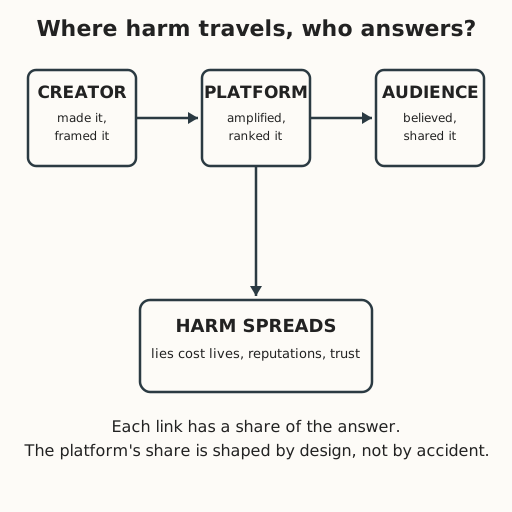
- Chain-of-harm map · 1 per learner A four-node organizer — creator, platform, audience, harm — with a space to assign a responsibility at each link
- Stewardship journal · 1 per learner
Low-tech / no-cost
- Four role cards on paper (creator, platform, audience, the person harmed) · 1 set per group Cards naming each link in the chain, to sort and assign responsibilities
- Paper and pencil To draw the map by hand
Enriched / lab & device
- Two short accounts of one harm case (a false claim that spread widely and hurt real people, and the platform's stated response) · 1 per pair So learners weigh responsibility against real actions taken, not abstractions
Works in different contexts
- large-group Map one harm case whole-class on a wall, then pairs each assign responsibilities at the four links and defend their assignment
- multi-age Younger learners name one thing that should be stopped from spreading; older learners weigh the full chain and argue where the heaviest responsibility sits
- self-directed A learner sorts the role cards, fills the chain-of-harm map, and writes who they hold most responsible and why
- level-grouped A ready group also distinguishes legal responsibility from ethical responsibility and argues where they diverge
- outdoor-only Four stations — creator, platform, audience, harm; learners stand at the link they hold most responsible and speak their reason, then may move
Lesson 7 — When Information Spreads Harm
Summary
Learners trace how harmful information travels — from a creator, through a platform’s ranking and amplification, to an audience, and finally to real harm — and evaluate where responsibility sits at each link. They learn to distinguish legal from ethical responsibility, and to see platform design as a choice rather than a fact of nature.
Objectives
- Evaluate the responsibilities of creators and platforms when information spreads harm. (D10.S2.11.02)
Connection
Not everything that spreads is true, and not everything that spreads is harmless. A lie can move faster than a correction, and the harm it does — to a person’s reputation, to a group’s safety, to public trust — is real. When that happens, who answers for it? The person who wrote it? The platform whose design showed it to millions? The millions who shared it? This lesson refuses the easy answer (“nobody” or “everybody”) and instead asks you to think carefully about the shape of the chain — because where you place responsibility determines what you would change.
Materials
- Chain-of-harm map
- Stewardship journal
- Four role cards (low-tech: paper)
Preparation
- Copy or draw the chain-of-harm map; prepare the role cards.
- Retrieval: from Lesson 5 (techniques) and Lesson 6 (defenses). Today we ask who is responsible when harm spreads anyway.
- Prepare the mechanism facts: platforms rank and recommend by engagement, set and enforce rules, and moderate content (Britannica, S-481); personalization can invisibly surround a person with what confirms their views — the “filter bubble” (Pariser, S-482); synthetic media and deepfakes are now cheap to make and hard to detect (WITNESS, S-393). Model the chain analysis on one example before learners do their own (S-011).
Facilitator note
This lesson is written to the learner (“you”). The idea to land: when information spreads harm, responsibility is distributed across a chain — creator, platform, audience — and the platform’s share is shaped by design choices (ranking by engagement, personalization, moderation), not by accident (Britannica, S-481; Pariser, S-482; WITNESS, S-393). The skill is evaluation: assign responsibility with reasons, and separate legal responsibility (what a law could enforce) from ethical responsibility (what a person or company ought to do even if no law forces them).
Two things to hold. First, avoid the false poles: “the platform is just a neutral pipe” (denies the design choice) and “the platform is guilty of everything” (ignores creators and audiences, and ignores that harm existed before platforms). The mature view is a distribution of responsibility with reasons. Second, distinguish evidence (what a platform’s design actually does) from value (what we think it owes). Both belong in the analysis; do not blur them.
The ethics lens: responsibility is a moral concept before it is a legal one. The egalitarianism lens: harm falls hardest on those with the least power to correct the record — ask whose reputation is cheapest to destroy. The global lens: the same platform operates under different laws in different places. The technology lens is core: the harm’s reach is a property of the design. The critical-thinking lens: reasoning about responsibility, not just assigning blame.
Procedure
- Recall (5 min). From Lessons 5–6: what are the techniques of manipulation, and what resists them? Today: when harm spreads anyway, who answers?
- Meet the chain (12 min). A harmful claim moves from a creator, through a platform that ranks and recommends it, to an audience that believes and shares it — and harm lands on real people. Model the analysis: platforms rank by engagement, personalize what you see, and set the rules for what stays up (S-481; S-482). Synthetic media like deepfakes make the creator’s work easier and the harm harder to detect (S-393).
- Assign responsibility (12 min). In your chain-of-harm map, write, at each link, what that actor could have done differently — and what they did do. Use one real case or a constructed example.
- Sort legal from ethical (10 min). With a partner, mark each responsibility as legal (a law could require it) or ethical (it ought to be done even without a law). Where do they diverge, and why does that gap matter?
- Argue the heaviest link (10 min). Stand by your answer: which link carries the heaviest responsibility, and why? Listen to a partner who chose differently; note their strongest point.
- Close (6 min). Say, in your own words, why “the platform is neutral” is a claim to be tested, not assumed.
Differentiation
- Support: Assign responsibility at two links only (creator and platform) with one reason each, leaving the legal/ethical sort aside.
- Extension: Research one platform’s actual moderation rules (S-481) and evaluate how well they match the responsibilities you assigned.
Assessment
- Formative (peer + self): Can the learner trace the chain, assign responsibility at each link with reasons, and separate legal from ethical responsibility?
- Portfolio artifact (unit): The completed chain-of-harm map with the “heaviest link” argument, opened in the stewardship journal.
Home connection
Ask someone at home about a time they shared something online that turned out to be false or harmful. Write one sentence on what they felt responsible for, if anything, and one on what you think they were responsible for.
Resources
- On platform ranking, rules, and moderation: Encyclopaedia Britannica, “Social media” (S-481).
- On personalization and the filter bubble: Pariser (2011), The Filter Bubble (S-482).
- On synthetic media and deepfakes: WITNESS Media Lab (S-393).
- On worked examples and guided practice: Kirschner, Sweller & Clark (2006) (S-011).