Lesson 08 — Arguing for What Should Change
Learners turn evaluation into argument: they construct a change–who-it-helps–what- it-costs proposal for reform in how creators and platforms handle harmful information, drawing on real directions — transparent rules, accountability and appeals, and reader tools. They learn to answer the objections that any real reform will face.
Objectives
Objectives
- D10.S2.11.02 Evaluate the responsibilities of creators and platforms when information spreads harm, and argue for what should change.
Essential question
What should change in how creators and platforms handle information that can harm?
Key vocabulary
Materials
Standard materials
- Proposal builder · 1 per learner A three-part organizer — the change, who it helps, what it costs — for constructing an argument for reform
- Stewardship journal · 1 per learner
Low-tech / no-cost
- Three direction cards on paper (clear rules, accountability, reader tools) · 1 set per pair Cards naming three directions for change, to sort and choose among
- Paper and pencil To build the proposal by hand
Enriched / lab & device
- One page on a real reform proposal or institutional framework (e.g., a transparency or appeals mechanism, or SDG 16 on accountable institutions) · 1 per pair To ground the proposal in an existing real-world direction
Works in different contexts
- large-group Build one model proposal whole-class, then pairs each build and exchange theirs for critique
- multi-age Younger learners name one change they want; older learners build the full change–who-it-helps–what-it-costs argument and answer objections
- self-directed A learner sorts the direction cards, builds the three-part proposal, and writes who would resist it and how they would answer
- level-grouped A ready group also tests each proposal against "who decides?" and "who pays?" and revises
- outdoor-only Three stations — rules, accountability, tools; learners rotate, gather one idea at each, then assemble the proposal in a circle
Lesson 8 — Arguing for What Should Change
Summary
Learners turn evaluation into argument: they construct a change–who-it-helps–what- it-costs proposal for reform in how creators and platforms handle harmful information, drawing on real directions — transparent rules, accountability and appeals, and reader tools. They learn to answer the objections that any real reform will face.
Objectives
- Argue for what should change in the responsibilities of creators and platforms when information spreads harm. (D10.S2.11.02)
Connection
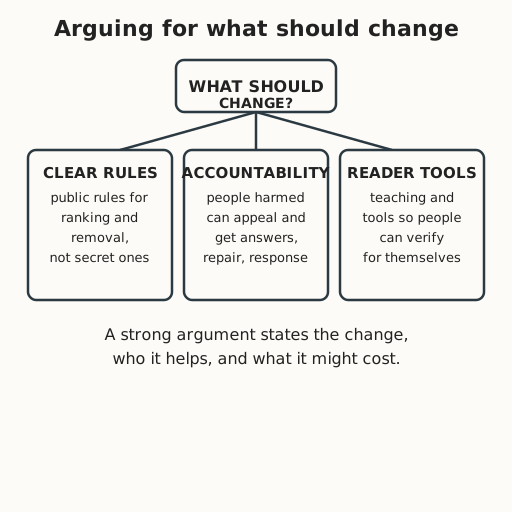
Yesterday you assigned responsibility along the chain. Today you do the harder, more useful thing: you propose the change. Real reforms have real shapes. Some push for clear rules — public, reviewable standards for what gets ranked and removed, instead of secret ones. Some push for accountability — a way for people who are harmed to appeal and get an answer and a remedy. Some push for reader tools — teaching and technology so people can verify for themselves. None of these is free or perfect; each has a cost and an objection. A strong argument for change names the change, names who it helps, and names what it costs — and that is exactly what you will build.
Materials
- Proposal builder
- Stewardship journal
- Three direction cards (low-tech: paper)
Preparation
- Copy or draw the proposal builder; prepare the direction cards.
- Retrieval: from Lesson 7, the chain of responsibility. Today we propose the change.
- Prepare the three directions with a worked example of each (S-011): clear rules (transparent, reviewable moderation standards), accountability and appeals (a path for the harmed to be heard and to get remedy), and reader tools (verification literacy and technology). These are real, live directions in the governance debate around platforms (Britannica, S-481); the institutional ideal of accountable, transparent decision-making is a stated international goal (UN SDG 16, S-463).
Facilitator note
This lesson is written to the learner (“you”). The idea to land: arguing for change is a skill with a shape — the change, who it helps, what it costs — and the strongest proposals draw on real directions: transparent rules, accountability and appeals, and reader tools (Britannica, S-481; UN SDG 16, S-463). The skill is not to have the “right” answer but to make a proposal that can survive the objections any real reform faces: who decides? who pays? will it work here? who might misuse it?
Keep the lesson from collapsing into either a utopia (a proposal with no cost is not a proposal) or a shrug (every proposal has a cost, but that is not a reason to do nothing — the harms themselves have costs). The mature stance: weigh costs against costs, not cost against nothing. Distinguish evidence (what reform mechanisms exist and do) from value (which harms matter most to prevent). The strong institutions ideal is a stated international commitment (S-463) — a value frame, not a claim that it is already achieved.
The ethics lens: a proposal is a claim about what we owe the harmed. The egalitarianism lens is core: ask whether the change protects the powerless or concentrates more power in the already powerful. The global lens: the same proposal lands differently under different laws. The technology lens: the change must actually reach the design of the tool, not just its surface. The critical-thinking lens: testing a proposal against objections, not just preferring it.
Procedure
- Recall (5 min). From Lesson 7, where did you place the heaviest responsibility? Today you propose the change that answers it.
- Meet three directions (10 min). Clear rules — public, reviewable standards for ranking and removal. Accountability and appeals — a path for the harmed to be heard and get a remedy. Reader tools — verification literacy and technology (S-481; S-463). Work one model proposal of each together (S-011).
- Choose a direction (5 min). Pick the direction that best answers the harm you care most about, and say why in one sentence.
- Build the proposal (15 min). In your journal, write: the change (specific, concrete), who it helps, and what it costs (money, freedom, speed — be honest). Name one person or group who would resist it, and why.
- Answer the objection (10 min). With a partner, exchange proposals. Raise the strongest objection to theirs; answer the strongest objection to yours. Revise one part of your proposal as a result.
- Close (5 min). Say, in your own words, what makes a proposal for reform strong rather than just well-meant.
Differentiation
- Support: Build the change and who-it-helps parts only, with the cost supplied, leaving the objection exchange aside.
- Extension: Write the proposal as a short policy memo — the change, the evidence, the cost, and the response to the strongest objection.
Assessment
- Formative (peer + self): Can the learner build a change–who-it-helps–what-it- costs proposal, and answer the strongest objection to it?
- Portfolio artifact (unit): The completed proposal builder (with the revision after the objection exchange), opened in the stewardship journal.
Home connection
Ask someone at home what one change they would make to how harmful online content is handled, and who they think should decide it. Write one sentence on their answer and one on whether you agree.
Resources
- On platform governance and moderation: Encyclopaedia Britannica, “Social media” (S-481).
- On accountable, transparent institutions as a stated international goal: United Nations, Sustainable Development Goal 16 (S-463).
- On worked examples and guided practice for argument: Kirschner, Sweller & Clark (2006) (S-011).