Lesson 09 — The Carbon Cycle
Learners trace the carbon cycle through its reservoirs and fluxes and explain how human activity — chiefly burning fossil fuels — has moved carbon that was buried for millions of years into the atmosphere on a timescale of decades. This is the first of three cycle lessons, and the model for the other two.
Objectives
Objectives
- D10.S3.11.01 Trace a global cycle (carbon, nitrogen, or water) through its parts and explain how human activity has altered it.
Essential question
How does carbon move through Earth's systems, and how has human activity altered the cycle?
Key vocabulary
Materials
Standard materials
- Cycle-tracing sheet · 1 per learner A labeled diagram with blanks for reservoirs and fluxes, to complete by tracing carbon's path
- Stewardship journal · 1 per learner
Low-tech / no-cost
- Reservoir and flux cards on paper (atmosphere, plants and animals, soil and ocean, fossil fuels, photosynthesis, respiration, decomposition, burning) · 1 set per group Cards to physically arrange into a cycle on a desk or floor
- Paper and pencil To draw the cycle by hand
Enriched / lab & device
- One page of emissions data (Our World in Data, cumulative CO2 emissions since 1750) · 1 per pair To ground the human-alteration claim in documented numbers
Works in different contexts
- large-group Build the cycle whole-class on a wall with cards and yarn for fluxes, then pairs each trace one carbon atom's full path
- multi-age Younger learners arrange four reservoirs in a loop; older learners add the fluxes and explain the human shortcut through fossil fuels
- self-directed A learner arranges the cards, draws the cycle, and writes the path of one carbon atom over ten thousand years
- level-grouped A ready group also distinguishes fast fluxes (photosynthesis, respiration) from slow ones (burial into fossil fuels) and explains why the timescale matters
- outdoor-only Use the ground as the diagram — learners stand as reservoirs and toss a token as the carbon atom along the fluxes, then add the "burning" shortcut
Lesson 9 — The Carbon Cycle
Summary
Learners trace the carbon cycle through its reservoirs and fluxes and explain how human activity — chiefly burning fossil fuels — has moved carbon that was buried for millions of years into the atmosphere on a timescale of decades. This is the first of three cycle lessons, and the model for the other two.
Objectives
- Trace the carbon cycle through its parts and explain how human activity has altered it. (D10.S3.11.01)
Connection
The carbon in your own body — every cell of you — has been in the air, in a plant, in a fish, in a rock, many times over, for billions of years. Carbon is not created or destroyed; it moves. It sits in reservoirs — the air, the living world, the soil and ocean, and, buried deep, the fossil fuels — and it flows between them through fluxes like photosynthesis, breathing, and decay. For most of Earth’s history those flows balanced. Then humans found a shortcut: burning the buried carbon. Understanding that shortcut — what it moves, and how fast — is the difference between seeing a cycle and seeing a problem in it.
Materials
- Cycle-tracing sheet
- Stewardship journal
- Reservoir and flux cards (low-tech: paper)
Preparation
- Copy or draw the cycle-tracing sheet; prepare the cards.
- Retrieval: from Grade 10 (D10), energy and sustainability; from earlier this year (D06), matter and energy. Today we trace a closed system: carbon cycles, reused again and again (National Geographic, S-253).
- Prepare the mechanism: carbon moves between reservoirs via photosynthesis, respiration, decomposition, and the burning of fossil fuels; Earth is a closed system, so the amount of carbon never changes — only where it sits (S-253). The greenhouse effect: certain gases trap heat near the surface, keeping Earth warm enough for life, and extra greenhouse gases strengthen it (NASA, S-438). Human activity has altered the cycle by burning coal, oil, and gas (IPCC, S-005).
Facilitator note
This lesson is written to the learner (“you”). The idea to land: carbon cycles between reservoirs — atmosphere, living things, soil and ocean, and buried fossil fuels — through fluxes like photosynthesis, respiration, and decomposition, and the amount of carbon is constant (National Geographic, S-253); human burning of fossil fuels has moved a huge amount of it from the slow reservoir into the atmosphere very fast (IPCC, S-005), strengthening the greenhouse effect (NASA, S-438). The greenhouse effect is itself a good thing — Earth would be frozen without it — so the teaching is about altering a balance, not “carbon is bad.” Carbon is life’s backbone; the issue is rate and direction, not the element.
The environment lens is core: this is a system, and the skill is tracing a system. The ethics lens: the people who burn the most and the people who feel the change most are not the same — hold that for Lessons 13–14. The egalitarianism lens: the alteration is distributed unevenly across the world. The global lens: the cycle has no borders; it is the definition of a shared system. The critical-thinking lens: distinguishing “the carbon cycle is real and well documented” (evidence) from “what we should do about it” (value). Preview: Lessons 10–11 do the same tracing for water and nitrogen; the skill is transferable.
Procedure
- Recall (5 min). From earlier science work: what is matter, and what happens to it when things burn or decay? Today: matter cycles.
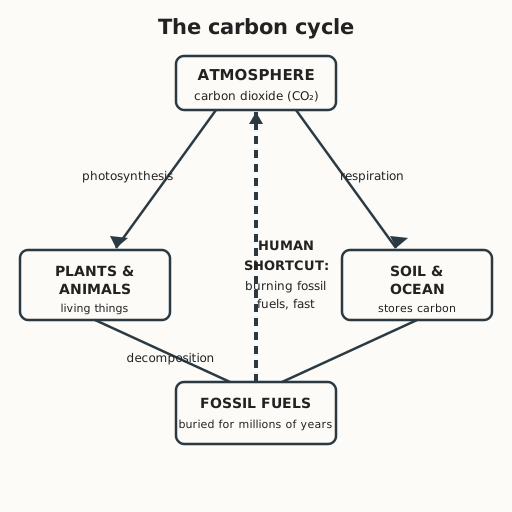
- Meet reservoirs and fluxes (10 min). A reservoir is where a substance sits; a flux is the flow between reservoirs. Name carbon’s reservoirs — atmosphere, living things, soil and ocean, fossil fuels — and its fluxes — photosynthesis, respiration, decomposition, dissolving, and burning (S-253).
- Arrange the cycle (15 min). With the cards, arrange the reservoirs and connect them with the fluxes. Check your loop: can a single carbon atom travel all the way around and back? Trace its path and write it in your journal.
- Add the shortcut (10 min). Burning fossil fuels moves carbon from the slow, buried reservoir into the atmosphere in decades, not millions of years (S-005). Add this flux to your diagram. What changes about the balance?
- Explain the warming (8 min). Extra greenhouse gases trap more heat near the surface (S-438). Write two sentences linking the shortcut to the strengthened greenhouse effect.
- Close (7 min). Say, in your own words, why “carbon is not the problem; the rate we move it is the problem” is a more accurate sentence than “carbon is bad.”
Differentiation
- Support: Arrange four reservoirs in a loop with the two main fluxes (photosynthesis, respiration) and name the shortcut, leaving the warming link aside.
- Extension: Trace one carbon atom’s path from a dinosaur-era plant to today’s atmosphere, labeling each reservoir and flux and the time spent in each.
Assessment
- Formative (peer + self): Can the learner name the reservoirs and fluxes, trace a carbon atom through the full cycle, and explain the human shortcut and its link to warming?
- Portfolio artifact (unit): The completed cycle diagram with the written path and the two-sentence warming link, opened in the stewardship journal.
Home connection
Find one thing at home made of fossil carbon (plastic, fuel, asphalt) and one thing made of recently living carbon (wood, cotton, food). Write one sentence on how each connects to the cycle.
Resources
- On the carbon cycle: National Geographic Education, “The Carbon Cycle” (S-253).
- On the greenhouse effect: NASA, “What Is the Greenhouse Effect?” (S-438).
- On human alteration of the carbon cycle: IPCC (S-005); on cumulative emissions data: Our World in Data (S-006).
- On worked examples and guided practice for a new tracing skill: Kirschner, Sweller & Clark (2006) (S-011).