Lesson 10 — The Water Cycle
Learners trace the water cycle through evaporation, condensation, precipitation, and collection, and explain how human activity — dams, diversions, and pollution — has altered where water goes and who can reach it. This is the second of three cycle lessons.
Objectives
Objectives
- D10.S3.11.01 Trace a global cycle (carbon, nitrogen, or water) through its parts and explain how human activity has altered it.
Essential question
How does water move through Earth's systems, and how has human activity altered the cycle?
Key vocabulary
Materials
Standard materials
- Cycle-tracing sheet · 1 per learner A labeled water-cycle diagram with blanks, to complete by tracing water's path
- Stewardship journal · 1 per learner
Low-tech / no-cost
- Stage cards on paper (ocean, clouds, rain, rivers, ground, plants) · 1 set per group Cards to physically arrange into a water cycle on a desk or floor
- Paper and pencil To draw the cycle by hand
Enriched / lab & device
- One page on water access (WHO drinking-water fact sheet — who has safely managed water and who does not) · 1 per pair To connect the physical cycle to the human question of who can reach clean water
Works in different contexts
- large-group Build the cycle whole-class with cards and yarn, then pairs each trace one water molecule's path from ocean to tap to sea
- multi-age Younger learners arrange the four main stages (evaporation, condensation, precipitation, collection); older learners add runoff, groundwater, and human alteration
- self-directed A learner arranges the cards, draws the cycle, and writes the path of one water molecule over a year
- level-grouped A ready group also explains why the sun drives the "up" and gravity drives the "down," and what that implies for human dams and diversions
- outdoor-only If near water, observe evaporation, condensation, and flow directly; otherwise learners stand as stages and pass a token as the water molecule
Lesson 10 — The Water Cycle
Summary
Learners trace the water cycle through evaporation, condensation, precipitation, and collection, and explain how human activity — dams, diversions, and pollution — has altered where water goes and who can reach it. This is the second of three cycle lessons.
Objectives
- Trace the water cycle through its parts and explain how human activity has altered it. (D10.S3.11.01)
Connection
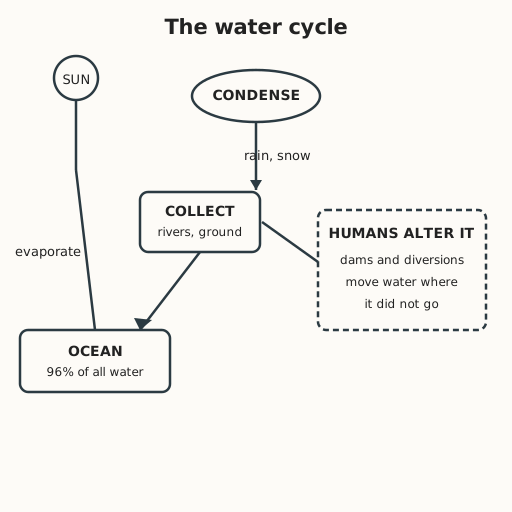
Every sip of water you take has already been a cloud, a river, an ocean, and rain — countless times, for billions of years. Water is not made new; it is recycled. The Sun lifts it up (evaporation), it cools and gathers (condensation), it falls (precipitation), and it collects in rivers and the ground before returning to the sea. The cycle is simple, but human hands have reached into it: we dam rivers, divert water to fields and cities, and pollute what we use. Tracing the cycle shows you both how water moves — and where our fingerprints are on it.
Materials
- Cycle-tracing sheet
- Stewardship journal
- Stage cards (low-tech: paper)
Preparation
- Copy or draw the cycle-tracing sheet; prepare the cards.
- Retrieval: from Lesson 9, the reservoir-and-flux tracing skill. Today we apply it to water.
- Prepare the mechanism: the water cycle is driven by the Sun (evaporation up) and gravity (precipitation and runoff down), moving water through evaporation, evapotranspiration, condensation, precipitation, runoff, and infiltration into groundwater (USGS, S-212; NASA GPM, S-213). Oceans store the great majority of Earth’s water (S-212). Human activity — dams, diversions, and pollution — changes where water goes and who can reach it; billions still lack safely managed drinking water (WHO, S-049).
Facilitator note
This lesson is written to the learner (“you”). The idea to land: water cycles from ocean to cloud to rain to river and ground and back, driven by the Sun upward and gravity downward (USGS, S-212; NASA GPM, S-213), and human activity — dams, diversions, and pollution — has altered where it goes and who can reach it; billions still lack safely managed drinking water (WHO, S-049). The water cycle is the clearest of the three for showing direction: energy (the Sun) moves water up, and gravity moves it down — which is why damming and diverting water is intervening in a flow that gravity already set.
The environment lens is core (a physical system). The ethics lens: altering a shared cycle is a choice with downstream consequences — literally — for people downstream. The egalitarianism lens: access to clean water is deeply uneven (WHO, S-049), and the people whose water is diverted or polluted are rarely the people who chose it. The global lens: water crosses borders (rivers, aquifers), so the cycle is a coordination problem, previewing Lesson 13. The critical-thinking lens: distinguishing “the cycle is well documented” (evidence) from “water is a right that should be shared” (value — a commitment, not a scientific claim).
Procedure
- Recall (5 min). From Lesson 9, what were a reservoir and a flux? Today we trace water.
- Meet the stages (10 min). Evaporation — the Sun lifts water up. Condensation — it cools and gathers into clouds. Precipitation — it falls as rain or snow. Collection — it gathers in rivers, lakes, and the ground before returning to the sea (S-212; S-213).
- Arrange the cycle (15 min). With the cards, arrange the stages into a loop. Trace one water molecule’s path from the ocean, to a cloud, to rain, to a river, to the ground, and back to the sea. Write the path in your journal, naming the Sun’s “up” and gravity’s “down.”
- Add human hands (10 min). Dams hold water back; diversions send it to fields and cities; pollution changes what flows. Add these to your diagram. What changes for the people and places downstream?
- Connect to access (8 min). Billions of people still lack safely managed drinking water (S-049). Write two sentences linking the physical cycle to this human fact.
- Close (7 min). Say, in your own words, why “water is not scarce — clean, reachable water is” captures the difference between the cycle and the problem.
Differentiation
- Support: Arrange the four main stages in a loop and name one human alteration, leaving the access link aside.
- Extension: Trace water from a mountain glacier to a coastal city’s tap, naming every stage and one human intervention at each.
Assessment
- Formative (peer + self): Can the learner name the stages, trace a water molecule through the full cycle, and explain at least one human alteration and its consequence?
- Portfolio artifact (unit): The completed cycle diagram with the written path and the two-sentence access link, opened in the stewardship journal.
Home connection
Where does the water at your home come from, and where does it go when you are done with it? Ask someone or find out; write one sentence on each.
Resources
- On the water cycle: USGS Water Science School (S-212); NASA GPM Precipitation Education (S-213).
- On clean-water access as uneven: WHO, Drinking-water fact sheet (S-049).
- On worked examples and guided practice for tracing: Kirschner, Sweller & Clark (2006) (S-011).