Lesson 11 — The Nitrogen Cycle
Learners trace the nitrogen cycle through fixation, use by life, decomposition, and denitrification, and explain how human activity — chiefly synthetic fertilizer — has roughly matched and then exceeded natural fixation, sending extra nitrogen into water and air. This is the third of three cycle lessons.
Objectives
Objectives
- D10.S3.11.01 Trace a global cycle (carbon, nitrogen, or water) through its parts and explain how human activity has altered it.
Essential question
How does nitrogen move through Earth's systems, and how has human activity altered the cycle?
Key vocabulary
Materials
Standard materials
- Cycle-tracing sheet · 1 per learner A labeled nitrogen-cycle diagram with blanks, to complete by tracing nitrogen's path
- Stewardship journal · 1 per learner
Low-tech / no-cost
- Stage cards on paper (air, fixation, plants and animals, decomposition, soil, denitrification) · 1 set per group Cards to physically arrange into a nitrogen cycle on a desk or floor
- Paper and pencil To draw the cycle by hand
Enriched / lab & device
- One page on agriculture and fertilizer (FAO, on the scale of synthetic nitrogen in global food production) · 1 per pair To ground the claim that human nitrogen use is now a dominant flux in the cycle
Works in different contexts
- large-group Build the cycle whole-class with cards and yarn, then pairs each trace one nitrogen atom's path from air to food to soil and back
- multi-age Younger learners arrange the main stages in a loop; older learners add the human fertilizer input and its consequences for rivers and air
- self-directed A learner arranges the cards, draws the cycle, and writes the path of one nitrogen atom through a farm and back to the air
- level-grouped A ready group also explains why "extra" nitrogen that leaves the cycle harms rivers and climate, and why the fertilizer that feeds billions is the same nitrogen
- outdoor-only Learners stand as stages and pass a token as the nitrogen atom, then add a "fertilizer factory" station that adds far more tokens than natural fixation
Lesson 11 — The Nitrogen Cycle
Summary
Learners trace the nitrogen cycle through fixation, use by life, decomposition, and denitrification, and explain how human activity — chiefly synthetic fertilizer — has roughly matched and then exceeded natural fixation, sending extra nitrogen into water and air. This is the third of three cycle lessons.
Objectives
- Trace the nitrogen cycle through its parts and explain how human activity has altered it. (D10.S3.11.01)
Connection
The air you are breathing is about four-fifths nitrogen — but in a form almost no living thing can use. Life depends on nitrogen, yet it must first be “fixed” into a usable form by bacteria and lightning. For almost all of history, that natural fixation was the only gate, and it limited how much life the land could feed. Then, about a century ago, humans learned to fix nitrogen in factories — the same process that makes fertilizer — and the gate swung open. The result feeds billions of people and sends far more nitrogen into rivers and air than natural systems can absorb. One cycle, one human shortcut, two enormous consequences.
Materials
- Cycle-tracing sheet
- Stewardship journal
- Stage cards (low-tech: paper)
Preparation
- Copy or draw the cycle-tracing sheet; prepare the cards.
- Retrieval: from Lessons 9–10, the reservoir-and-flux tracing skill. Today we apply it to nitrogen — the trickiest of the three, because most of it is locked in the air.
- Prepare the mechanism: nitrogen cycles (like carbon) within a closed system, with the element conserved and reused (National Geographic carbon-cycle framing, S-253, used here for the cycle concept, not for nitrogen specifics). Nitrogen is fixed from the air by bacteria and lightning, taken up by plants and animals, returned to soil by decomposition, and returned to the air by denitrification. Human activity — synthetic fertilizer made in factories, plus fossil-fuel burning — has greatly increased the amount of reactive nitrogen in circulation (IPCC, S-005, as the authority for human alteration of global cycles).
Facilitator note
This lesson is written to the learner (“you”). The idea to land: nitrogen, like carbon, cycles within a closed system (the cycle concept, S-253) — fixed from the air, taken up by life, returned by decomposition, and released back by denitrification — and human activity, chiefly synthetic fertilizer, has greatly increased the reactive nitrogen in circulation (IPCC, S-005), so the same substance that feeds billions also overloads rivers and air. This is the nitrogen dilemma: it is not a story of “we broke a cycle that was fine” so much as “we opened a gate that let us feed far more people, and the excess has costs.” Hold both truths; neither “fertilizer is evil” (nonsense — it feeds billions) nor “there is no problem” (the excess is documented).
Keep the science honest and hedged: the curriculum’s sources cover the carbon and water cycles at claim level (S-253, S-212, S-213), and the IPCC (S-005) is the authority for the human alteration of global cycles, which it documents for nitrogen alongside carbon. Do not invent a precise statistic; say “greatly increased” and point to the IPCC. The environment lens is core. The ethics lens: one technology (synthetic nitrogen) is simultaneously one of the greatest life-savers and one of the greatest alterers of natural systems — the very definition of a trade-off. The egalitarianism lens: the benefit (food) and the cost (polluted water) do not land on the same people or places. The global lens: the cycle is planetary. The critical-thinking lens: distinguishing “the cycle is real” from “how we should weigh food against pollution.”
Procedure
- Recall (5 min). From Lessons 9–10, what did you learn about tracing a cycle? Today the tricky one: nitrogen, most of it locked in the air.
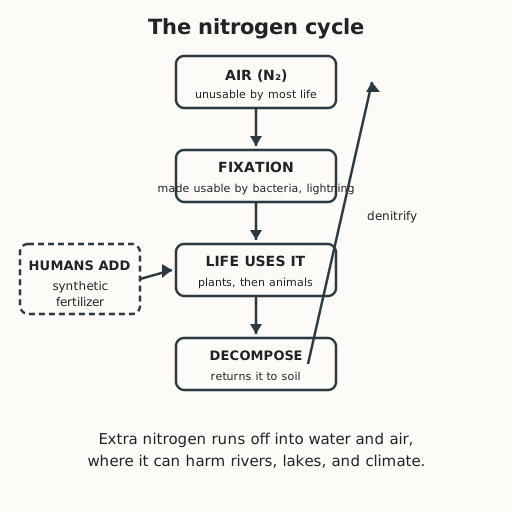
- Meet the stages (10 min). Fixation — bacteria and lightning turn air nitrogen into a usable form. Use — plants take it up, then animals. Decomposition — returns it to the soil. Denitrification — returns it to the air (cycle concept, S-253).
- Arrange the cycle (15 min). With the cards, arrange the stages into a loop. Trace one nitrogen atom from the air, through a plant, through an animal, into the soil, and back to the air. Write the path in your journal.
- Add the human gate (10 min). Synthetic fertilizer, made in factories, fixes far more nitrogen than natural processes did (S-005). Add this input to your diagram. Where does the extra nitrogen go when it is not taken up by a crop?
- Weigh the dilemma (8 min). The same nitrogen feeds billions and overloads rivers and air. Write two sentences holding both truths without choosing between them too quickly.
- Close (7 min). Say, in your own words, why the nitrogen cycle is the clearest example of a technology that is both a lifesaver and a disruptor of a natural system.
Differentiation
- Support: Arrange the four main stages in a loop and name the fertilizer input, leaving the dilemma aside.
- Extension: Trace nitrogen from a fertilizer factory to a coastal “dead zone,” naming every stage and the consequence at each.
Assessment
- Formative (peer + self): Can the learner name the stages, trace a nitrogen atom through the full cycle, and explain the human fertilizer input and its double consequence?
- Portfolio artifact (unit): The completed cycle diagram with the written path and the two-sentence dilemma, opened in the stewardship journal.
Home connection
Find a food at home that was almost certainly grown with fertilizer. Write one sentence on how that food connects you to the nitrogen cycle — for better and for worse.
Resources
- On the cycle concept (conservation within a closed system): National Geographic Education, “The Carbon Cycle” (S-253).
- On human alteration of global cycles, including nitrogen: IPCC (S-005).
- On worked examples and guided practice for tracing: Kirschner, Sweller & Clark (2006) (S-011).