Lesson 12 — The More-Than-Human World
Learners explain the idea of the more-than-human world — the living community that includes rivers, forests, animals, mountains, and people — and why some traditions treat land, water, and other species as beings owed care, not mere resources. They meet living traditions in their own words, held side by side as accounts to understand rather than to rank.
Objectives
Objectives
- D10.S3.11.02 Explain the idea of the more-than-human world and why some traditions treat land, water, and other species as beings owed care.
Essential question
What is the more-than-human world, and why do some traditions treat land, water, and other species as beings owed care?
Key vocabulary
Materials
Standard materials
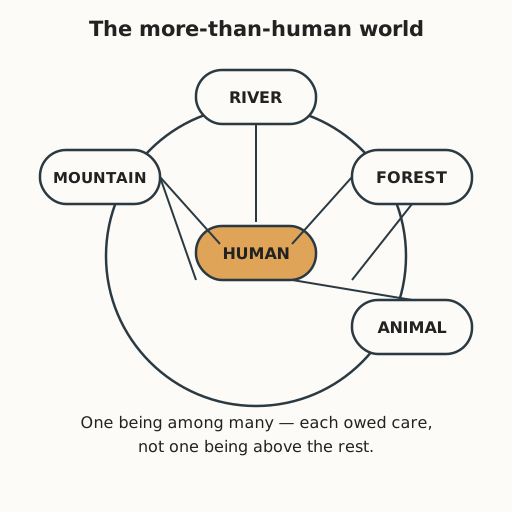
- More-than-human map · 1 per learner A circle organizer — beings of a place (river, forest, animal, mountain, human) — to connect with lines of kinship and care
- Stewardship journal · 1 per learner
Low-tech / no-cost
- Being cards on paper (river, forest, animal, mountain, human, and one more chosen by the learner) · 1 set per group Cards naming beings of a place, to arrange into a circle of relationship
- Paper and pencil To draw the map by hand
Enriched / lab & device
- Two short, faithful excerpts (Robin Wall Kimmerer on plants named as persons in Potawatomi; the Standing Rock 'water is life' framing) · 1 per pair So learners meet living traditions in their own words, not only in summary
Works in different contexts
- large-group Build one place's circle whole-class, then small groups each build the circle for a different place and compare
- multi-age Younger learners name the beings they care about; older learners compare the concept of animacy across traditions and argue what it changes about care
- self-directed A learner arranges the being cards, draws the circle for a place they know, and writes what treating a river as a being would change
- level-grouped A ready group also distinguishes "treating something as a being" from "treating it as a resource," and argues where the practical difference shows up
- outdoor-only Walk to a real place and name its beings aloud; form a physical circle and pass a token to show the lines of relationship
Lesson 12 — The More-Than-Human World
Summary
Learners explain the idea of the more-than-human world — the living community that includes rivers, forests, animals, mountains, and people — and why some traditions treat land, water, and other species as beings owed care, not mere resources. They meet living traditions in their own words, held side by side as accounts to understand rather than to rank.
Objectives
- Explain the idea of the more-than-human world and why some traditions treat land, water, and other species as beings owed care. (D10.S3.11.02)
Connection
In one way of seeing, the world is a warehouse of things: timber, water, land, fish — resources to be used and replaced. In another way of seeing, the world is a community: a river you drink from and are responsible to, a forest that shelters you, animals who are your kin, a mountain that has been here longer than any of us. That second way has a name — the more-than-human world — and it is not a new idea or a fringe one. It is carried by living traditions on every inhabited continent. This lesson asks you not to adopt or reject it, but to understand it well enough to see what it changes: when a river is a being, harming it is not a cost — it is a wrong.
Materials
- More-than-human map
- Stewardship journal
- Being cards (low-tech: paper)
Preparation
- Copy or draw the more-than-human map; prepare the being cards.
- Retrieval: from Lessons 9–11, the cycles that connect all life. Today we ask a relational question about those connections: what are they owed?
- Prepare the accounts, held faithfully and without ranking. Robin Wall Kimmerer, a botanist and citizen of the Citizen Potawatomi Nation, describes how learning Potawatomi plant words revealed a grammar that calls plants persons, not things — a language of respect and relationship (S-427). At Standing Rock, opposition to an oil pipeline under the Missouri River was grounded in the Lakota phrase Mní wičhóni, “water is life” (S-485). Inuit traditions treat the animals and land they live with as kin, not merely quarry (S-058). The scientific parallel: the living world is a web on which humans depend, and its loss falls first on those who live closest to it (IPBES, S-437).
Facilitator note
This lesson is written to the learner (“you”). The idea to land: the more-than-human
world is the idea that the living community includes rivers, forests, animals, and
mountains — not just people — and that these beings are owed care, not merely used;
this is a living idea in traditions across the world (Kimmerer on Potawatomi animacy,
S-427; Standing Rock’s “water is life,” S-485; Inuit kinship with land and animals,
S-058). The scientific register runs alongside, not against, it: human life depends
on a living web, and its loss falls hardest on those closest to it (IPBES, S-437).
Hold these as accounts to understand, never to rank against each other or against
science — the philosophy here is inquiry over creed (see docs/philosophy.md §11).
Guard against two errors. First, exoticizing: these are living traditions of real, contemporary peoples, not museum pieces or “ancient wisdom” to be borrowed as decoration. Second, flattening: no single concept (“animacy,” “personhood,” “water is life”) stands for all Indigenous or place-based traditions — name specific peoples and their specific words, as the sources do. The respect the curriculum owes is to the specificity.
The environment lens is core. The ethics lens: what is owed to a being that cannot speak in a courtroom. The egalitarianism lens: this is a challenge to the idea that only humans matter — an expansion of the circle of care. The global lens: the idea recurs across continents and traditions, each in its own form. The critical-thinking lens: distinguishing “what a tradition holds” (a faithful description) from “what I believe” (a value).
Procedure
- Recall (5 min). From Lessons 9–11, the cycles connect all life. Today: what do those connections owe?
- Meet two ways of seeing (10 min). A resource is something to be used. A being is someone to be in relationship with — owed care, not just use. These are two different ways of seeing the same river.
- Meet the traditions (15 min). Read the excerpts. Kimmerer: Potawatomi grammar calls plants persons, not things (S-427). Standing Rock: Mní wičhóni — water is life (S-485). Inuit traditions: animals and land as kin (S-058). For each, name what is treated as a being and why it is owed care.
- Draw your circle (12 min). Choose a real place you know. Arrange the being cards — river, forest, animal, mountain, human, and one more you choose — into a circle, and draw lines of relationship among them. Where would you place yourself in this circle, and why there?
- Name what changes (8 min). With a partner, ask: if a river is a being, what actually changes about a decision to dam it, divert it, or pollute it? Write one concrete difference.
- Close (5 min). Say, in your own words, what the phrase “the more-than-human world” adds that “the environment” does not.
Differentiation
- Support: Name three beings of a place and one thing each is owed, leaving the “what changes” step aside.
- Extension: Compare how two traditions you read describe care for the non-human, and write where they agree and where they differ — without ranking them.
Assessment
- Formative (peer + self): Can the learner explain the more-than-human world, name specific traditions and their concepts, and identify what treating a being as a being changes in practice?
- Portfolio artifact (unit): The completed more-than-human circle with the written “what changes” reflection, opened in the stewardship journal.
Home connection
Ask someone at home whether there is a place — a tree, a river, an animal, a garden — they feel responsible to, and why. Write one sentence on their answer and one on whether you share it.
Resources
- On animacy and relationship with the living world: Kimmerer, Braiding Sweetgrass (S-427).
- On “water is life” and stewardship as defense: Standing Rock Sioux Tribe (S-485).
- On Inuit kinship with land and animals: Inuit Circumpolar Council (S-058).
- On the living web and its uneven loss: IPBES, Global Assessment (S-437).
- On worked examples and guided practice for a new concept: Kirschner, Sweller & Clark (2006) (S-011).