Lesson 06 — Mutual Aid with Accountability: Beginning a Sustained Effort
Learners plan and begin a sustained mutual-aid or cooperative effort, distinguishing mutual aid from charity by where the power sits, and adding the question of sustainability: an accountability loop — plan, act, check, adjust — that keeps the effort honest and alive past the first week. This completes the D02.S4.11.02 artifact.
Objectives
Objectives
- D02.S4.11.02 Plan and begin a sustained mutual-aid or cooperative effort with accountability.
Essential question
How do I plan and begin a sustained mutual-aid or cooperative effort, with accountability, and keep it going past the first week?
Key vocabulary
Materials
Standard materials
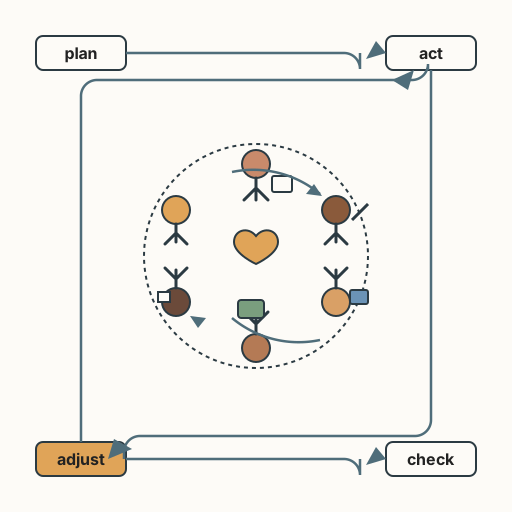
- Mutual-aid accountability loop graphic (SVG) · 1 per learner or projected A circle of people each giving and receiving, with two-way arrows, wrapped by a four-step loop — plan, act, check, adjust
- A one-page effort plan · 1 per learner Who gives and receives, who decides, the first action, a progress check, and an adjustment ready
Low-tech / no-cost
- A circle of people or drawn figures Stand in a circle and pass something in both directions — the felt picture of giving and receiving as equals
- Voice and discussion Plan the effort aloud with a partner, who asks the checking question
Enriched / lab & device
- A first-person account of a mutual-aid network · 1 per class To ground the idea in one lived example from any world region
- A list of local mutual-aid groups (optional) · 1 per class To connect the global examples to something the learner can join
Works in different contexts
- large-group Contrast charity and mutual aid whole-class, then learners plan their own effort in pairs and check each other's accountability step
- multi-age Younger learners name one tradition of communal help; older learners plan a sustained effort with a progress check and an adjustment
- self-directed A learner plans the effort alone, then reads it back and asks how it will know it is still working next month
- level-grouped A ready group adds a second progress check and a way to share the work so no one burns out
- outdoor-only Do one small task of mutual help together, then name which parts felt like giving and which like receiving — and how you would keep it going
Lesson 6 — Mutual Aid with Accountability: Beginning a Sustained Effort
Summary
Learners plan and begin a sustained mutual-aid or cooperative effort. They retrieve the charity-vs-mutual-aid distinction (where the power sits), then add this year’s deepening: accountability and sustainability — a four-step loop (plan, act, check, adjust) that keeps the effort honest and alive past the first flush of enthusiasm. This completes the D02.S4.11.02 artifact and points to Grade 12’s ethic of care (D02.S4.12.01).
Objectives
- Plan and begin a sustained mutual-aid or cooperative effort with accountability. (D02.S4.11.02)
Connection
When a neighbor’s roof is damaged, charity is a one-way gift in which the giver keeps the deciding; mutual aid is the whole street gathering — one brings tiles, one a ladder, one cooks — and the neighbor gives back when the next roof fails. Both repair the roof, but in the second the deciding and the dignity stay with everyone. Yet even the best first gathering can fade: who comes next week, who holds the plan, who notices when one person is doing everything and burning out? That is what accountability and sustainability mean — the difference between a single warm day of help and a network that is still helping a year later.
Materials
- Mutual-aid accountability loop graphic (SVG)
- A one-page effort plan
Preparation
- Retrieval cue: from Grade 10’s closing unit, the charity–mutual-aid–cooperative spectrum and named traditions of communal work (harambee, gotong royong, mink’a/minga, barn raising). Today we deepen the charity vs. solidarity distinction and add the accountability loop that makes an effort last.
- Prepare the contrast: charity (one-way gift, power kept) vs. mutual aid (equals giving, receiving, and deciding together) — plus the sustainability question.
Facilitator note
This lesson is written to the learner (“you”). The idea to land: mutual aid is people meeting one another’s needs together as equals — sharing the giving and the deciding — and accountability is what makes a single act into a sustained effort. Dean Spade’s Mutual Aid (S-345) makes the charity-vs-solidarity distinction precisely, and it is a descriptive distinction: saying they differ is not saying “charity is bad.” The term “mutual aid” was popularized by Kropotkin’s 1902 Mutual Aid: A Factor of Evolution (S-163). Named traditions of communal work span the world: harambee (East Africa), gotong royong (Indonesia), mink’a/minga (the Andes), and barn raising (North America), among others (S-164) — present each as one named tradition in one place, never as “all people there do this,” and invite learners to verify local details with their own community.
The egalitarian lens is central: who keeps the power is the difference between the two forms, and a shared accountability loop (rotating roles, open plans, a named checker) keeps power from re-concentrating inside even a well-meant effort. The ethics lens: dignity matters as much as the roof. The global/anthropological lens: these traditions are living practices on every continent, not ranked and not a Western export. The critical-thinking lens: “what keeps this honest and alive past next month?” is careful planning, not optimism. Distinguish evidence from values: “mutual-aid traditions are widespread and documented, and accountability structures help cooperation thrive” is descriptive (see also Slavin, S-147, and Johnson & Johnson, S-233, on cooperative structures); “sharing the deciding is a fairer way to help” is a value learners weigh. Model the plan once (S-011), then let learners plan.
Procedure
- Recall (7 min). Think of a time neighbors or friends helped each other with no one in charge and no one being paid. Who decided how the help flowed — and did it last, or fade? Say it in one sentence.
- See the circle (8 min). Look at the mutual-aid graphic: everyone gives, everyone receives, arrows run both ways — and a four-step loop (plan, act, check, adjust) wraps the outside. Compare it to a one-way gift. Where does the power sit in each, and what keeps the circle turning?
- Examine real examples (12 min). Choose one. Named traditions: harambee in East Africa, gotong royong in Indonesia, mink’a/minga in the Andes, or barn raising in North America (S-164). Modern networks: neighborhood solidarity groups, disaster-response networks, or food-sharing circles. Write: who gives, who decides, how the help flows back — and what kept (or could keep) it going.
- Plan your own effort (15 min). On your one-page plan, write: (a) Plan — one sustained mutual-aid or cooperative effort you could begin, tied to a real need; who gives, who receives, who decides. (b) Act — the first concrete action this week. (c) Check — how you will know, next month, that it is still working and no one is burning out. (d) Adjust — one thing you will change if the check says it is slipping. Keep it small enough to actually begin.
- Close (8 min). In your portfolio, write one sentence: “The effort I will begin is ___, and what will keep it mutual and lasting is ___.”
Differentiation
- Support: Provide a fill-in frame — “In my effort, ___ gives, ___ decides, the help flows ___, and I will know it is still working when ___.”
- Access (blind / low vision): Describe the graphic aloud — five people in a circle passing things forward with arrows flowing both ways, wrapped by a plan-act-check-adjust loop — and offer a real circle where the group passes one object in both directions so reciprocity can be felt.
- Alternative expression (non-writing, non-oral): Build the plan with four cards or found objects in order and point to each as a partner reads the labels; the plan may be spoken or drawn.
- Extension: Add a second check and a rotation plan — one way to share the work so the effort does not rest on one person’s shoulders.
Assessment
- Formative (self + peer): Can the learner plan a mutual-aid or cooperative effort that names who gives/decides, includes a first action, a progress check, and an adjustment — and distinguish it from charity?
- Portfolio artifact (unit): The one-page effort plan, as the second half of the cooperative-effort artifact.
Home connection
Ask an elder about a tradition of communal help they know — a harvest, a wedding, a recovery, a shared task — and how the help flowed back, and what kept it alive over time. Add what you learn to your plan.
Resources
- On the term “mutual aid” and its long, documented history: Kropotkin, Mutual Aid: A Factor of Evolution (1902) (S-163).
- On named traditions of communal work: harambee, gotong royong, mink’a/minga, barn raising — see the “Communal work” entry (S-164); verify local details with community members.
- On the charity vs. mutual-aid distinction: Dean Spade, Mutual Aid: Building Solidarity During This Crisis (and the Next) (2020) (S-345).
- On cooperative structures helping groups thrive (the accountability research base): Slavin, Cooperative Learning (1995) (S-147); Johnson & Johnson, social interdependence theory (S-233).
- On the Grade-12 summit this strand builds toward: D02.S4.12.01 and D02.S4.12.02 in
curriculum/standards/domains/domain-02-relationships-and-community/domain.md. - On worked examples for new skills: Kirschner, Sweller & Clark (2006) (S-011).