Lesson 05 — Cooperative Ownership: Deciding and Sharing Together
Learners examine cooperative ownership across the world — worker cooperatives, credit unions, and shared-resource commons — and contrast "one member, one vote" with ownership by a few, adding the question of accountability: who checks that the shared deciding actually serves the members. This is the first half of the D02.S4.11.02 artifact.
Objectives
Objectives
- D02.S4.11.02 Plan and begin a sustained mutual-aid or cooperative effort with accountability.
Essential question
How do people run cooperative ownership — deciding and sharing together — and how is that different from ownership held by a few?
Key vocabulary
Materials
Standard materials
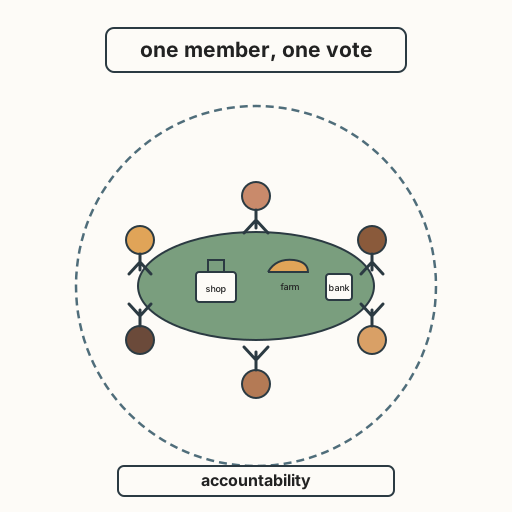
- One member, one vote graphic (SVG) · 1 per learner or projected A circle of people around a shared shop, farm, and bank, each with one equal vote, with an accountability ring around the outside
- Writing journal or portfolio · 1 per learner
Low-tech / no-cost
- A circle of stones or drawn figures One stone per member, all equal, around a shared object — the picture of one member, one vote
- Voice and discussion Name a real shared thing near you — a community fund, a shared garden, a family-run shop — and who decides
Enriched / lab & device
- A first-person profile of a worker co-op or credit union · 1 per class To ground the global idea in one real, lived example
- A directory of local cooperatives (optional) · 1 per class To connect the world examples to something the learner can visit or join
Works in different contexts
- large-group Contrast two ownership models whole-class (one owner vs. one member, one vote), then learners match real examples to each
- multi-age Younger learners name one shared-owned thing and who benefits; older learners compare a co-op with a conventional firm and design an accountability mechanism
- self-directed A learner studies one cooperative example and writes what it shares, who decides, who benefits, and how it stays accountable
- level-grouped A ready group argues how "one member, one vote" plus accountability changes who decides and who gains, compared with ownership by a few
- outdoor-only Do one small shared task together (clearing, carrying, planting) and name who decided and who benefited — then connect it to a cooperative
Lesson 5 — Cooperative Ownership: Deciding and Sharing Together
Summary
Learners examine cooperative ownership across the world — worker cooperatives, credit unions, and communities governing shared resources — and contrast “one member, one vote” with ownership held by a few. This year’s deepening is the question of accountability: not only who decides and benefits, but what keeps the deciding honest and the benefit shared over time. This is the first half of the D02.S4.11.02 artifact.
Objectives
- Examine examples of cooperative ownership and explain how shared deciding and benefit, kept honest by accountability, differ from ownership held by a few. (D02.S4.11.02)
Connection
Think of a group of people who share one well. If one person owned the well alone, they could set the price and keep the profit; everyone else would drink on their terms. If instead the people who use the well own it together — one vote each — then the water is managed for all of them, and the benefit flows back to the users. But even a shared well needs a way to check itself: who makes sure the person drawing for the group does not quietly take extra, or that the well is cleaned and not over-drawn? That checking is accountability. Credit unions, food co-ops, farming collectives, and shared housing are versions of the same well, all over the world — and maybe near you.
Materials
- “One member, one vote” graphic (SVG)
- Writing journal or portfolio
Preparation
- Retrieval cue: from Grade 10’s closing unit, worker co-ops, credit unions, and the charity–mutual aid–cooperative spectrum. Today we deepen cooperative ownership specifically and add the accountability question.
- Prepare a two-column contrast: ownership by a few vs. one member, one vote — plus a third row: who checks that it stays fair.
Facilitator note
This lesson is written to the learner (“you”). The idea to land: a cooperative is a people-centred enterprise jointly owned and democratically controlled by its members — run on “one member, one vote” — so the people who use or work in it also decide and benefit, and accountability is what keeps that true over time. The International Cooperative Alliance (founded 1895) reports about 3 million cooperatives whose members represent at least 12% of humanity (S-486). Mondragón, a federation of worker cooperatives in the Basque Country, is a famous large example (S-487). Communities have long governed shared resources — forests, fisheries, irrigation, grazing — by their own rules for the common good (Ostrom, S-416). These are descriptive facts; “shared ownership is a fairer way” is a value we examine, not assert.
The egalitarian lens is the heart of the lesson: who owns and decides determines who benefits, and accountability is the guard that keeps power from re-concentrating. The ethics lens: two systems can both be legal and yet serve very different ends. The global/anthropological lens: cooperatives and shared resource-governance are not a Western invention — Ostrom documented them across many societies, and cooperative forms thrive on every continent. The critical-thinking lens: asking “who decides, who benefits, and who checks?” about any system is careful analysis, not opinion. Distinguish evidence from values: “cooperatives are widespread, member-owned, and use accountability mechanisms” is descriptive; “that is a fairer shape for an economy” is a judgment learners are invited to weigh. Model the contrast once (S-011), then let learners examine examples.
Procedure
- Recall (7 min). What is the difference between a business owned by one person and one owned by everyone who works in it? Say it in your own words, then we will sharpen it — and add the question no one asked yet: who checks that it stays fair?
- See the difference (8 min). Look at the “one member, one vote” graphic: a circle of people around a shared shop, farm, and bank, with an outer ring of accountability. In a cooperative, one member has one vote — not one vote per coin or per share. Who decides, who benefits, and who checks, when the answer is “everyone, together”?
- Examine real examples (20 min). Choose two to study. Worker co-ops: the people who work in the business own it and elect its direction (e.g., Mondragón, S-487). Credit unions: members own the financial institution and share its benefit (the ICA, S-486, documents cooperatives worldwide). Shared-resource commons: communities managing forests, fisheries, or irrigation by their own fair rules (Ostrom, S-416). For each, write: what is shared, who decides, who benefits — and what mechanism keeps it accountable (an elected board, open books, a rule the group can change).
- Contrast (8 min). Draw two columns: “owned by a few” and “owned by the members.” Place each example, and note one thing that changes for the people when ownership changes — and one thing that accountability protects.
- Close (7 min). In your portfolio, write one sentence: “When people own, decide, and hold themselves accountable together, what changes is ___.”
Differentiation
- Support: Provide a fill-in frame — “In a ___, the people who ___ own it, decide by ___, the benefit goes to ___, and ___ keeps it honest.”
- Access (blind / low vision): Describe the graphic aloud — six people around a shared table holding a shop, a farm, and a bank, each with one equal vote, and an outer ring of accountability — and offer six stones placed evenly around a shared object with a string loop around all of them so “one member, one vote” and the accountability ring can be felt.
- Alternative expression (non-writing, non-oral): Sort pre-printed example cards into two piles — “owned by a few” and “owned by the members” — by placing or pointing, with a partner reading each card aloud.
- Extension: Compare a worker co-op with a conventional firm on one question — how ownership and accountability change who decides and who gains — and argue which serves the members better, with a reason.
Assessment
- Formative (self + peer): Can the learner name a cooperative form, explain “one member, one vote,” and contrast who decides/benefits/checks in shared vs. concentrated ownership?
- Portfolio artifact (unit): The examples-and-contrast page, as the first half of the cooperative-effort artifact.
Home connection
Ask whether anyone near you belongs to a cooperative, credit union, or shared fund — and how the deciding is shared and kept honest. If there is one nearby, find out one way its members hold each other accountable.
Resources
- On the global cooperative movement and “one member, one vote”: International Cooperative Alliance, https://ica.coop/ (S-486).
- On Mondragón as a federation of worker cooperatives: https://www.mondragon-corporation.com/ (S-487).
- On communities governing shared resources by their own rules: Elinor Ostrom, Governing the Commons (1990) (S-416).
- On worked examples for new skills: Kirschner, Sweller & Clark (2006) (S-011).