Lesson 01 — When Feeling Guides and Fools Us
Learners distinguish the two faces of emotion in judgment: the way feeling *informs* decisions with real, often bodily data, and the way it can *bias* decisions when it runs ahead of evidence. They open the capstone year by naming, in their own lives, one moment each where feeling helped and where feeling misled — and they adopt a first checking habit: pause and ask whether a feeling is a compass or a fog.
Objectives
Objectives
- D01.S1.12.01 Integrate emotional understanding into ethical judgment, recognizing how emotion informs and can bias moral reasoning.
Essential question
How does emotion both inform and bias my judgment, and how can I tell the difference?
Key vocabulary
Materials
Standard materials
- Capstone journal · 1 per learner The unit-long notebook for reflections, dilemma logs, and portfolio artifacts
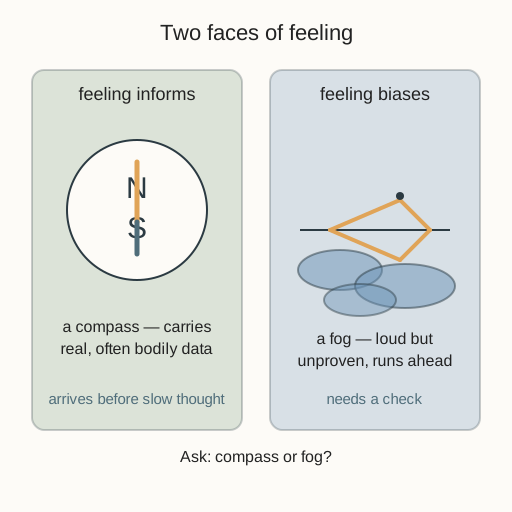
- Feeling-compass diagram · 1 per learner A two-panel organizer — emotion as compass (informs) and emotion as fog (biases) — with a space to log one personal example of each
Low-tech / no-cost
- Paper and pencil To draw the feeling-compass diagram by hand when no printed organizer is available
- Everyday moment slips Six ordinary decisions (whether to speak up, how fast to answer a message, what to believe online, whether to lend money, how to react to a criticism, which route home) to sort as 'feeling helped' or 'feeling misled'
Enriched / lab & device
- One summary of the somatic-marker hypothesis · 1 per pair A short, plain-language page on Damasio's account of gut feelings in decision-making, to ground the 'body as data' idea
Works in different contexts
- large-group Sort the slips whole-class into two columns, then pairs each write one personal example per column
- multi-age Younger learners name one time a feeling helped them decide; older learners argue about a case where the same feeling both helped and hurt
- self-directed A learner sorts the slips alone, draws the compass-fog diagram, and writes one sentence on how they will check a feeling before trusting it as a reason
- level-grouped A ready group also distinguishes a gut feeling (somatic) from a reasoned inference and argues where the line falls
- outdoor-only Stand in a wide space and physically step toward "compass" or "fog" as each moment is read aloud, then name why
Lesson 1 — When Feeling Guides and Fools Us
Summary
Learners separate the two faces of emotion in judgment: feeling informs decisions with real, often bodily data (a compass), and feeling biases decisions when it runs ahead of evidence (a fog). They begin the capstone year by naming one moment each where feeling helped and where feeling misled, and they adopt a first checking habit — pause and ask whether this feeling is a compass or a fog.
Objectives
- Analyze how emotion both informs and can bias judgment, and begin to tell the difference in real cases. (D01.S1.12.01)
Connection
Think of a real decision from this week: whether to speak up in a meeting or class, how fast to trust a message on your phone, whether to lend money, whether to take a risk. In each one, feeling was probably the first thing to arrive — a tightening, a warmth, a warning. Sometimes that first feeling was wise: it noticed something real before your slow thinking caught up. Sometimes it was loud and wrong: it pushed you toward an answer the evidence did not support. The skill this unit opens with is not “ignore your feelings” or “always trust your feelings.” It is learning to tell the compass from the fog.
Materials
- Capstone journal
- Feeling-compass diagram
- Everyday moment slips (low-tech: paper)
- Somatic-marker summary (enriched)
Preparation
- Copy or draw the feeling-compass diagram; prepare the moment slips.
- Retrieval: from Grade 11 (D01.S1.11.01), naming the emotional climate of a group; from Grade 10 (D01.S1.10.01), how personal history and culture shape how a feeling is felt and named. Today we add the capstone turn: judgment.
- Prepare a plain definition: a judgment is a decision about what is true or what to do. A bias here is a systematic lean — not a moral failing, but a predictable tilt (worked example first: Kirschner, Sweller & Clark, S-011).
Facilitator note
This lesson is written to the learner (“you”). The idea to land, held as description, never as a claim that feeling is the enemy of reason: emotion is integral to judgment — it can improve decision quality and it can degrade it (Lerner, Li, Valdesolo & Kassam, S-333). One respected scientific account of the “informing” half is the somatic marker idea — that bodily responses (“gut feelings”) carry information that guides choice (Damasio, S-406); offer it as one well-supported story, not settled fact. The “biasing” half is captured by the fast, automatic, feeling-laden first response versus the slower, deliberate check (Kahneman, S-337).
The ethics lens: whether to act on a feeling is itself a question about what is right to do. The egalitarianism lens: whose feelings are heard as “intuition” and whose are dismissed as “too emotional” is not even across people — the word itself has been used unevenly. The global lens: feeling and its value in judgment are understood differently across cultures, so no single culture’s “calm rationality” is the default. The critical-thinking lens: “compass or fog?” is a test we run on a feeling, not a verdict on a person. Preview: Lesson 2 puts feeling to work inside an ethical judgment.
Procedure
- Recall (5 min). From Grade 11: how do you read the emotional climate of a group — its hope, fear, or grief? Today we turn that same noticing inward, toward your own judgment.
- Meet the two faces (10 min). Work a model example first (S-011): a driver slams the brake an instant before a child runs into the road. The bodily jolt informed the choice — it arrived faster than thought and was right (a compass). Now a second example: the same jolt of fear, reading a shocking headline, leads a person to share it before checking whether it is true — feeling biased the choice (a fog). Name the pattern: feeling can carry real data, and feeling can run ahead of evidence.
- Sort the moments (12 min). With a partner, sort each everyday moment as “feeling helped” (compass), “feeling misled” (fog), or “both.” Argue the borderline ones and say why.
- Name your own (10 min). In your capstone journal, write one moment where a feeling guided you well and one where it misled you. For each, name what the feeling was and what the check would have been.
- Adopt the check (8 min). Agree on a first habit: before acting on a strong feeling, pause and ask — Is this feeling carrying real information, or is it loud but unproven? Write it in your own words.
- Close (5 min). Say, in one sentence, why “trust your gut” and “never trust your feelings” are both too simple.
Differentiation
- Support: Sort only the clearest moments and name the two faces with one word each (compass, fog), leaving the borderline cases aside.
- Extension: Find one real case from news or history where a leader’s emotion either saved or wrecked a decision, and argue which face was at work.
Assessment
- Formative (peer + self): Can the learner name the two faces, sort examples with reasons, and produce a personal example of each with a plausible check?
- Portfolio artifact (unit): The completed feeling-compass diagram and the two-example journal entry, opened in the capstone journal.
Home connection
Ask someone at home about a decision where a feeling turned out to be right, and one where it turned out to be wrong. Write one sentence about each and one about what surprised you.
Resources
- On emotion as integral to — and able to bias — decision-making: Lerner, Li, Valdesolo & Kassam (2015), Emotion and Decision Making (S-333).
- On gut feelings as information (one respected account): Damasio, Descartes’ Error (somatic marker hypothesis) (S-406).
- On the fast, emotional first response vs. the slower check: Kahneman, Thinking, Fast and Slow (S-337).
- On worked examples for a new analytical skill: Kirschner, Sweller & Clark (2006) (S-011); on retrieval and spacing across the unit: Dunlosky et al. (2013) (S-039).