Lesson 02 — Feeling and Fairness
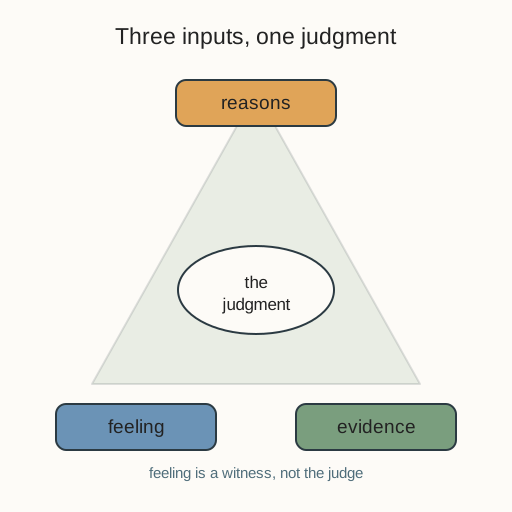
Learners put emotion to work *inside* ethical judgment. They learn that a fair verdict draws on three inputs — reasons (consequences and duties), feeling (one's own and others'), and evidence (what can be verified) — and that feeling belongs as a witness, not as the judge. They practice on short, age-appropriate dilemmas and name, in each, what feeling contributed and where it needed a check.
Objectives
Objectives
- D01.S1.12.01 Integrate emotional understanding into ethical judgment, recognizing how emotion informs and can bias moral reasoning.
Essential question
How do I bring feeling *into* ethical judgment without letting it run the verdict?
Key vocabulary
Materials
Standard materials
- Ethical-judgment triangle · 1 per learner A three-input organizer — reasons (consequences, duties), feeling (what I and others feel), and evidence (what I can verify) — with a decision space at the center
- Dilemma cards · 1 set per pair Four short moral dilemmas, chosen to be within a senior's reach but not psychologically raw (see Facilitator note)
Low-tech / no-cost
- Paper and pencil To draw the triangle by hand and write out a decision
- Spoken dilemma A dilemma the facilitator reads aloud twice, so no printed cards are needed
Enriched / lab & device
- One short excerpt on empathic concern vs. personal distress · 1 per pair A plain-language page distinguishing feeling *for* another from feeling *with* them, to sharpen the "feeling as input" step
Works in different contexts
- large-group Work one dilemma whole-class first (think-pair-share), then pairs each take a second dilemma
- multi-age Younger learners name what the people in the dilemma might feel; older learners run the full triangle and defend a verdict
- self-directed A learner reads a dilemma, fills the triangle alone, writes a verdict, then checks it against the "would I say it out loud?" test
- level-grouped A ready group also names the *counter-argument* to their own verdict and answers it
- outdoor-only Three physical stations (reasons, feeling, evidence); walk between them to gather inputs, then stand in the center to state the verdict
Lesson 2 — Feeling and Fairness
Summary
Learners put emotion to work inside ethical judgment. A fair verdict draws on three inputs — reasons (consequences and duties), feeling (one’s own and others’), and evidence (what can be verified) — and feeling belongs as a witness, not the judge. They practice on short, age-appropriate dilemmas and name what feeling contributed and where it needed a check.
Objectives
- Integrate emotional understanding into ethical judgment, using feeling as an input alongside reasons and evidence. (D01.S1.12.01)
Connection
When you must judge a real situation — whether a friend who broke a promise deserves another chance, whether a rule is fair to everyone, whether to speak up when a group is unfair to someone — you already use your feelings. Outrage tells you something matters; warmth tells you someone is hurting. But if feeling is the only thing deciding, the verdict is just a mood with confidence. This lesson teaches you to seat feeling at the table of judgment, where it can testify, without letting it grab the gavel.
Materials
- Ethical-judgment triangle
- Dilemma cards
- Spoken dilemma (low-tech)
- Empathic concern excerpt (enriched)
Preparation
- Copy or draw the ethical-judgment triangle; prepare the dilemma cards.
- Retrieval: yesterday’s compass/fog distinction (Lesson 1). Today we apply it inside an ethical decision.
- Choose dilemmas that are real in a senior’s life without being raw: e.g., “A student is unfairly blamed for a prank; speaking up will cost them popularity,” “A coach ignores an injury to keep a star player in,” “A family must decide whether to spend scarce money on one member’s education or another’s medicine.” Avoid anything that demands personal trauma disclosure (see Facilitator note).
- Prepare plain definitions: reasons are why an act is right or wrong (consequences for everyone affected; duties one owes); evidence is what can be checked; feeling is what you and others feel (model the integration once: Kirschner, Sweller & Clark, S-011).
Facilitator note
This lesson is written to the learner (“you”). The idea to land: feeling is an input to ethical judgment, not its replacement — it can carry moral information (empathic concern) while also needing a check against reasons and evidence (Decety & Cowell, S-231, on the relation between empathy and morality; Lerner et al., S-333, on emotion as both informing and biasing). Hold the two together rather than collapsing into “feelings are facts” or “feelings are irrelevant.”
The ethics lens: this is the ethics question — how a right judgment is built. The egalitarianism lens: ask who gets to be heard in the dilemma and whose feeling tends to be discounted — the quieter person, the less powerful person. The global lens: moral traditions worldwide weight feeling differently (some center care and relationship, some center duty, some center consequences), and none is the default. The critical-thinking lens: the triangle is a check on judgment, not a calculator — it forces you to name your inputs before you announce a verdict.
Safeguarding: use the provided dilemmas or equivalents that stay one step removed from learners’ private pain. Do not require any learner to disclose their own trauma or history. If a learner volunteers deeply personal material, hold it gently and redirect to the dilemma, not the disclosure.
Procedure
- Recall (5 min). From yesterday: what were the two faces of feeling (compass and fog)? Today we put feeling to work inside a fair judgment.
- Meet the triangle (10 min). Work a model dilemma together first (S-011): the unfairly blamed student. Gather the three inputs aloud — reasons (what happens to everyone if you speak or stay silent; what you owe a classmate), feeling (your outrage, the blamed student’s fear and shame), and evidence (what you can actually verify about who did it). Then state a verdict.
- Run a dilemma in pairs (15 min). Take a dilemma card. Fill the triangle: list reasons, feelings (yours and theirs), and evidence. Mark the place where feeling most helped and the place where it most needed a check.
- Answer your own counter-argument (8 min). Write one sentence a fair critic would say against your verdict, and one sentence answering it.
- Share and test (10 min). Exchange with another pair. Apply the “would I say it out loud?” test: can you defend the verdict using all three inputs, not just the strongest feeling?
- Close (5 min). In one sentence: what did feeling add to your judgment, and what did the check add?
Differentiation
- Support: Use only reasons + feeling (skip evidence) for the first dilemma, and name feeling’s contribution in one word.
- Extension: Add a second dilemma where feeling and reasons conflict, and argue which should give way and why.
Assessment
- Formative (peer + self): Can the learner gather all three inputs, name where feeling helped and where it needed checking, and defend a verdict against a counter-argument?
- Portfolio artifact (unit): The completed ethical-judgment triangle with the verdict and counter-argument, kept in the capstone journal.
Home connection
Describe one small dilemma to someone at home (without names) and ask how they would weigh reasons, feeling, and evidence. Write one sentence about where their answer differed from yours.
Resources
- On the relation between empathy, feeling, and moral behavior: Decety & Cowell, The Complex Relation Between Morality and Empathy (S-231).
- On emotion as both informing and biasing judgment: Lerner, Li, Valdesolo & Kassam (2015) (S-333).
- On worked examples for a new reasoning skill: Kirschner, Sweller & Clark (2006) (S-011); on spaced retrieval across the unit: Dunlosky et al. (2013) (S-039).