Lesson 13 — Through the Setback
Learners learn to sustain purpose through setbacks and constraints they did not choose. They distinguish a barrier they made from a *systemic* one, meet a growth view of setback and self-compassion as the two resources that make a detour possible, and map a real detour on their own goal. The lesson refuses both despair ("the barrier is permanent") and denial ("the barrier is only in my head").
Objectives
Objectives
- D01.S3.12.02 Sustain self-regulation and purpose through setbacks and systemic constraints, naming what sustains them.
Essential question
How do I sustain purpose and self-regulation when I hit a setback or a constraint I did not choose?
Key vocabulary
Materials
Standard materials
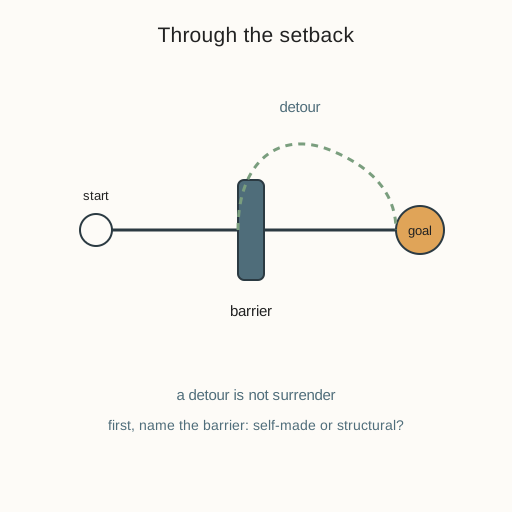
- Setback map · 1 per learner A road diagram — the goal, a labeled barrier (the setback), and a detour path continuing forward — with a space to name what the barrier was and what the detour is
- Setback cards · 1 set per pair Four kinds of setback: a failure I caused, a constraint I did not choose (money, access, discrimination), a change of circumstances, and a loss of motivation — each described gently and generally
Low-tech / no-cost
- Paper and pencil To draw the setback map and write one detour by hand
Enriched / lab & device
- One plain-language page on the growth view and self-compassion · 1 per pair A short page distinguishing a growth view of setback from self-blame, and self-compassion from self-excusing, to ground the detour step
Works in different contexts
- large-group Work one setback whole-class, then pairs each map a second and share their detour
- multi-age Younger learners name one time they tried again; older learners map a setback and distinguish a barrier they made from one the system made
- self-directed A learner maps a setback on their own goal, names whether the barrier was chosen or systemic, and writes one detour
- level-grouped A ready group also argues where "try harder" is the right advice and where the barrier is structural and needs changing, not enduring
- outdoor-only Place a real obstacle on a path, then walk around it — naming, as you do, what the detour required
Lesson 13 — Through the Setback
Summary
Learners learn to sustain purpose through setbacks and constraints they did not choose. They distinguish a barrier they made from a systemic one, meet a growth view of setback and self-compassion as the two resources that make a detour possible, and map a real detour on their own goal. The lesson refuses both despair (“the barrier is permanent”) and denial (“the barrier is only in my head”).
Objectives
- Sustain self-regulation and purpose through setbacks and systemic constraints, and begin to name what sustains them. (D01.S3.12.02)
Connection
Every path worth walking has a place where it is blocked — sometimes by your own mistake, sometimes by something larger you did not choose: money, access, a system that was never built for someone like you. The two common failures are equally costly: to treat every barrier as your own fault, or to treat every barrier as permanent. The skill that matters is telling the difference, and then finding the detour. A detour is not a surrender — it is the way forward that actually exists.
Materials
- Setback map
- Setback cards
- Paper and pencil (low-tech)
- Growth view / self-compassion page (enriched)
Preparation
- Copy or draw the setback map; prepare the setback cards, kept gentle and general.
- Retrieval: from Lesson 12, the plan and its first step; from Grade 10 (D01.S3.10.02), balancing independence with seeking help. Today we prepare the plan for the moment it meets a barrier.
- Prepare plain definitions (model once: Kirschner, Sweller & Clark, S-011): a setback is a barrier on the way to a goal; a systemic constraint is a barrier made by structure (rules, resources, roles), not by the person — and is not solved by “trying harder” alone. A growth view of setback treats a failure as information to revise from, not as proof of fixed worth — and is honestly hedged (effort is not a guarantee) (Dweck, S-096). Self-compassion is treating oneself with the kindness one would give a friend — not self-excusing (Neff, S-222).
Facilitator note
This lesson is written to the learner (“you”). The idea to land: setbacks are met with a detour, not despair or denial — and the first move is naming whether the barrier is one I made or one the system made. Both errors are tempting: self-blame for structural barriers (which the egalitarian lens names as real and unequally distributed), and excusing personal failure as fate. The growth view (Dweck, S-096) and self-compassion (Neff, S-222) are offered as resources, honestly hedged — effort is not a guarantee, and self-compassion is kindness, not excuse.
The ethics lens: how we treat ourselves in failure is an ethical question, and so is how a society treats those its structures block. The egalitarianism lens: some barriers are structural and unequally distributed — a learner blocked by money, access, or discrimination is not failing to “try hard enough,” and the lesson must say so plainly. The global lens: what a “setback” is, and what resources exist to meet it, varies dramatically by place and circumstance — no single story of resilience is the default. The critical-thinking lens: distinguishing self-made from structural is a careful descriptive act, not a mood.
Safeguarding: cards are general and gentle. No learner is required to disclose real hardship, discrimination, or trauma. If a learner names real structural harm, honor it as fact, do not minimize it, and redirect toward support and the detour that actually exists — never toward “try harder.”
Procedure
- Recall (5 min). From Lesson 12: what was your first step and its date? Today we prepare for what happens when the step meets a barrier.
- Meet the two kinds of barrier (10 min). Work a model example (S-011): a learner’s first step fails. Barrier A: they overslept and skipped it (self-made). Barrier B: the course they need costs more than their family has, or the door is closed to people like them (structural). The response differs: A calls for a revised plan; B calls for a detour or a changed structure — not for self-blame.
- Map a setback (12 min). In pairs, take a setback card. On the map, label the barrier and the detour — the way forward that actually exists.
- Meet the two resources (8 min). Argue briefly: what does a growth view of the setback offer that self-blame does not? And how is self-compassion different from letting yourself off the hook?
- Map your own detour (12 min). Privately, choose one real or likely barrier on your goal. Name whether it is self-made or structural, and write one detour — a different step, a resource to find, a person to ask.
- Close (5 min). Say, in one sentence, why a detour is not surrender — and why the first move is naming the barrier, not blaming yourself for it.
Differentiation
- Support: Map one barrier and one detour, and name only whether the barrier is self-made or structural.
- Extension: For a structural barrier, write one thing you could do to change the structure (an appeal, an ally, a resource) rather than only route around it.
Assessment
- Formative (peer + self): Can the learner distinguish self-made from systemic barriers, name what a growth view and self-compassion each add, and write a real detour?
- Portfolio artifact (unit): The setback map with the detour, kept in the capstone journal (feeds Lesson 14).
Home connection
Ask someone at home about a setback they faced and the detour they found. Write one sentence on what they named as the barrier and what sustained them.
Resources
- On a growth view of setback (honestly hedged): Dweck, Mindset (S-096).
- On self-compassion vs. self-criticism: Neff, Self-Compassion (S-222).
- On worked examples: Kirschner, Sweller & Clark (2006) (S-011); on spaced retrieval: Dunlosky et al. (2013) (S-039).