Lesson 14 — What Sustains Me
Learners close the unit by naming what sustains them. They map four kinds of anchor — people, practices, values, and hope — each with one specific real example, and say what it does when things are hard. They then run a closing retrieval pass across the whole unit, distilling its tools into one sentence they will carry forward. The lesson ends the capstone arc in agency and belonging, not in finality.
Objectives
Objectives
- D01.S3.12.02 Sustain self-regulation and purpose through setbacks and systemic constraints, naming what sustains them.
- D01.S2.12.01 Articulate an integrated sense of who they are, what they value, and how they will act, holding together across contexts.
Essential question
What actually sustains me — through setbacks, through constraints, through the long middle — and how do I carry it forward?
Key vocabulary
Materials
Standard materials
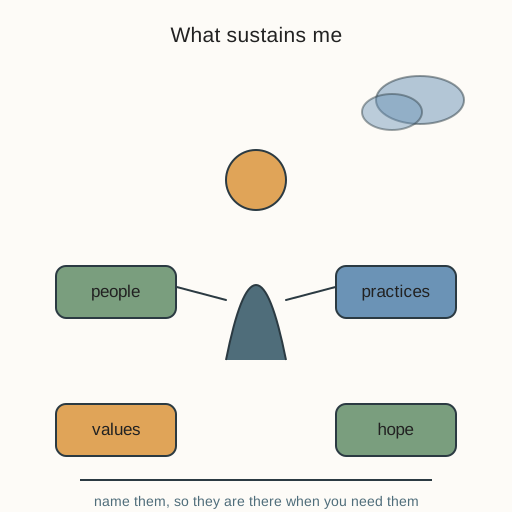
- Anchors map · 1 per learner A figure holding four labeled anchors — people, practices, values, hope — with a space to name one specific anchor in each and one sentence on what it does when things are hard
- Unit retrieval sheet · 1 per learner A single page recalling the unit's core tools — compass/fog, the judgment triangle, the respond loop, concern vs. distress, the integrated statement, the goal plan, the detour — as a closing retrieval pass
Low-tech / no-cost
- Paper and pencil To draw the anchors map and write the closing reflection by hand
Enriched / lab & device
- One plain-language page on habits and routine as support · 1 per pair A short page on how steady routines (sleep, movement, small rituals) carry people through hard stretches, to ground the "practices" anchor
Works in different contexts
- large-group Fill the anchors map individually, then a closing circle shares one anchor each; the class names what it heard repeated
- multi-age Younger learners name one person and one practice that help them; older learners complete all four anchors and the closing reflection
- self-directed A learner completes the anchors map and the retrieval sheet alone, then files the reflection as the unit's capstone artifact
- level-grouped A ready group also distinguishes an anchor (something that steadies) from a distraction (something that numbs), and argues the difference
- outdoor-only Four marked stations for the four anchors; stand in each and name one real anchor aloud, then return to center for the closing reflection
Lesson 14 — What Sustains Me
Summary
Learners close the unit by naming what sustains them. They map four kinds of anchor — people, practices, values, and hope — each with one specific real example, and say what it does when things are hard. They then run a closing retrieval pass across the whole unit, distilling its tools into one sentence they will carry forward. The lesson ends the capstone arc in agency and belonging, not in finality.
Objectives
- Sustain self-regulation and purpose through setbacks and constraints by naming what sustains them, and carry an integrated self forward. (D01.S3.12.02, D01.S2.12.01)
Connection
A ship in a storm does not survive by wishing the waves away; it survives because of what holds it — the anchors, the crew, the practiced routines, the destination it still believes in. The same is true of a life. You have been gathering your anchors all unit: the people who steady you, the small practices that restore you, the values that point you, and the hope that keeps the goal worth walking toward. Today you name them out loud, so they are there when you need them — which is the whole point of the work.
Materials
- Anchors map
- Unit retrieval sheet
- Paper and pencil (low-tech)
- Habits-and-routine page (enriched)
Preparation
- Copy or draw the anchors map; prepare the unit retrieval sheet.
- Retrieval: this lesson is the unit’s closing retrieval pass — spaced across three weeks, which is exactly the evidence-backed payoff of spacing and retrieval (Dunlosky et al., S-039).
- Prepare plain definitions (model once: Kirschner, Sweller & Clark, S-011): an anchor is something that steadies you — a person, a practice, a value, or a hope; sustain is what keeps purpose and self-regulation alive through the hard middle.
Facilitator note
This lesson is written to the learner (“you”). The idea to land: what sustains a person is nameable and portable — people, practices, values, and hope — and naming them is a skill, not a confession. Steady routines (sleep, movement, small rituals) are part of what carries people through hard stretches, which is the honest, hedged core of the “practices” anchor; it is not a claim that routine fixes suffering.
The ethics lens: what we owe ourselves in a hard stretch — care, not contempt — is an ethical claim. The egalitarianism lens: some people have more anchors available (wealth, family, safety) and some have had to build their own from very little; the lesson honors every learner’s anchors, whatever their size. The global lens: what sustains a person — faith, family, craft, land, community — differs across cultures and lives; no anchor is the “correct” one. The critical-thinking lens: the closing retrieval is a check on what actually stuck across the unit, not a performance of completion.
Safeguarding: anchors are the learner’s own and may be private; no one is required to name a trauma, a loss, or a family in crisis. “I don’t have this one yet” is a complete and honored answer for any anchor.
Procedure
- Recall the unit (8 min). Using the retrieval sheet, write each tool in one phrase: compass/fog, the judgment triangle, the respond loop, concern vs. distress, the integrated statement, the goal plan, the detour. (Spaced retrieval — the whole unit at once.)
- Meet the four anchors (8 min). Work a model example (S-011): people (who steadies you?), practices (what small routine restores you?), values (what points you when you are lost?), hope (what future keeps the goal worth it?).
- Map your anchors (15 min). For each anchor, name one specific real example and write one sentence on what it does when things are hard.
- Write what sustains you (12 min). Compose one sentence — “What sustains me through the hard middle is ___” — and one sentence on how you will keep it close.
- Closing circle (8 min). Each person who wishes shares one anchor aloud. Notice what the room repeats — the shared and the particular.
- Close (4 min). Say, in your own words, what this unit left you that you did not have three weeks ago — and what you will carry into the rest of the capstone year.
Differentiation
- Support: Name one person and one practice that help, and write the single closing sentence.
- Extension: Write a one-page “sustainment plan” — what you will do, and who you will reach for, the next time the hard middle arrives — and file it with your capstone artifacts.
Assessment
- Summative + portfolio (unit): The anchors map and the “what sustains me” sentence, filed as the closing capstone artifact; the unit retrieval sheet as evidence of spaced recall.
- Self: Did the learner name real, specific anchors and say what they do when things are hard?
Home connection
Share your “what sustains me” sentence with someone at home, and ask them to name one of their anchors. Write one sentence on what you heard.
Resources
- On spaced retrieval as a high-utility learning technique (the closing pass): Dunlosky et al. (2013) (S-039).
- On worked examples: Kirschner, Sweller & Clark (2006) (S-011).
- On self-compassion as a resource in hard stretches: Neff, Self-Compassion (S-222).