Lesson 01 — The Body That Thinks and Feels
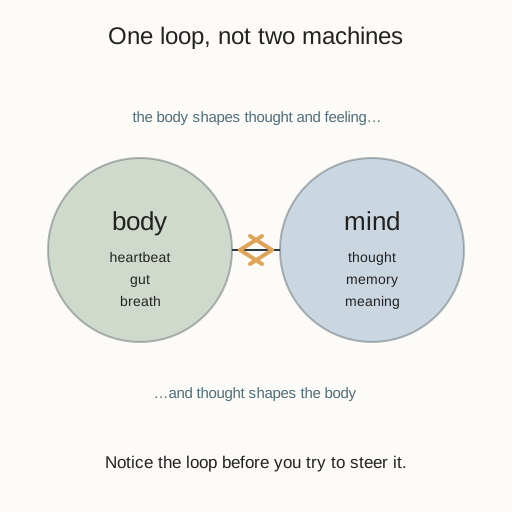
Learners dismantle the old split that treats the body as a mere vehicle for the mind and instead see the two as one loop: the body sends signals that shape thought and feeling, and thought shapes what the body does next. They trace one real loop in their own lives and open the unit-long journal that will hold their lifelong body–mind framework.
Objectives
Objectives
- D03.S1.12.01 Integrate the body-mind connection into a personal framework for lifelong awareness and wellbeing, and explain it to others.
Essential question
How is the body not a vehicle for the mind but part of how I think and feel?
Key vocabulary
Materials
Standard materials
- Lifelong wellness journal · 1 per learner The unit-long notebook for reflections, body maps, plans, and portfolio artifacts
- Body–mind loop diagram · 1 per learner A two-way diagram (body ⇄ mind) with a space to log one personal example of the loop in action
Low-tech / no-cost
- Paper and pencil To draw the body–mind loop by hand when no printed organizer is available
- Everyday moment slips Six ordinary moments (a stomach knot before speaking, a warm ease with a friend, a racing heart on a dark street, a dry mouth before a test, a heavy calm after a run, a tight jaw in an argument) to sort by where the signal came from
Enriched / lab & device
- One plain-language summary of the somatic-marker hypothesis · 1 per pair A short page on Damasio's account of "gut feelings" carrying information into decisions, to ground the body-as-data idea
Works in different contexts
- large-group Sort the moment slips whole-class into two columns (body → mind, mind → body), then pairs each write one personal example per direction
- multi-age Younger learners name one bodily feeling they noticed today; older learners trace a full loop (sensation → feeling → thought → action) and argue about which direction usually comes first
- self-directed A learner sorts the slips alone, draws the loop, and writes two sentences on where their own feelings seem to start — body or thought
- level-grouped A ready group also distinguishes a bodily sensation from an interpretation of that sensation and argues where the line falls
- outdoor-only Walk slowly and notice one bodily signal (breath, pulse, temperature, balance), then turn and walk back naming what that signal might be saying — a live loop
Lesson 1 — The Body That Thinks and Feels
Summary
Learners dismantle the old split that treats the body as a mere vehicle for the mind. They come to see the body–mind connection as one two-way loop: the body sends signals (a racing heart, a knot in the stomach, a held breath) that shape thought and feeling, and thought in turn shapes what the body does next. They trace one real loop from their own lives and open the lifelong wellness journal that will hold their personal framework all unit long.
Objectives
- Explain how the body and mind form one connected loop, and begin building a personal framework for noticing it. (D03.S1.12.01)
Connection
Think of the last time you had to speak in front of people, or got a message that made your stomach drop, or stood at the top of something high. Before you “decided” anything, your body had already answered: a faster heartbeat, a dry mouth, a tightening chest. That is not your body betraying your mind, and it is not your mind riding passively in your body. It is the two working as one system — each shaping the other, every second of your life. This unit begins by learning to read that loop, because you cannot care for a connection you cannot see.
Materials
- Lifelong wellness journal
- Body–mind loop diagram
- Everyday moment slips (low-tech: paper)
- Somatic-marker summary (enriched)
Preparation
- Copy or draw the body–mind loop diagram; prepare the moment slips.
- Retrieval: from Grade 8 (D03.S1.08.01), the nervous system sensing and responding; from Grade 11 (D01.S1.11.01), reading the emotional climate of a group. Today we turn that noticing inward and make it a framework, not just a moment.
- Prepare a plain definition: interoception is sensing the inside of your own body (heart, breath, gut, muscles). A somatic marker is the idea that a bodily feeling can carry information into a decision (one respected account — worked example first: Kirschner, Sweller & Clark, S-011).
Facilitator note
This lesson is written to the learner (“you”). The idea to land, held as description, never as a claim that thought is an illusion: body and mind are one loop, not two machines — the body shapes thought and feeling, and thought shapes the body (Barrett’s interoception account, S-401; Damasio’s somatic-marker account, S-406). Offer both as respected scientific stories held side by side, not settled fact and not therapy. The goal is a noticing habit, not a diagnosis.
The ethics lens: reading the body well helps us treat ourselves and others with accuracy rather than reaction. The egalitarianism lens: every body signals, but not every body is heard — some people’s bodily distress is dismissed as “overreacting” while others’ is taken seriously; noticing this is part of the framework. The global lens: how much a culture attends to the body in thinking and healing differs everywhere — no single tradition’s “mind over body” or “body over mind” is the default. The critical-thinking lens: a signal is not a verdict — we learn to read it and check it, not to obey it blindly. The technology lens: an always-on device is itself a steady source of body signals — a ping, a message, a feed that drops the stomach — so reading the loop means noticing what the screen does to the body, not only what the body does to thought. Preview: Lesson 2 sharpens the reading of signals.
Procedure
- Recall (5 min). From Grade 8: when you are startled, what does your body do before you think? Today we add the capstone turn — the body and mind are one loop, not two machines.
- Meet the loop (10 min). Work a model example first (S-011): you stand to speak and your heart pounds. The body signals first (heartbeat), your mind reads it (“I’m nervous”), and that thought feeds back into your body (a shaky voice). Then run the loop the other way: a calm memory or a slow breath can start in the mind and settle the body. Name the two-way arrow.
- Sort the slips (12 min). With a partner, sort each everyday moment by where the signal seems to start: “body → mind,” “mind → body,” or “a loop I can’t untangle.” Argue the borderline ones and say why.
- Trace your own (12 min). In your journal, draw the loop and trace one real moment: the bodily signal, the thought it shaped, and what your body did next. Write one sentence on which direction usually comes first for you.
- Name the stakes (8 min). Why does it matter to notice this? Write one sentence on what changes when you treat your body as information rather than as a problem to silence or a machine to ignore.
- Close (4 min). Say, in your own words, what is wrong with the sentence “my body is just a vehicle for my mind.”
Differentiation
- Support: Sort only the clearest slips and name the two directions with one word each (body-first, mind-first), leaving the tangled cases aside.
- Extension: Find one real example from a culture or tradition you know where the body is treated as central to thinking or healing, and compare it with a culture that treats the mind as separate.
Assessment
- Formative (peer + self): Can the learner describe the two-way loop, sort examples with reasons, and trace one personal loop with a plausible signal, thought, and response?
- Portfolio artifact (unit): The completed body–mind loop diagram and the traced personal example, opened in the lifelong wellness journal.
Home connection
Ask someone at home where they feel a feeling first — chest, stomach, shoulders, or somewhere else — and whether they notice it before or after they think. Write one sentence about what they said and one about how their answer differs from yours.
Resources
- On interoception and how the brain constructs feeling from bodily signals (one respected account): Barrett, How Emotions Are Made (S-401).
- On bodily “gut feelings” carrying information into decisions (one respected account): Damasio, Descartes’ Error — somatic marker hypothesis (S-406).
- On worked examples for a new analytical skill: Kirschner, Sweller & Clark (2006) (S-011); on retrieval and spacing across the unit: Dunlosky et al. (2013) (S-039).