Lesson 02 — Reading the Body's Signals
Learners move from a vague sense that "something feels off" to precise, zone-by-zone reading of the body's signals — chest, gut, jaw, hands, legs — and learn that a richer vocabulary of body feeling (emotional granularity) supports finer awareness and better self-care. They refine two of their own vague words into precise ones.
Objectives
Objectives
- D03.S1.12.01 Integrate the body-mind connection into a personal framework for lifelong awareness and wellbeing, and explain it to others.
Essential question
How can I read my body's signals more precisely, and why does precision help me care for myself?
Key vocabulary
Materials
Standard materials
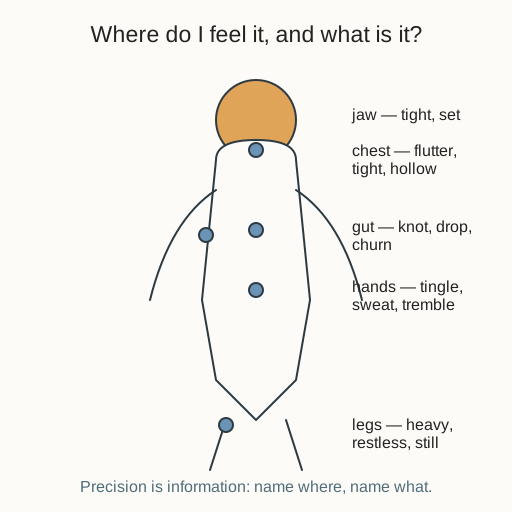
- Body-signal map · 1 per learner An outline of a body with labeled zones (chest, gut, jaw, hands, legs) and a word bank for naming what each zone can signal
Low-tech / no-cost
- Paper and pencil To draw a body outline and label zones by hand when no printed map is available
- Signal word slips A deck of body words (tight, flutter, warm, hollow, buzzing, heavy, cold, still) to sort as 'more precise' or 'more vague'
Enriched / lab & device
- One plain-language page on emotional granularity · 1 per pair A short page on Barrett's finding that a richer feeling vocabulary is linked to finer awareness and better regulation
Works in different contexts
- large-group Build the word bank whole-class on a shared board, then learners each label their own body map with two precise signals
- multi-age Younger learners match one body zone to one feeling word; older learners distinguish a raw sensation from an interpretation and refine a vague word into a precise one
- self-directed A learner labels their own body map, refines two vague words into precise ones, and writes one sentence on what the precision changed
- level-grouped A ready group debates where "sensation" ends and "interpretation" begins for a shared example
- outdoor-only Sit or stand still and scan from feet to head, naming one precise signal in each of three zones aloud to a partner
Lesson 2 — Reading the Body’s Signals
Summary
Learners move from a vague sense that “something feels off” to a precise, zone-by-zone reading of the body’s signals. They learn the difference between a raw sensation (a flutter) and an interpretation of it (“I’m afraid”), and they meet emotional granularity — the idea that a richer vocabulary of body feeling is linked to finer awareness and better regulation (Barrett, S-401). They refine two of their own vague words into precise ones and label their own body map.
Objectives
- Read the body’s signals with greater precision and connect precise awareness to better self-care, building toward a personal framework. (D03.S1.12.01)
Connection
“Something feels off” is a real signal — but it is a blurry one. The person who can only say “I feel bad” has fewer options than the person who can say “my jaw is tight and my breath is high and shallow, and that usually means I am bracing before a hard conversation.” Precision is not fussiness; it is information. The more exactly you can read your own body, the more exactly you can care for it — whether that care is a slow breath, a rest, a glass of water, or a hard word spoken on time.
Materials
- Body-signal map
- Signal word slips (low-tech: paper)
- Emotional-granularity summary (enriched)
Preparation
- Copy or draw the body-signal map; prepare the signal word slips.
- Retrieval: from Lesson 1, the body–mind loop. Today we sharpen the reading of the body’s half of that loop.
- Prepare a plain definition: emotional granularity is the fineness with which a person can name a feeling — a richer vocabulary of body feeling, linked to better awareness and regulation (one well-supported account, held as description, not a ranking of people: Barrett, S-401).
Facilitator note
This lesson is written to the learner (“you”). The idea to land: precision in reading the body is a skill, not a talent — and it is linked to better self-care (Barrett’s emotional-granularity account, S-401). Hold it as description: finer naming is associated with better regulation, but no one is ranked by it, and some bodies and neurotypes signal differently or more quietly — that is difference, not deficit. Never let this become “your body is wrong or too vague”; the point is a tool the learner owns, not a test they pass.
The ethics lens: accurate self-reading lets us act on what is real rather than on a blurry alarm, which protects both ourselves and others. The egalitarianism lens: access to a rich feeling vocabulary is not evenly distributed — some languages and cultures name body states far more finely than others, and no vocabulary is “better” as a person. The global lens: different traditions locate feelings in different parts of the body (the heart, the gut, the chest, the liver), so no single body map is universal. The critical-thinking lens: a sensation is data; an interpretation is a guess — we learn to keep the two apart and check the guess. The technology lens: wearables and health apps give a coarse, external read — heart rate, steps, sleep — but they cannot do the precise inner reading, so a device is a helper to check against, never a replacement for the sensor you already are. Preview: Lesson 3 turns to the stress wave and the return to calm.
Procedure
- Recall (5 min). From Lesson 1: where does a feeling start for you — body or mind? Today we read the body’s half with more precision.
- Meet precision (10 min). Work a model example first (S-011): “I feel bad” vs. “my chest is tight, my breath is shallow, and I keep holding my shoulders up.” The second names where and what, and it opens a door the first cannot — you can act on a tight chest (breathe, drop the shoulders); “bad” gives you nothing to do. Name the move: sensation first, then interpretation, then a check.
- Sort the words (10 min). With a partner, sort the signal words as “more precise” or “more vague,” and for each precise one, name a body zone it might come from.
- Label your map (12 min). On your body map, write one precise signal you have actually felt in at least three zones, and a vague word that covers each one.
- Refine two words (8 min). Choose two vague words from your own life and refine each into a precise phrase (zone + quality + what it usually means). Write what the precision lets you do that the vague word could not.
- Close (5 min). Say, in one sentence, why “I feel bad” is the beginning of self-care, not the end of it.
Differentiation
- Support: Label one zone with one precise word and skip the refinement of vague words; build the word bank together instead.
- Extension: Compare two languages or traditions you know for how finely they name a single body feeling, and write one sentence on what that reveals.
Assessment
- Formative (peer + self): Can the learner distinguish sensation from interpretation, sort words by precision, and refine one vague word into a precise phrase with a plausible action?
- Portfolio artifact (unit): The labeled body-signal map, filed in the journal as part of the emerging framework.
Home connection
Ask someone at home for the most precise word they have for a body feeling you both know, in any language they speak. Write it down with what it means and one body zone it lives in.
Resources
- On emotional granularity — finer naming linked to better awareness and regulation: Barrett, How Emotions Are Made (S-401).
- On worked examples for a new analytical skill: Kirschner, Sweller & Clark (2006) (S-011); on retrieval and spacing: Dunlosky et al. (2013) (S-039).