Lesson 11 — Making It Stick and Adapting
Learners turn their movement plan into a durable habit using a cue–routine–reward loop, and — just as importantly — write a setback plan so that a missed week is a bend in the road, not the end of it. They learn that habits and sleep are built in the same formative stretch of life, and rehearse adapting the plan to a real life change, completing the lifelong-adaptable-movement strand.
Objectives
Objectives
- D03.S2.12.01 Integrate movement into a lifelong, adaptable plan that supports physical, mental, and social health.
Essential question
How do I make my movement plan stick for the long run — and keep adapting it as my life and body change?
Key vocabulary
Materials
Standard materials
- Habit-loop card · 1 per learner A cue–routine–reward card plus a "setback plan" box for naming what to do when the plan breaks
Low-tech / no-cost
- Paper and pencil To draw the habit loop and setback plan by hand when no printed organizer is available
Enriched / lab & device
- One page on sleep and movement in a healthy routine · 1 per pair A short page on sleep as a partner to movement (teenagers about 8–10 hours) and on adolescence as a formative time for building habits
Works in different contexts
- large-group Model one habit loop whole-class, then learners each build their own and share in pairs
- multi-age Younger learners name one cue that already starts a good habit; older learners write a full loop plus a setback plan and rehearse it aloud
- self-directed A learner builds the loop, writes the setback plan, and rehearses both in a few lines of "I will … when …"
- level-grouped A ready group also compares two adaptation strategies for a life change (e.g., a new job or an injury) and argues which is more durable
- outdoor-only Anchor the habit to a physical cue you can see (a gate, a tree, a door) and rehearse the loop by walking to it and back
Lesson 11 — Making It Stick and Adapting
Summary
Learners turn their movement plan into a durable habit using a cue–routine–reward loop, and — just as importantly — write a setback plan so that a missed week is a bend in the road, not the end of it. They learn that movement and sleep are partners in a healthy routine (teenagers need about 8–10 hours, AASM, S-050) and that adolescence is a formative stretch for building habits that last (WHO, S-311). This completes the lifelong, adaptable movement strand.
Objectives
- Make movement a durable, adaptable habit — and recover from setbacks — so the plan lasts across a lifetime. (D03.S2.12.01)
Connection
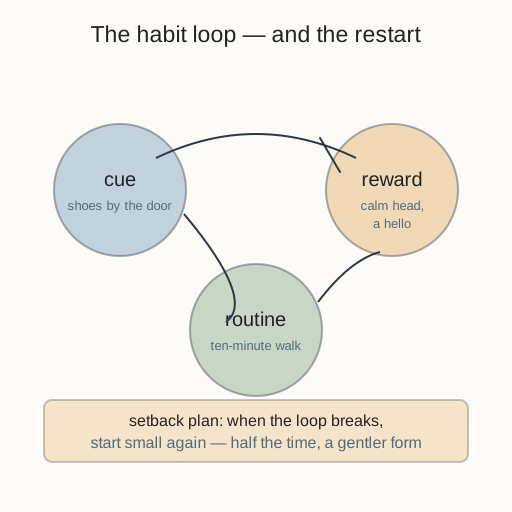
Most movement plans do not fail because they are wrong; they fail because a single missed week becomes a verdict: “I’m not a person who exercises.” The truth is quieter. A habit is a loop — a cue that starts it, a routine you do, a reward that makes you want to do it again — and a setback is just a loop that broke once. The skill is not perfection; it is restarting. Today you build the loop and, more important, the plan for what happens when it breaks.
Materials
- Habit-loop card
- Sleep-and-habit summary (enriched)
Preparation
- Copy or draw the habit-loop card.
- Retrieval: from Lesson 10, your FITT plan; from Lesson 3, the return to calm. Today we ask how a plan becomes a habit and survives a setback.
- Prepare a plain definition: a habit loop has three parts — a cue (the trigger), a routine (the action), and a reward (what makes you want to repeat it).
Facilitator note
This lesson is written to the learner (“you”). The idea to land, held as skill plus value: a habit is a cue–routine–reward loop, and a setback plan is what makes a habit durable — the restart, not the perfect streak, is the skill. Movement is one part of a healthy routine that also includes sleep (about 8–10 hours for teenagers, AASM, S-050), and adolescence is a formative time for building habits that persist (WHO, S-311). Teach the loop explicitly (worked example first: Kirschner, Sweller & Clark, S-011). No shame about broken streaks — the lesson itself treats a setback as information, never a verdict.
The ethics lens: a promise you restart after breaking is stronger than a promise you never break, because it is honest about being human. The egalitarianism lens: not everyone’s day has room for a gym — the loop should be built on cues and rewards that fit real, crowded, low-resource lives. The global lens: habits are anchored to the specific textures of a life (a market day, a harvest, a commute, a call to prayer), so no single cue is universal. The critical-thinking lens: “I’m not a person who exercises” is a claim about identity, not a fact — check it against one small restart. The technology lens: habit apps and phone reminders are today’s most common cue-and-reward scaffolds, and they can help — but a durable loop should also anchor to a real-world cue (a door, a tree, a time of day) so the habit survives a lost phone or a dead battery. Preview: Lesson 12 pivots from the plan to the places that help or block movement.
Procedure
- Recall (5 min). From Lesson 10: what are your four FITT levers? Today we ask how the plan survives the long run.
- Meet the loop (10 min). Work a model example first (S-011): a person who wants to walk more. Cue — shoes by the door; routine — a ten-minute walk after a meal; reward — a calm head and a chat with a neighbor. Show how the cue does the remembering so willpower does not have to.
- Build your loop (10 min). On the habit-loop card, write one cue, one routine, and one reward for your own plan. Make the cue something already in your day.
- Write the setback plan (10 min). Name a realistic setback — a busy week, an illness, a cold season — and write exactly what you will do to restart (start small, half the time, a gentler form). Write it as “when …, I will ….”
- Rehearse the restart (8 min). With a partner, role-play the setback: one of you says “I missed two weeks,” the other reads the restart plan back. Swap.
- Close (5 min). Say, in one sentence, what matters more than never missing a day — and why.
Differentiation
- Support: Build the loop with one cue and one reward from an existing daily routine, and write the setback plan as a single “when … I will …” sentence.
- Extension: Research how sleep and movement interact, and add one sleep-related cue to your loop (e.g., setting the shoes out at the time you wind down).
Assessment
- Formative (peer + self): Can the learner name the three parts of the loop, build one for their plan, and write a concrete restart plan?
- Portfolio artifact (unit): The completed habit-loop card with the setback plan, filed alongside the movement plan as its “stick” plan.
Home connection
Ask someone at home what habit they have kept for years and what keeps it going. Write one sentence about their cue and one about what you will borrow.
Resources
- On sleep duration for teenagers (about 8–10 hours) as part of a healthy routine: American Academy of Sleep Medicine (S-050).
- On adolescence as a formative time for building habits: WHO, Mental health of adolescents (S-311).
- On worked examples for a new skill: Kirschner, Sweller & Clark (2006) (S-011); on retrieval and spacing: Dunlosky et al. (2013) (S-039).