Lesson 10 — Designing My Own Movement Plan
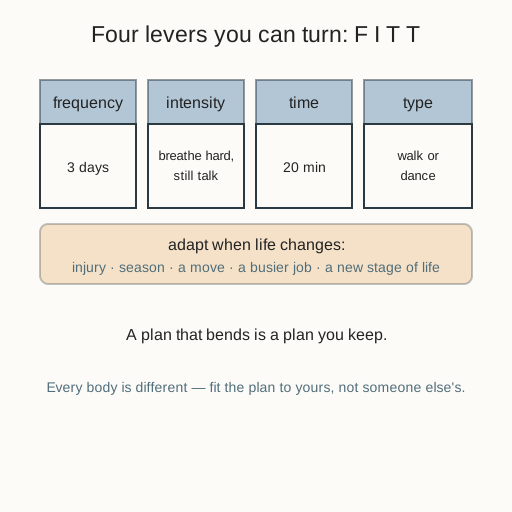
Learners learn the FITT levers — frequency, intensity, time, type — and use them to design a weekly movement plan that fits their own body, life, and circumstances. They add adaptation triggers (injury, season, a new job, a new stage of life) so the plan bends instead of breaking, producing the unit's lifelong, adaptable movement plan.
Objectives
Objectives
- D03.S2.12.01 Integrate movement into a lifelong, adaptable plan that supports physical, mental, and social health.
Essential question
How do I design a movement plan that fits my own body, life, and circumstances — and that I can adapt as they change?
Key vocabulary
Materials
Standard materials
- Movement-plan template · 1 per learner A weekly planner with four FITT columns (frequency, intensity, time, type) and a notes row for adaptation triggers
Low-tech / no-cost
- Paper and pencil To draw the FITT grid by hand when no printed template is available
Enriched / lab & device
- One page on energy needs differing among bodies · 1 per pair A short page on how energy needs differ by age, size, sex, and activity level — a reminder that every plan is individual
Works in different contexts
- large-group Model one FITT plan whole-class, then learners each draft their own in pairs
- multi-age Younger learners fill one row (type) for a week; older learners complete all four columns and add adaptation triggers
- self-directed A learner drafts the full FITT plan alone and writes one sentence on what would make them adapt it (injury, season, a new job)
- level-grouped A ready group also converts their plan into a low-tech and a no-equipment version and compares
- outdoor-only Walk the plan out loud — name frequency, intensity, time, and type as you move — and mark where the environment would help or block it
Lesson 10 — Designing My Own Movement Plan
Summary
Learners learn the FITT levers — frequency, intensity, time, type — and use them to design a weekly movement plan that fits their own body, life, and circumstances. They learn that energy needs and capacities differ among bodies (FAO, S-285), so every plan is individual. They add adaptation triggers — injury, season, a new job, a new stage of life — so the plan bends instead of breaking. This produces the unit’s third capstone artifact: the lifelong, adaptable movement plan.
Objectives
- Integrate movement into a lifelong, adaptable plan fitted to one’s own body and life, supporting physical, mental, and social health. (D03.S2.12.01)
Connection
A plan you cannot keep is worse than no plan, because it teaches you to quit. The best movement plan is not the most impressive one — it is the one you can actually do next week, and next year, and in a different season, with a different body. That is why a good plan is built on four levers you can turn — how often, how hard, how long, and what kind — and on a promise to adapt rather than quit when life changes. Today you build a plan that is honest to your own life, not someone else’s.
Materials
- Movement-plan template
- Energy-needs summary (enriched)
Preparation
- Copy or draw the movement-plan template.
- Retrieval: from Lesson 9, the four building blocks; from Lesson 8, the three kinds of health movement feeds. Today we turn blocks and benefits into a personal plan.
- Prepare a plain definition: FITT names four levers — frequency (how often), intensity (how hard), time (how long), type (what kind). A plan is adaptable when it names the triggers that would change it.
Facilitator note
This lesson is written to the learner (“you”). The idea to land, held as skill plus value: a plan is built from four levers (frequency, intensity, time, type), and it is only good if it is individual and adaptable — energy needs and capacities differ among bodies by age, size, sex, and activity level (FAO, S-285), and a balanced routine draws on aerobic and muscle-strengthening activity with balance and flexibility across the lifespan (WHO, S-341). Teach the FITT scaffold explicitly (worked example first: Kirschner, Sweller & Clark, S-011), then release to design. No body-shaming, no calorie-talk, no single “ideal” plan: the criterion is does it serve this learner’s health and joy across time, not does it look impressive.
The ethics lens: a plan is a promise to yourself, and an honest promise beats a heroic one you will break. The egalitarianism lens: plans must fit real lives — no money for equipment, no safe place to run, long work hours — and a good plan works with what is actually there. The global lens: movement forms differ everywhere, and the plan should use the forms the learner’s own life already contains (walking, dancing, farming, games). The critical-thinking lens: “you should exercise X minutes” is a general guide, not a law for every body — read it, then adapt it. The technology lens: apps and trackers can scaffold the FITT levers — they count frequency, intensity, time, and type — but access to them is uneven, and a plan that depends on a device fails the moment the device is gone; the plan must live in the life, not in the app. Preview: Lesson 11 makes the plan stick and teaches it to bend.
Procedure
- Recall (5 min). From Lesson 9: what are the four blocks? Today we turn them into your plan.
- Meet FITT (10 min). Work a model example first (S-011): a person with long work hours and no gym. Frequency — three times a week; intensity — enough to breathe harder but still talk; time — twenty minutes; type — brisk walk or dance, plus a carry for strength. Show how each lever turns to fit a real life.
- Draft your week (15 min). On the template, fill all four columns for one real week, using activities your life already contains. Keep it honest to what you can actually do.
- Peer-check (8 min). Swap with a partner. Each of you checks the other’s plan for two things: does it hit all four blocks across the week, and is it actually doable? Suggest one improvement.
- Add adaptation triggers (8 min). Write the triggers that would change your plan: an injury, a new season, a move, a busier job, a different stage of life. Write what you would switch to in each case.
- Close (5 min). Say, in one sentence, what makes your plan yours rather than a copy of someone else’s.
Differentiation
- Support: Fill one row (type and time) for three days and leave intensity aside; build the plan with a partner.
- Extension: Write a low-tech, no-equipment version of your plan and a fully equipped version, and name what you gain and lose in each.
Assessment
- Summative (portfolio): The completed FITT plan with adaptation triggers — the unit’s third capstone artifact, the lifelong, adaptable movement plan.
- Peer: Could a partner identify all four blocks and confirm the plan is doable?
Home connection
Show your plan to someone at home and ask them what they would change to make it fit your real week. Write one sentence about their suggestion and one about whether you will take it.
Resources
- On energy needs differing among bodies by age, size, sex, and activity level: FAO / WHO / UNU, Human energy requirements (S-285).
- On a balanced routine across the lifespan: WHO, Physical activity fact sheet (S-341).
- On worked examples for a new planning skill: Kirschner, Sweller & Clark (2006) (S-011); on retrieval and spacing: Dunlosky et al. (2013) (S-039).