Lesson 13 — Designing for Every Body
Learners turn their environment audit into action: they meet the principles of universal design, apply them to redesign one real place so more bodies can move through it, and write a concrete four-part access-widening proposal — the place, the barrier, the change, and who gains. This is the unit's fourth capstone artifact, linking individual movement to the shared, built world.
Objectives
Objectives
- D03.S2.12.02 Explain how environments, such as cities, workplaces, and natural spaces, shape people's ability to move and propose changes that widen access.
Essential question
How do I design a place so that every body can move through it — and propose a concrete change that widens access?
Key vocabulary
Materials
Standard materials
- Access proposal template · 1 per learner A four-part template — the place, the barrier, the change, who gains — for writing a concrete access-widening proposal
Low-tech / no-cost
- Paper and pencil To sketch the redesign and write the proposal by hand when no printed template is available
Enriched / lab & device
- One page on the seven principles of universal design · 1 per pair A short page on equitable use, flexibility, simplicity, perceptible information, and the rest, to ground the redesign
Works in different contexts
- large-group Redesign one shared space whole-class against the principles, then learners each write their own proposal for a place they know
- multi-age Younger learners sketch one change to one place; older learners write the full four-part proposal and defend it against a question
- self-directed A learner chooses a place, sketches the redesign, and writes the four-part proposal alone
- level-grouped A ready group also tests their redesign against all seven principles and notes the trade-offs
- outdoor-only Stand in a real place, point to one barrier, and sketch the change in the air with a partner, naming who gains
Lesson 13 — Designing for Every Body
Summary
Learners turn their environment audit into action: they meet the principles of universal design (equitable use, flexibility in use, simple and intuitive use, perceptible information, tolerance for error, low physical effort, size and space for approach and use — S-369), apply them to redesign one real place so more bodies can move through it, and write a concrete four-part access-widening proposal — the place, the barrier, the change, and who gains. This is the unit’s fourth capstone artifact.
Objectives
- Propose a concrete change to an environment that widens people’s ability to move, grounded in inclusive design principles. (D03.S2.12.02)
Connection
A ramp instead of a stair, a bench placed where people tire, a path wide enough for two wheelchairs to pass, a door that opens without a hard push — each of these is a small, ordinary choice that quietly decides who belongs. The people who build our cities, schools, and parks made thousands of such choices, mostly without asking everyone. But you can make the next one, and propose it, and hand it to someone who can build it. Design is a way of caring for strangers at scale. Today you practice it.
Materials
- Access proposal template
- Universal-design summary (enriched)
Preparation
- Copy or draw the access proposal template.
- Retrieval: from Lesson 12, your environment audit and the biggest barrier you named. Today we turn the audit into a proposal.
- Prepare a plain definition: universal design is design that works for as many people as possible from the start — the seven principles include equitable use, flexibility, simplicity, perceptible information, tolerance for error, low physical effort, and size and space for approach and use (S-369).
Facilitator note
This lesson is written to the learner (“you”). The idea to land, held as skill plus value: good design widens access, and the seven principles of universal design (equitable use, flexibility in use, simple and intuitive use, perceptible information, tolerance for error, low physical effort, size and space for approach and use — S-369) are one tested way to get there. The digital parallel — web accessibility standards (perceivable, operable, understandable, robust — W3C WCAG, S-280) — shows the same logic in another domain. The value: inclusive access to movement is a right (CRPD Article 30, S-100; UNESCO Charter, S-342). Teach the four-part proposal scaffold explicitly (worked example first: Kirschner, Sweller & Clark, S-011). Honor trade-offs: designs have costs and constraints, and the skill is to widen access within them, not to pretend constraints away.
The ethics lens: design is ethics made concrete — a ramp is a moral statement about who belongs. The egalitarianism lens: universal design widens the door for everyone, not as a favor to a “special” few but as the baseline. The global lens: a change that works in a dense city may not fit a steep mountain village or a flood-prone coast — good design answers to its place. The critical-thinking lens: a “universal” solution is a claim to check — test it against bodies and lives unlike your own. The technology & environment lens: universal design and web accessibility are the same idea in two materials — a ramp widens a doorway and a screen reader widens a page — so designing for every body applies to the built world and the digital one alike. Preview: Lesson 14 gathers all four artifacts into one whole.
Procedure
- Recall (5 min). From Lesson 12: what was the biggest barrier you named? Today we propose the fix.
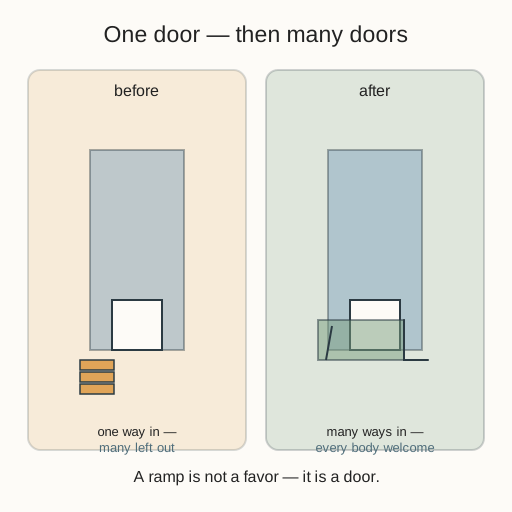
- Meet the principles (10 min). Work a model example first (S-011): a building with only stairs. Run it against the principles — is it equitable use? Flexible? Low physical effort? Then show the redesign: a ramp and the stairs, a handrail, a visible sign, a rest landing. Name which principles each change serves.
- Sketch the redesign (12 min). Choose one place from your audit and sketch the change — on paper, no need for artistry. Label what you added and why.
- Write the proposal (15 min). On the template, write the four parts: the place, the barrier, the change, and who gains. Make the change concrete and buildable.
- Peer-test (8 min). Swap proposals. Each of you asks one question the other must answer: “who does your change still leave out, and what would help them too?”
- Close (5 min). Say, in one sentence, why a ramp is not a favor — it is a door.
Differentiation
- Support: Propose one change to one barrier and write two of the four parts (place and change), discussing the rest aloud.
- Extension: Test your redesign against all seven principles and revise for the one it most fails, then note the trade-off you accepted.
Assessment
- Summative (portfolio): The four-part access-widening proposal — the unit’s fourth capstone artifact, linking movement to the shared, built world.
- Peer: Could a partner name the barrier, the change, and who gains from the proposal?
Home connection
Show your proposal to someone at home and ask who else the change would help and who it might still leave out. Write one sentence about each.
Resources
- On the seven principles of universal design: The Center for Universal Design (NC State), The Principles of Universal Design (S-369).
- On web accessibility principles (perceivable, operable, understandable, robust) as a parallel: W3C WAI, Web Content Accessibility Guidelines (S-280).
- On inclusive access to movement as a right: UN CRPD, Article 30 (S-100); UNESCO International Charter (S-342).
- On worked examples for a new design skill: Kirschner, Sweller & Clark (2006) (S-011); on retrieval and spacing: Dunlosky et al. (2013) (S-039).