Lesson 14 — The Whole Arc: A Life in a Body
Learners assemble the unit's four threads — the body–mind framework, embodied dignity across a lifetime, the lifelong movement plan, and environments that widen movement — into one whole, and write a single sentence that ties them into a life. They gather the unit's four capstone artifacts into a portfolio and reflect, through spaced retrieval, on what they now carry forward.
Objectives
Objectives
- D03.S1.12.01 Integrate the body-mind connection into a personal framework for lifelong awareness and wellbeing, and explain it to others.
- D03.S1.12.02 Articulate how to sustain their own and others' embodied health and dignity across a lifetime, including aging and change.
- D03.S2.12.01 Integrate movement into a lifelong, adaptable plan that supports physical, mental, and social health.
- D03.S2.12.02 Explain how environments, such as cities, workplaces, and natural spaces, shape people's ability to move and propose changes that widen access.
Essential question
How do the four threads of this unit — body–mind, dignity, movement, and environments — weave into one whole I can carry for a lifetime?
Key vocabulary
Materials
Standard materials
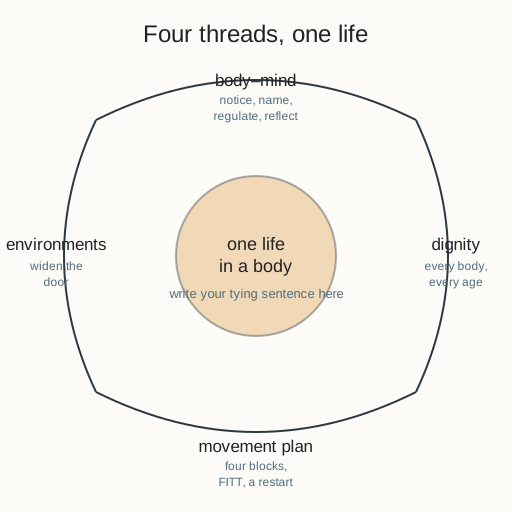
- Whole-arc map · 1 per learner A four-thread map — body–mind, dignity, movement plan, environments — with a center space for one sentence that ties them into a single life
Low-tech / no-cost
- Paper and pencil To draw the whole-arc map by hand when no printed organizer is available
Enriched / lab & device
- Portfolio checklist · 1 per learner A one-page checklist of the unit's four capstone artifacts — framework, dignity reflection, movement plan, access proposal — for final assembly
Works in different contexts
- large-group Assemble the four threads whole-class on a board, then learners each write their one tying sentence and share in pairs
- multi-age Younger learners name their favorite thread and why; older learners write the integration sentence and defend how the four threads support each other
- self-directed A learner completes the map, assembles the four artifacts, and writes the integration sentence alone
- level-grouped A ready group also writes a one-paragraph "whole-arc statement" and reads it aloud to the group for feedback
- outdoor-only Stand at four points of a wide space — one per thread — speak one line at each, then return to the center and say how they become one life
Lesson 14 — The Whole Arc: A Life in a Body
Summary
Learners assemble the unit’s four threads — the body–mind framework, embodied dignity across a lifetime, the lifelong movement plan, and environments that widen movement — into one whole, and write a single sentence that ties them into a life. They gather the unit’s four capstone artifacts into a portfolio and reflect, through spaced retrieval, on what they now carry forward (Dunlosky et al., S-039).
Objectives
- Integrate the unit’s four threads — body–mind, dignity, movement, and environments — into one lifelong whole. (D03.S1.12.01, D03.S1.12.02, D03.S2.12.01, D03.S2.12.02)
Connection
A life is not four separate projects. The way you read your body’s signals (Lesson 2) shows up in how you move (Lesson 10); the dignity you protect in caregiving (Lesson 7) shows up in the ramp you fight for (Lesson 13). What this unit has been building is not a checklist but a way of living in a body — one that notices, that respects every body’s worth, that moves on purpose, and that makes the world easier for others to move through. Today you gather the pieces and see that they were always one thing.
Materials
- Whole-arc map
- Portfolio checklist (enriched)
Preparation
- Copy or draw the whole-arc map; prepare the portfolio checklist.
- Retrieval (spaced): the four threads, each reached across the unit. Today is the capstone retrieval pass — recalling and integrating is what makes the learning durable (Dunlosky et al., S-039).
- Gather the four artifacts: the body–mind framework (Lesson 4), the dignity reflection (Lesson 7), the movement plan (Lesson 10), and the access proposal (Lesson 13).
Facilitator note
This lesson is written to the learner (“you”). The idea to land: the four threads are one thing — a way of living in a body that notices (body–mind), honors every body’s worth (dignity), moves on purpose (movement plan), and widens the world’s doors (environments). The capstone is a retrieval-and-integration pass, which is the highest-value kind of review (Dunlosky et al., S-039). Keep the tone open, not summative-in-the-punitive sense: this is a gathering, not a grading. Honor every body to the last line — the unit’s closing claim is that dignity and joy belong to the whole arc of a life, at every age and every ability, and that the learner now carries the tools to protect that.
The ethics lens: the four threads are all, at bottom, about care — for oneself, for others, for the shared world. The egalitarianism lens: the unit has insisted that every body is a whole body and every stage is a whole stage, and the capstone restates it as a commitment, not a slogan. The global lens: the learner may carry this framework into a life that looks like any life on Earth — a city, a farm, a coast, a mountain — and it is built to travel. The critical-thinking lens: the integration sentence is a claim about your own life, offered to be tested and revised as the life unfolds. The technology & environment lens: the four threads come together in a body that lives in a particular place and time — among devices, buildings, and climates that help or hinder — so the whole arc is carried not in a vacuum but in a world, and part of the task is making that world easier for every body to move through. Close with a forward-looking note: this is the beginning of carrying it, not the end of learning it.
Procedure
- Recall the four threads (8 min). Without looking back, write the four threads of the unit in one line each — body–mind, dignity, movement, environments — and what each means to you now.
- Map the whole (10 min). On the whole-arc map, place the four threads as arcs meeting at a center. At each thread, write its one essential idea in your own words.
- Write the tying sentence (12 min). In the center, write a single sentence that ties all four into one life — the sentence you would carry forward and hand to someone else. Make it true to you.
- Assemble the portfolio (10 min). Gather the four artifacts and set them beside the map: the framework, the dignity reflection, the movement plan, the access proposal. Check each against the checklist.
- Share the sentence (8 min). In pairs, read your tying sentence aloud. Each listener says one word they would not change and one they want to hear more about.
- Close (7 min). Say, in your own words, what this unit has changed about how you will live in your body — and in the world you move through.
Differentiation
- Support: Write the four threads with a word or two each and the tying sentence as a single clause, using the map’s labels as a scaffold.
- Extension: Write a one-paragraph “whole-arc statement” that explains the tying sentence to a stranger, then read it aloud and revise after hearing how it lands.
Assessment
- Summative (portfolio): The completed whole-arc map with the tying sentence, and the assembled four-artifact portfolio — the unit’s capstone.
- Self: Can the learner name all four threads and say how they connect in their own life, in one honest sentence?
Home connection
Read your tying sentence to someone at home and ask them what it makes them think about their own body and life. Write one sentence about what they said.
Resources
- On retrieval-and-integration as the highest-value review (the capstone pass): Dunlosky et al. (2013) (S-039).
- On the science-of-learning arc across the unit (worked examples, spacing, feedback): Kirschner, Sweller & Clark (2006) (S-011).