Lesson 03 — Repair: Listen, Own It, Make It Right
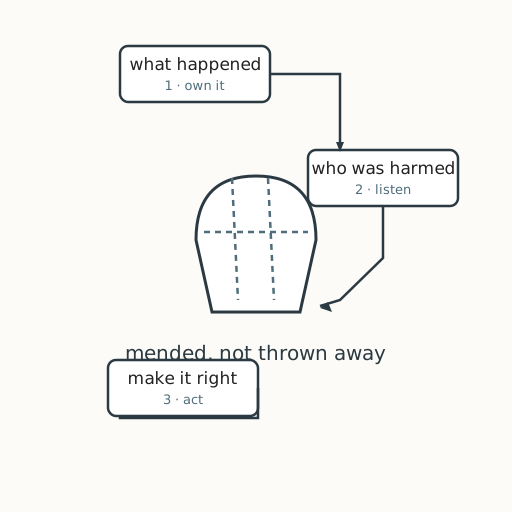
Learners practice real repair after harm in a close relationship, using a restorative three-question frame — what happened, who was harmed and how, how do we make it right (IIRP, S-022). They distinguish repair from a quick apology or a forced "sorry," work a model example, and draft a repair conversation for a fictional harm, then connect repair to the value of mending rather than discarding.
Objectives
Objectives
- D02.S1.12.01 Sustain intimate, trusting relationships through honest communication, repair, and mutual respect.
Essential question
After harm in a close relationship, what does real repair actually require — and how is it different from a quick apology?
Key vocabulary
Materials
Standard materials
- Repair conversation frame · 1 per learner A three-question frame — what happened, who was harmed and how, how do we make it right — for a restorative repair conversation
- Harm-and-repair scenario cards · 1 set per pair Fictional close-relationship harms (a broken promise, a public put-down, a borrowed thing lost) described gently
Low-tech / no-cost
- Paper and pencil To write the three answers by hand
- Voice and body (or pen, screen, or hands) Practice the repair conversation aloud — or write, sign, type, or gesture it — so no printed cards are needed
Enriched / lab & device
- One plain-language page on restorative practice · 1 per pair A page explaining the restorative three questions and why repair focuses on harm and needs rather than punishment
Works in different contexts
- large-group Model one repair conversation whole-class, then pairs each practice a second and share (aloud or in writing) one line of what worked
- multi-age Younger learners answer "what happened" and "how do we make it right"; older learners also name who was harmed and argue what true accountability requires
- self-directed A learner takes one scenario and writes the three answers alone, then drafts the two hardest sentences of a real apology
- level-grouped A ready group also distinguishes repair from punishment and from a forced "sorry," and argues why repair restores rather than humiliates
- outdoor-only Mark three spots on the ground — what happened, who was harmed, make it right — and walk the repair conversation through them in order, speaking, signing, writing, or gesturing each move
Lesson 3 — Repair: Listen, Own It, Make It Right
Summary
Learners practice real repair after harm in a close relationship, using a restorative three-question frame — what happened, who was harmed and how, how do we make it right (IIRP, S-022). They distinguish repair from a quick apology or a forced “sorry,” work a model example, and draft a repair conversation for a fictional harm, then connect repair to the value of mending rather than discarding.
Objectives
- Sustain an intimate, trusting relationship through repair after harm, using accountability, listening, and making it right. (D02.S1.12.01)
Connection
Every close relationship will be damaged at some point — not because it is broken, but because it is alive. What separates relationships that survive harm from those that quietly end is not the absence of harm but the presence of repair. A real repair is more than “sorry”: it names what happened, hears how the other was hurt, and does something to make it right. This lesson practices that, because the relationships worth keeping are the ones we know how to mend.
Materials
- Repair conversation frame
- Harm-and-repair scenario cards
- Paper and pencil (low-tech)
- Restorative practice page (enriched)
Preparation
- Copy or draw the repair conversation frame; prepare the scenario cards, kept fictional and gentle.
- Retrieval: from Lesson 2, the four moves of honest talk; from Grade 7 (D02.S1.07.02), apologizing, listening, and agreeing on next steps. Today we deepen it into full repair.
- Prepare plain definitions (model once: Kirschner, Sweller & Clark, S-011): repair is restoring a relationship after harm by taking accountability (owning what happened without excuses), listening (hearing how the other was harmed), and restitution (doing something concrete to make it right). This is the restorative frame (IIRP, S-022): what happened, who was harmed, how do we make it right.
Facilitator note
This lesson is written to the learner (“you”). The idea to land: repair is not a word but a set of actions — own it, hear the harm, make it right — and it restores rather than humiliates. The restorative three-question frame is a well-established practice (IIRP, S-022). Hold repair as a description of what works, and hold the value that people can change and relationships can mend as a commitment, not a fact.
The ethics lens: what we owe after harm — truth, hearing, and making right — is the core of restorative ethics. The egalitarianism lens: repair treats both people as equals with needs; it neither punishes downward nor lets harm stand unanswered. The global lens: cultures worldwide practice repair — truth-telling circles, peacemaking traditions, and restorative justice rooted in Indigenous practice; the frame is one modern form, not the only one. The technology lens: digital life complicates repair — a public apology can feel performative, an “unsent” message erases no harm, and a private repair is often the honest one (Suler, S-343). The environment lens: a throwaway culture throws away broken things and broken ties alike; the value of mending — a repaired bowl, a rewoven net, a restored streambank — is the same value that sustains relationships (and it echoes the circular-economy ideal of repairing rather than discarding). Preview: Lesson 4 turns to the listener we each want to become.
Safeguarding: all scenarios are fictional. No learner is asked to narrate a real private harm; they may always use a character.
Procedure
- Recall (5 min). From Lesson 2: what are the four moves of honest talk? Today we use honesty on the far side of harm — in repair.
- Meet the three questions (10 min). Work a model example first (S-011): one friend publicly mocks another’s project. A quick “sorry, ok?” is not repair. Repair names what happened (“I mocked your work in front of everyone”), hears the harm (“you felt humiliated and small in front of people you respect”), and makes it right (“I will correct it publicly and check in with you first next time”). Name each move.
- Sort real responses (12 min). In pairs, sort responses to a harm — “I’m sorry you felt that way,” “I was tired, it’s not a big deal,” “I did that, it was wrong, what can I do to make it right?” — into real repair and not repair, and say (or write/sign) why.
- Practice a repair conversation (12 min). Choose a scenario card. Write your three answers, then deliver them to your partner as the harmed person — aloud, or in writing, signing, typing, or gesture — and they respond honestly (in their preferred mode). Revise once so your accountability has no excuses in it.
- Connect to mending (8 min). In your care journal: name one thing in your life — an object, a place, a tie — that is worth mending rather than discarding, and one sentence on what mending it would take.
- Close (4 min). Say (or write, sign, type, or gesture) the three questions in order, and why “who was harmed?” comes before “how do we make it right?”
Differentiation
- Support: Answer only “what happened” and “how do we make it right,” and deliver one real apology sentence — aloud, in writing, in sign, or by AAC.
- Extension: Compare a repair that keeps the power with one that shares it — and write two sentences on which one actually restores the relationship.
- Communication access: A repair conversation can be spoken, written, signed, typed, gestured, or AAC; learners who are non-speaking, d/Deaf, hard-of-hearing, or AAC users complete the three answers and the exchange in their preferred mode, and a written or signed repair counts fully.
Assessment
- Formative (peer + self): Can the learner name the three questions, sort real repair from a quick apology, and practice a repair conversation with accountability and no excuses?
- Portfolio artifact (unit): The three answers plus the “worth mending” reflection, in the care journal.
Home connection
Ask someone at home about a time a relationship was repaired — or should have been. Write one sentence on what the repair (or its absence) changed.
Resources
- On the restorative three-question frame (what happened, who was harmed, how do we make it right): International Institute for Restorative Practices (S-022).
- On how digital communication complicates honest repair: Suler, “The Online Disinhibition Effect” (2004) (S-343).
- On worked examples for a new repair skill: Kirschner, Sweller & Clark (2006) (S-011); on spaced retrieval: Dunlosky et al. (2013) (S-039).