Lesson 04 — The Listener I Want to Become
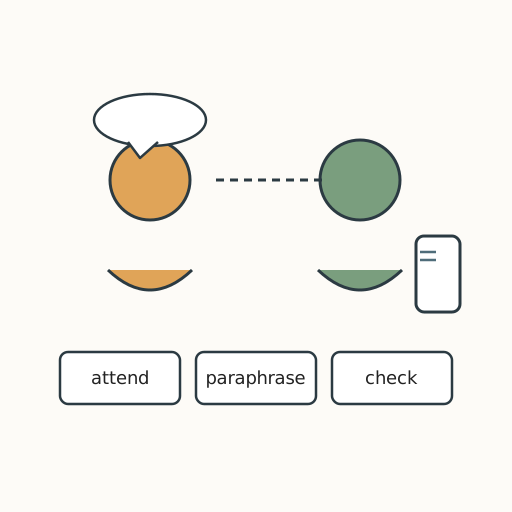
Learners honestly audit their own listening and relationship habits and commit to one concrete step of growth as a listener and partner. They learn active listening as a learnable skill — attend, paraphrase, check — practice it in pairs, and write a private when-then commitment that is small enough to keep.
Objectives
Objectives
- D02.S1.12.02 Reflect on their own communication and relationship habits and commit to growing as a listener and partner.
Essential question
What kind of listener and partner do I want to become — and what habit, honestly seen, is my next step to grow?
Key vocabulary
Materials
Standard materials
- Listening self-audit · 1 per learner A short honest checklist — do I interrupt, rehearse my reply, check my phone, paraphrase back, ask before advising — to be filled in privately
- Care journal · 1 per learner The unit-long notebook for reflections and the capstone portfolio
Low-tech / no-cost
- Paper and pencil To write the audit and the commitment by hand
- Voice and body (or pen, screen, or hands) Practice paraphrasing with a partner — aloud, in writing, in sign, or by typing — so no printed tool is needed
Enriched / lab & device
- One plain-language page on active listening · 1 per pair A page describing active listening — attending, paraphrasing, checking — as a learnable skill, not an inborn trait
Works in different contexts
- large-group Take the audit privately, then pairs practice paraphrase-and-check on a short shared story
- multi-age Younger learners practice one listening move (wait, then say back — in speech, sign, or writing); older learners complete the audit and write a growth commitment
- self-directed A learner fills the audit alone, practices paraphrasing a text they read, and writes one commitment with a when-then plan
- level-grouped A ready group also analyzes *why* half-listening is so common (speed, distraction, the pull to advise) and designs a counter-habit
- outdoor-only Practice a non-auditory form of listening — sit facing a partner and mirror their posture and gesture as they act out a short moment, or pass a written paraphrase back and forth — so attending, paraphrasing, and checking work entirely without sound
Lesson 4 — The Listener I Want to Become
Summary
Learners honestly audit their own listening and relationship habits and commit to one concrete step of growth as a listener and partner. They learn active listening as a learnable skill — attend, paraphrase, check — practice it in pairs, and write a private when-then commitment that is small enough to keep.
Objectives
- Reflect on one’s own communication and relationship habits, and commit to one concrete step of growth as a listener and partner. (D02.S1.12.02)
Connection
Listening is not a talent you are born with or without; it is a set of habits you can see and change. Most of us, honestly, half-listen — we wait for our turn, we glance at a screen, we rush to fix. Naming that truth, without shame, is where growth begins, because a habit you can see is a habit you can change. This lesson asks you to look at your own listening squarely and pick one small, real step to take — not to become a perfect listener tomorrow, but to become a slightly better one by next week.
Materials
- Listening self-audit
- Care journal
- Paper and pencil (low-tech)
- Active listening page (enriched)
Preparation
- Copy or draw the listening self-audit.
- Retrieval: from Lessons 1–3, the four blocks of trust, the four moves of honest talk, and the three questions of repair. Today we turn the lens on ourselves.
- Prepare plain definitions (model once: Kirschner, Sweller & Clark, S-011): active listening is attending fully, paraphrasing (saying back what you heard — in speech, sign, writing, or text), and checking (asking if you got it right) — a learnable skill (CASEL, S-001). Listening is not only auditory: it can be visual (reading, watching posture and gesture) and text-based too. Half-listening is the familiar state of hearing while preparing to speak or attending to a device.
Facilitator note
This lesson is written to the learner (“you”). The idea to land: listening is a learnable habit, and honest self-observation is the engine of growth — not shame, but “not yet.” Keep the audit private and judgment-free; a learner who cannot yet name a habit is not failing, they are at the start of the spiral.
The ethics lens: listening well is a form of respect — it treats the other’s inner world as worth attending to. The egalitarianism lens: who gets truly listened to, and who gets talked over or ignored, is uneven — by status, gender, age, and ability; better listening is a quiet leveller. The global lens: cultures signal listening differently — eye contact, silence, a nod, a repeated phrase, a sign, a written note — so “good listening” is not one posture or one sense; it is attending in the way the speaker can receive, in the mode that reaches them. The technology lens: the device is the modern rival of attention — notifications and the pull to check split attention in ways face-to-face conversation never had to fight (Suler, S-343; WHO notes adolescent digital habits shape wellbeing, S-311). The environment lens: deep listening is also a way of attending to the living world — noticing a bird’s alarm call, a stream’s change, a season’s shift — the same skill of attention turned outward. Preview: Lesson 5 moves from intimate listening to empathy in ethical reasoning.
Safeguarding: the audit is private and not collected; learners share only what they choose, and the when-then commitment may be about any relationship, including with themselves or the living world.
Procedure
- Recall (5 min). From Lessons 1–3, name the blocks of trust, the four moves of honest talk, and the three questions of repair. Today: what kind of listener holds all of that together?
- Audit yourself honestly (8 min). Privately, fill in the listening self-audit: do I interrupt? rehearse my reply while they speak? check my phone? paraphrase back? ask before advising? No one else sees it.
- Meet active listening (10 min). Work a model example first (S-011): a partner tells you a small frustration. Half-listening interrupts with advice (“You should just…”). Active listening attends, then paraphrases (“So it sounds like you felt dismissed when…”), then checks (“Did I get that right?”). The same three moves work without sound — read or watch a message, write or sign back what you understood, and check. Name the three moves in any mode.
- Practice in pairs (12 min). One partner shares a small, ordinary story (no private disclosure) — told aloud, written, or signed. The other practices attend, paraphrase, check, then they swap. Work in the mode that fits you: speak and be heard, or exchange written/signed/text messages and paraphrase back in writing or sign. Notice what changed when you held off on advising.
- Name your next step (10 min). In your care journal, write one habit you saw honestly, and one small when-then commitment: “When I feel the urge to interrupt, then I will pause and paraphrase first.” Make it small enough to keep this week.
- Close (5 min). Say (or write, sign, type, or gesture), in one sentence, the listener you want to become — and the one habit that is your next step.
Differentiation
- Support: Practice a single move (wait, then say back — in speech, sign, or writing) and write a one-line commitment.
- Extension: Notice why half-listening is so common — speed, distraction, the pull to advise — and design a counter-habit for one specific situation, then test it for a day and note the result.
- Communication access: Listening in this lesson is not only auditory. d/Deaf and hard-of-hearing learners attend visually (reading, watching posture and gesture) and paraphrase in writing, signing, typing, or AAC; non-speaking learners paraphrase in their preferred mode. No step requires hearing or producing sound — the audit, the when-then commitment, and the pair practice are all available in written or signed form.
Assessment
- Formative (self + peer): Can the learner name the three moves, practice paraphrase-and-check in a pair (in speech, sign, writing, or text), and write one honest, concrete growth commitment?
- Portfolio artifact (unit): The private audit (kept by the learner) and the written when-then commitment, dated in the care journal.
Home connection
This week, practice attend-paraphrase-check once with someone at home — in speech, sign, writing, or text — without telling them you are practicing. Write one sentence on what you noticed.
Resources
- On listening as a learnable relationship skill within social-emotional learning: CASEL (S-001).
- On digital distraction and adolescent wellbeing as context for the attention habit: WHO, “Mental health of adolescents” (S-311); Suler (2004) (S-343).
- On worked examples for a new skill: Kirschner, Sweller & Clark (2006) (S-011); on retrieval and spacing: Dunlosky et al. (2013) (S-039).