Lesson 05 — Empathy as Evidence
Learners integrate empathy and perspective-taking into ethical reasoning about a complex social problem, rather than treating feeling and principle as rivals. They learn the difference between empathic concern (which informs) and personal distress (which overwhelms), reason one real problem through both columns — inside experience and outside principles — and defend a reasoned position that is more honest because it includes both.
Objectives
Objectives
- D02.S2.12.01 Integrate empathy and perspective-taking into ethical reasoning about complex social problems.
Essential question
How do I let empathy and perspective-taking *inform* my reasoning about a complex social problem — without letting feeling replace thinking?
Key vocabulary
Materials
Standard materials
- Empathy-into-reasoning organizer · 1 per learner A two-column organizer — 'what I understand from the inside' (empathy) and 'what I can weigh from the outside' (principles, consequences, duties) — for reasoning about one complex problem
- Complex-problem briefs · 1 set per group Three real, complex social problems (unaffordable housing, migration and borders, a dam's trade-offs) described factually, with named stakeholders
Low-tech / no-cost
- Paper and pencil To draw the two columns and write the reasoning by hand
- The problem shared aloud, in sign, or in print The facilitator describes (aloud, in sign, or in print) one problem and its stakeholders in three sentences, so no printed briefs are required
Enriched / lab & device
- One plain-language page on empathic concern vs. distress · 1 per pair A page distinguishing feeling *for* others (concern that informs) from feeling *swamped* (distress that overwhelms), to keep empathy a tool, not a fog
Works in different contexts
- large-group Reason through one problem whole-class into the two columns, then groups each take a second and defend one conclusion — aloud or in writing
- multi-age Younger learners name one feeling each stakeholder might have; older learners weigh principles and consequences and argue a reasoned position
- self-directed A learner fills both columns for one problem alone and writes a reasoned position of three sentences, marking which parts are evidence and which are values
- level-grouped A ready group also distinguishes when empathy should *correct* a principle and when a principle should *restrain* empathy, and argues a case where they conflict
- outdoor-only Walk to two marked spots — "inside the experience" and "outside, weighing" — and argue one point from each spot before writing a conclusion
Lesson 5 — Empathy as Evidence
Summary
Learners integrate empathy and perspective-taking into ethical reasoning about a complex social problem, rather than treating feeling and principle as rivals. They learn the difference between empathic concern (which informs) and personal distress (which overwhelms), reason one real problem through both columns — inside experience and outside principles — and defend a reasoned position that is more honest because it includes both.
Objectives
- Integrate empathy and perspective-taking into ethical reasoning about a complex social problem, weighing what I understand from the inside against principles and consequences. (D02.S2.12.01)
Connection
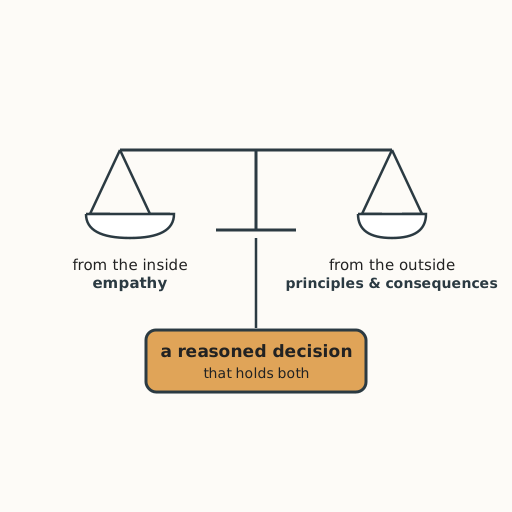
Reasoning about a complex problem — who should get housing, who may cross a border, whose water a dam may take — without ever asking what it feels like for the people inside it is reasoning about a ghost. But feeling alone is not reasoning either; outrage without weighing can do as much harm as coldness. The mature move is to hold both: let empathy tell you what is at stake from the inside, and let principles and consequences tell you what to do from the outside. This lesson practices holding both at once.
Materials
- Empathy-into-reasoning organizer
- Complex-problem briefs
- Paper and pencil (low-tech)
- Empathic concern vs. distress page (enriched)
Preparation
- Copy or draw the empathy-into-reasoning organizer; prepare the complex-problem briefs, kept factual and non-graphic, with stakeholders named.
- Retrieval: from Grade 11 (D02.S2.11.01), empathy for people we have never met; from Unit 1 this year (D01.S1.12.01), how feeling shapes judgment. Today we make empathy a deliberate input to reasoning.
- Prepare plain definitions (model once: Kirschner, Sweller & Clark, S-011): empathic concern is other-oriented feeling that moves us to help; personal distress is self-oriented feeling of being overwhelmed (Batson, S-230). Perspective-taking is deliberately seeing the situation as another sees it (Decety & Cowell, S-231). Ethical reasoning weighs principles, consequences, and duties — now fed by what we understand from the inside.
Facilitator note
This lesson is written to the learner (“you”). The idea to land: empathy is not the enemy of clear reasoning; it is one input, held alongside principles and consequences — and mature reasoning refuses to drop either. The concern-versus-distress distinction is well evidenced (Batson, S-230), and perspective-taking is a well-studied route to prosocial judgment, not automatic (Decety & Cowell, S-231). Hold empathy as description of how we respond, not as a demand to feel a prescribed way.
The ethics lens: what is right here is decided by both — the inner facts empathy reveals and the outer principles that bind everyone. The egalitarianism lens: whose experience we are willing to imagine is uneven; reasoning is skewed when we only imagine the people who resemble us. The global lens: the same problem — housing, migration, water — looks different in a megacity, a village, a refugee camp, and a drought region; none is the default. The technology lens: media curates whose inner world we are shown, and feeds can narrow empathy into an echo of people like us (Britannica, S-481), so perspective-taking must be sought, not received. The critical-thinking lens: mark clearly which parts of your conclusion are evidence (what is at stake) and which are values (what you believe matters) — and do not let one wear the other’s clothes. Preview: Lesson 6 turns to deliberately taking many views of one problem.
Safeguarding: problems are described factually and gently, no graphic detail; a learner with a lived connection to a problem speaks only if they choose, and is honored, not turned into a case study.
Procedure
- Recall (5 min). From Lesson 4: the three moves of active listening. Today we extend listening into imagining another’s inner world — and feed it into reasoning.
- Meet concern vs. distress (8 min). Work a model example (S-011): hearing about families losing their homes can move you to help (concern) or swamp you into looking away (distress). Only concern is usable in reasoning; distress is the fog. Name the difference.
- Fill the two columns (15 min). In a group, take one complex-problem brief. First, the inside column: for each stakeholder, one sentence on what the situation is like for them (perspective-taking). Then the outside column: the principles, duties, and consequences that apply to everyone.
- Argue a reasoned position (12 min). Weigh the columns and defend one position — aloud or in writing — but you must cite at least one thing from each column in your defense. Notice where empathy changed your principle, and where a principle restrained your empathy.
- Mark evidence vs. values (8 min). In your care journal, rewrite your position in three sentences, underlining what is evidence (what is at stake) and circling what is value (what you hold matters).
- Close (4 min). Say (or write, sign, type, or gesture) why dropping either column makes your reasoning worse — not more honest.
Differentiation
- Support: Name one feeling for one stakeholder and one principle, and write a one-sentence position using both.
- Extension: Find a case where empathy and a principle genuinely conflict, argue both sides in writing, and say which should yield and why.
- Communication access: “Arguing” and “defending” a position may be done aloud or in writing, signing, typing, or AAC; a written or signed defense with one cite from each column is complete. Learners who are non-speaking, d/Deaf, or hard-of-hearing complete every reasoning step in their preferred mode.
Assessment
- Formative (peer + self): Can the learner distinguish concern from distress, fill both columns for a real problem, and defend (aloud or in writing) a position that cites both empathy and principle, marking evidence from value?
- Portfolio artifact (unit): The two-column organizer plus the three-sentence position with evidence/value marked, in the care journal.
Home connection
With someone at home, take one decision your household faces and name both columns: what each person feels from the inside, and what principles or consequences apply from the outside. Write one sentence on what changed.
Resources
- On empathic concern vs. personal distress: Batson, Fultz & Schoenrade (1987) (S-230).
- On perspective-taking as a route to moral judgment (not automatic): Decety & Cowell (2014) (S-231).
- On how feeds and algorithms can narrow whose perspective we see: Encyclopaedia Britannica, “Social media” (S-481).
- On worked examples for a new reasoning skill: Kirschner, Sweller & Clark (2006) (S-011); on spaced retrieval: Dunlosky et al. (2013) (S-039).