Lesson 06 — Many Views, One Problem
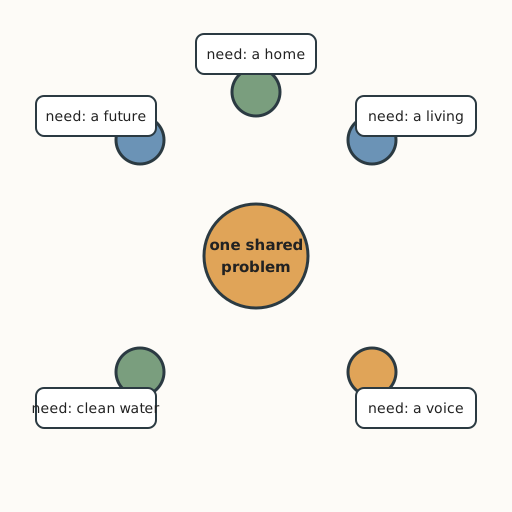
Learners deliberately take the perspectives of people they disagree with about one contested shared problem, and let that change their reasoning. They fill a perspective matrix — what each stakeholder needs, fears, and is fairly asked — then "steelman" the view they least agree with, and revise their own position in its light.
Objectives
Objectives
- D02.S2.12.01 Integrate empathy and perspective-taking into ethical reasoning about complex social problems.
Essential question
How do I deliberately take the perspectives of people I disagree with — and let that change my reasoning about a shared problem?
Key vocabulary
Materials
Standard materials
- Perspective matrix · 1 per group A table — one row per stakeholder, columns for 'what they need,' 'what they fear,' and 'what is fair to ask of them' — about one shared problem
- Shared-problem briefs · 1 set per group One contested local-global problem (a dam, a new road, a factory, a land use) with five named stakeholders who genuinely disagree
Low-tech / no-cost
- Paper and pencil To draw the matrix by hand and fill each row
- Voice and body (or pen, screen, or hands) Speak — or write, sign, type, or gesture — each stakeholder's view in first person, so no printed briefs are needed
Enriched / lab & device
- One plain-language page on perspective-taking and bias · 1 per pair A page on perspective-taking as a learnable route to better judgment, and on the bias that makes us over-trust our own first view"
Works in different contexts
- large-group Build one row of the matrix whole-class, then groups each complete a different stakeholder and share
- multi-age Younger learners name what one stakeholder needs and fears; older learners fill all three columns and steelman the view they least agree with
- self-directed A learner fills the matrix alone for two stakeholders, then writes the strongest version of the view they reject before responding
- level-grouped A ready group also identifies where their own first view was biased, and revises their position in light of the view they least liked
- outdoor-only Assign each stakeholder a spot in a wide space; stand in each spot and argue that view in first person — aloud, in writing, or in sign — before returning to the center
Lesson 6 — Many Views, One Problem
Summary
Learners deliberately take the perspectives of people they disagree with about one contested shared problem, and let that change their reasoning. They fill a perspective matrix — what each stakeholder needs, fears, and is fairly asked — then “steelman” the view they least agree with, and revise their own position in its light.
Objectives
- Take multiple perspectives, including ones I disagree with, and integrate them into ethical reasoning about a shared problem. (D02.S2.12.01)
Connection
When a problem has many sides — a dam that powers a city but floods a valley, a road that connects markets but cuts a forest, a factory that brings jobs but fouls a river — our first instinct is to line up behind the side that already matches our gut. But the strongest reasoning does something harder: it tries on the views it does not like, and says them as their best, not their worst, before answering. That is called steelmanning, and it is how your conclusion earns the right to be trusted — because it survived meeting its rivals fairly.
Materials
- Perspective matrix
- Shared-problem briefs
- Paper and pencil (low-tech)
- Perspective-taking and bias page (enriched)
Preparation
- Copy or draw the perspective matrix; prepare the shared-problem briefs, each with five stakeholders who genuinely disagree.
- Retrieval: from Lesson 5, the two columns (inside/outside); from Grade 8 (D02.S2.08.01), analyzing a conflict from multiple perspectives. Today we steelman.
- Prepare plain definitions (model once: Kirschner, Sweller & Clark, S-011): perspective-taking is deliberately seeing a situation as another sees it (Decety & Cowell, S-231). A steelman is the strongest, fairest version of a view you reject — the opposite of a strawman. Bias here means the tendency to over-trust the view we already hold.
Facilitator note
This lesson is written to the learner (“you”). The idea to land: taking a rival view at its strongest — not its weakest — is a discipline that makes reasoning more honest, and it is a learnable skill, not a gift. Perspective-taking is well evidenced as a route to better judgment and prosocial behavior (Decety & Cowell, S-231); our first views are biased toward themselves (Banaji & Greenwald on implicit bias — see Resources). Hold this as description of how minds work, not as a claim that every view is equally right.
The ethics lens: fairness to a view is not agreeing with it; it is the minimum respect reasoning owes the people who hold it. The egalitarianism lens: which stakeholders we are willing to steelman is itself a choice — the powerful are easy to imagine, the quiet and the poor and the more-than-human are easy to skip. The global lens: the same problem (a dam, a road, a land use) plays out differently in a river valley on each continent; the method travels, the details differ. The technology lens: media and feeds decide which rival views you even see, and algorithms can hand you only strawmen of the other side (Britannica, S-481) — steelmanning is a counter to that. The critical-thinking lens: distinguish understanding a view from endorsing it, and show both in your writing. Preview: Lesson 7 extends perspective-taking beyond humans, to the more-than-human world.
Safeguarding: keep disagreements about the problem (water, land, jobs), never about a learner’s identity or private life; no one is made to argue against their own safety or dignity.
Procedure
- Recall (5 min). From Lesson 5: the two columns of reasoning. Today we make the “inside” column wide — many views, not just the one we already hold.
- Meet steelmanning (8 min). Work a model example (S-011): in a valley, a dam would power homes but flood farmland and a fish run. A strawman of the farmers is “they’re just resisting progress.” A steelman is “the river is their livelihood and their home; asking them to trade it for distant electricity is a real loss.” Name the difference.
- Fill the perspective matrix (15 min). In a group, take a shared-problem brief. For each of the five stakeholders, write what they need, what they fear, and what is fair to ask of them — including the stakeholder you would normally skip.
- Steelman the rival view (12 min). Choose the view you least agree with. In first person, deliver its strongest case for two minutes — speak, write, sign, or type it as if it were your own. Then, without mocking it, write one sentence it gets right.
- Revise your position (8 min). In your care journal, rewrite your own position, now naming the one thing the rival view changed in it. If nothing changed, say (or write/sign) why — honestly.
- Close (4 min). Say (or write, sign, type, or gesture) why a conclusion that has met its rivals fairly is stronger than one that has not.
Differentiation
- Support: Fill “what they need” and “what they fear” for two stakeholders, and say (or write/sign) one thing the other side gets right.
- Extension: Write a two-paragraph essay that presents the rival view at full strength, then answers it — and have a partner check that your steelman is genuinely strong, not a strawman in disguise.
- Communication access: Steelmanning may be spoken, written, signed, typed, gestured, or AAC; a written or signed first-person steelman counts fully. Learners who are non-speaking, d/Deaf, hard-of-hearing, or AAC users deliver and receive each view in their preferred mode.
Assessment
- Formative (peer + self): Can the learner fill the matrix for all stakeholders, steelman a rival view in first person (aloud or in writing/sign), and show what it changed in their own position?
- Portfolio artifact (unit): The completed matrix and the revised position, in the care journal.
Home connection
Pick a disagreement you have had at home or with a friend, and write the strongest version of the other person’s view before you respond again. Write one sentence on what it changed.
Resources
- On perspective-taking as a learnable route to judgment and prosocial behavior: Decety & Cowell (2014) (S-231).
- On implicit bias (our first views over-trust themselves): Banaji & Greenwald, Blindspot (S-344).
- On how feeds can hand us only strawmen of the other side: Encyclopaedia Britannica, “Social media” (S-481).
- On worked examples for a new skill: Kirschner, Sweller & Clark (2006) (S-011); on spaced retrieval: Dunlosky et al. (2013) (S-039).