Lesson 07 — Dignity for the More-Than-Human
Learners extend empathy beyond humans to the more-than-human world, and act on it by planning a concrete act of dignity for a real living being or place near them. They meet the idea of intrinsic value and reciprocity, study documented acts of ecological care (the Chipko tree-huggers, the Green Belt Movement), and design one small, local action they can actually take.
Objectives
Objectives
- D02.S2.12.02 Act on empathy to reduce suffering and promote dignity for others, including the more-than-human world.
Essential question
What does it mean to act on empathy for the more-than-human world — and to treat a river, a forest, or an animal as having dignity, not just use?
Key vocabulary
Materials
Standard materials
- Dignity-in-action planner · 1 per learner A small planner — name one more-than-human being or place, what harms it, and one concrete act of dignity you can actually do — for a real, local action
- More-than-human example cards · 1 set per group Documented acts of ecological care — villagers embracing trees to stop felling, a movement that planted millions of trees, a community restoring a river — described factually
Low-tech / no-cost
- Paper and pencil To write the planner by hand
- A place nearby, observed Go and simply observe one living thing or place — a tree, a bird, a stream, soil — for five minutes as the anchor for the action
Enriched / lab & device
- One plain-language page on reciprocity and the land · 1 per pair A page on the ethic of reciprocity with the living world — taking and giving back — as a way of honoring more-than-human dignity
Works in different contexts
- large-group Share the example cards whole-class, then each learner names (aloud, in writing, or in sign) one local more-than-human being and one act of dignity
- multi-age Younger learners name one living thing they care about and one way to help it; older learners weigh intrinsic value against use and plan a real action
- self-directed A learner observes one nearby living thing, fills the planner alone, and writes one act of dignity they will take this week
- level-grouped A ready group also debates whether "dignity" applies beyond sentient beings, and argues a case for a river or a forest
- outdoor-only Observe a real living thing or place, then name what harms it and one act of dignity you can take — and take the first small step now
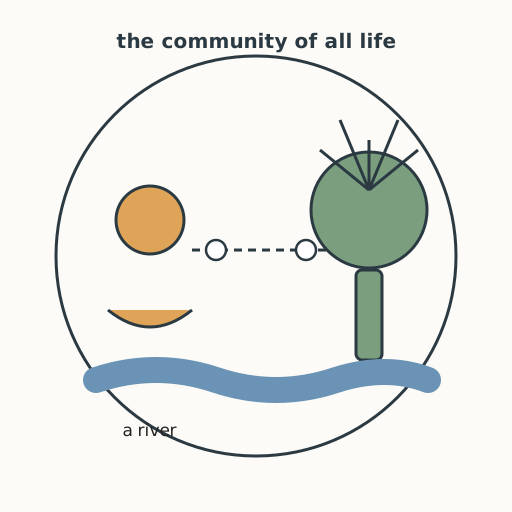
Lesson 7 — Dignity for the More-Than-Human
Summary
Learners extend empathy beyond humans to the more-than-human world, and act on it by planning a concrete act of dignity for a real living being or place near them. They meet the idea of intrinsic value and reciprocity, study documented acts of ecological care (the Chipko tree-huggers, the Green Belt Movement), and design one small, local action they can actually take.
Objectives
- Act on empathy to reduce suffering and promote dignity for the more-than-human world, planning a concrete local act of care. (D02.S2.12.02)
Connection
The empathy you have been practicing does not have to stop at the edge of the human. A river carries life downstream; a tree shades a street for a century; a soil holds the world’s quietest work. People across the world have acted on that — villagers in the Himalayas embraced trees to stop them being felled, and a movement in Kenya planted millions of trees from a woman’s backyard. This lesson asks what you can do, right where you are, to treat a living thing as worthy of care for its own sake — not only for what it gives you.
Materials
- Dignity-in-action planner
- More-than-human example cards
- Paper and pencil (low-tech)
- Reciprocity and the land page (enriched)
Preparation
- Copy or draw the dignity-in-action planner; prepare the example cards, kept factual.
- Retrieval: from Lesson 6, steelmanning a rival view; from Grade 11 (D02.S2.11.01), empathy for people we have never met. Today we extend empathy past the human line.
- Prepare plain definitions (model once: Kirschner, Sweller & Clark, S-011): the more-than-human world is all living beings and places beyond human persons. Intrinsic value is worth a thing holds for its own sake, not only its use to us. Reciprocity is taking and giving back — the ethic that “all flourishing is mutual” (Kimmerer, S-427). Ecological empathy is empathy turned to the living world.
Facilitator note
This lesson is written to the learner (“you”). The idea to land: the circle of moral concern can extend beyond humans — a tree, a river, an animal can be a subject of care, not only a resource — and empathy, enacted, becomes an act of dignity. The examples are documented: the Chipko movement’s villagers embraced trees to prevent felling (Britannica, S-328); Wangari Maathai’s Green Belt Movement planted over thirty million trees and spread across Africa (S-059). The ethic of reciprocity with the living world is a real, honored tradition — Kimmerer names it in Braiding Sweetgrass (S-427). Hold the claim “the living world deserves care for its own sake” as a value the curriculum affirms, distinct from the fact that many peoples have practiced it.
The ethics lens: is a river’s worth only what it does for us, or does it hold worth on its own — and what follows for how we act? The egalitarianism lens: dignity has been denied to some humans by treating them as less than fully persons; extending the circle to the more-than-human is a widening of the same principle, not a distraction from human justice. The global lens: these are not one culture’s idea — tree-hugging in the Himalayas, tree-planting in Kenya, river-restoration on many continents — different places, one recognition. The environment lens: this is the environment lens made moral — empathy as an ecological force. The technology lens: technology cuts both ways — machines that clear a forest in a day, and tools (mapping, monitoring, organizing) that let distant people defend a river; the question is whose flourishing technology serves. Preview: Lesson 8 maps your own place among nested communities, from family to this whole living world.
Safeguarding: the action is small, local, and optional to share; no one is graded on grandiosity. A learner without easy outdoor access can choose a potted plant, a pet, a street tree, or a place they remember.
Procedure
- Recall (5 min). From Lesson 6: why does a conclusion get stronger by meeting its rivals fairly? Today we meet a rival claim — that the living world is only a resource — and weigh it.
- Meet intrinsic value and reciprocity (10 min). Work a model example (S-011): a tree can be cut for timber (use), or kept as a neighbor that shades, breathes, and lives for its own sake (dignity). Name the two ways of seeing, and the ethic of reciprocity — what we take, we give back (Kimmerer, S-427).
- Study acts of ecological care (10 min). In a group, read the example cards: villagers in the Indian Himalaya embracing trees to stop felling (Chipko, S-328); Wangari Maathai’s Green Belt Movement planting over thirty million trees across Africa (S-059); a community restoring its river. Note what each did.
- Observe one living thing (8 min). If possible, go and observe one nearby living being or place for five minutes. Otherwise, bring one to mind. Notice what it needs and what harms it.
- Plan one act of dignity (12 min). In the planner, name the being or place, what harms it, and one concrete act of dignity you can actually do this week — feed, clean, plant, protect, speak for (or write, sign, or campaign for), or simply learn about it. Make it real and small.
- Close (5 min). Say (or write, sign, type, or gesture), in one sentence, why treating the living world as worthy of care for its own sake changes what you will do this week.
Differentiation
- Support: Name one living thing and one small way to help it, and take that one step.
- Extension: Research one documented act of ecological care in depth, and write a short account of what made it work — then connect it to your own local action.
- Communication access: Naming and sharing in this lesson can be written, signed, typed, gestured, or AAC; “speaking for” the living world may equally mean writing, signing, or campaigning for it. Learners who are non-speaking, d/Deaf, hard-of-hearing, or AAC users complete every step in their preferred mode.
Assessment
- Formative (self + peer): Can the learner name intrinsic value and reciprocity, describe a documented act of ecological care, and plan one concrete local act of dignity?
- Portfolio artifact (unit): The dignity-in-action planner, kept in the care journal, with a one-sentence note on the first step actually taken.
Home connection
With someone at home, do one small act of care for a living thing or place together — and write one sentence on what you each noticed.
Resources
- On the ethic of reciprocity with the living world (“all flourishing is mutual”): Kimmerer, Braiding Sweetgrass (S-427).
- On the Chipko movement (villagers embracing trees to stop felling): Encyclopaedia Britannica, “Chipko movement” (S-328).
- On the Green Belt Movement (over thirty million trees; Nobel Peace Prize 2004): Nobel Prize, Wangari Maathai (S-059).
- On worked examples for a new skill: Kirschner, Sweller & Clark (2006) (S-011); on spaced retrieval: Dunlosky et al. (2013) (S-039).