Lesson 08 — My Place in the Nest
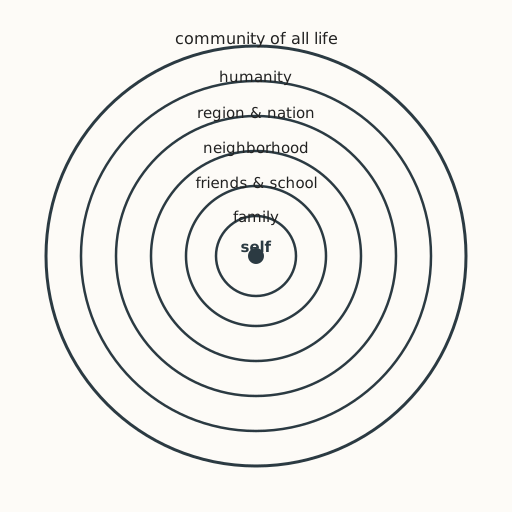
Learners articulate their own place within nested communities, from family to the global community of all life. They draw a concentric map and name one real belonging in each ring — noticing the rings they usually forget, how online communities cut across the rings, and how the outermost ring includes the whole living Earth.
Objectives
Objectives
- D02.S3.12.01 Articulate their own place within nested communities, from family to the global community of all life.
Essential question
Where am I, actually, within the nested communities I belong to — from family to the global community of all life?
Key vocabulary
Materials
Standard materials
- Nested-communities map · 1 per learner Concentric rings — self, family, friends/school, neighborhood, region/nation, humanity, the global community of all life — with space to name one real belonging in each
- Care journal · 1 per learner The unit-long notebook for reflections and capstone portfolio artifacts
Low-tech / no-cost
- Paper and pencil To draw the concentric rings by hand and write one belonging in each
- Voice and body (or pen, screen, or hands) Name each ring as you draw it — aloud, in writing, or in sign — so no printed map is needed
Enriched / lab & device
- One plain-language page on nested and imagined communities · 1 per pair A page on communities from family to humanity, including "imagined communities" whose members will never all meet
Works in different contexts
- large-group Draw the rings whole-class, then each learner fills their own and shares one ring they had not noticed before
- multi-age Younger learners name the innermost rings (family, friends); older learners fill every ring and weigh where the outer ring — all life — begins to pull on them
- self-directed A learner draws the rings alone, names one belonging in each, and writes one sentence on which ring they usually forget
- level-grouped A ready group also maps how two of their rings overlap (e.g., an online community that spans nations) and what that changes
- outdoor-only Stand in the center and pace out the rings on the ground — self, family, school, nation, all life — stepping to each as you name it, aloud or by writing/signing at each stop
Lesson 8 — My Place in the Nest
Summary
Learners articulate their own place within nested communities, from family to the global community of all life. They draw a concentric map and name one real belonging in each ring — noticing the rings they usually forget, how online communities cut across the rings, and how the outermost ring includes the whole living Earth.
Objectives
- Articulate one’s own place within nested communities, from family to the global community of all life. (D02.S3.12.01)
Connection
You belong to more than one “we.” There is the “we” of your household, the “we” of your friends and your school, the “we” of your neighborhood and your region and your country — and behind all of them, the quiet “we” of humanity, and the even larger “we” of every living thing that shares this planet. Each is a ring in a nest, and you sit at the center of your own. Naming each ring — including the ones you usually forget — is how you locate yourself, because you cannot act well in a community you cannot see.
Materials
- Nested-communities map
- Care journal
- Paper and pencil (low-tech)
- Nested and imagined communities page (enriched)
Preparation
- Copy or draw the nested-communities map.
- Retrieval: from Grade 3 (D02.S3.03.01), comparing one’s community with another’s; from Grade 10 (D02.S3.10.02), how local connects to global. Today we draw the whole nest.
- Prepare plain definitions (model once: Kirschner, Sweller & Clark, S-011): a nested community is a set of belonging rings, each holding the smaller ones. Some outer rings are imagined communities — groups whose members will never all meet, yet hold a shared sense of “we” (Anderson, S-415). The outermost ring is the biosphere, the community of all life.
Facilitator note
This lesson is written to the learner (“you”). The idea to land: I am located inside nested communities, and the outermost ring — the community of all life — is not metaphorical; it is where my belonging actually ends. The concept of the imagined community (a nation whose members never meet, Anderson, S-415) is a real, well-established idea; hold it as description, not as a claim that nations are unreal. Naming one’s rings is a descriptive map, not a ranking of which belonging matters most.
The ethics lens: each ring carries a different “we” with different obligations — and the outermost ring quietly obliges me to all life, not only my own. The egalitarianism lens: belonging is uneven — some people are pushed to the margins of rings, some are told they do not belong at all; noticing that is part of mapping honestly. The global lens: the rings are not the same everywhere — in one place “region” is a valley, in another a language group, in another a diaspora — the map adapts, the nesting does not. The technology lens: online communities cut across the rings — a group of people on three continents who never meet, yet feel “we” — a new kind of imagined community made possible by networks (Britannica, S-481; Anderson’s frame applied to the digital age). The environment lens: the outermost ring is the living Earth itself — soil, water, atmosphere, and every species — and it is the one ring every other ring depends on. Preview: Lesson 9 asks who is included in a ring and who is left out.
Safeguarding: learners name their rings at whatever depth they choose; no one is required to name a family, a nation, or any identity they do not wish to claim.
Procedure
- Recall (5 min). From Lesson 7: the community of all life. Today we locate ourselves inside it.
- Meet nested communities (10 min). Work a model example (S-011): a student in a coastal city — their rings are themselves, their household, their friends and school, their neighborhood, their city and country, humanity, and all life. Name the rings and the idea that some outer rings are imagined communities (Anderson, S-415): you will never meet most of your country, yet you share a “we.”
- Draw your own nest (15 min). In your care journal, draw the concentric rings and name one real belonging in each — a person, a group, a place, a species, an ecosystem. Notice which rings you had to think hard about.
- Find the forgotten ring (8 min). Which ring do you usually forget — the region? humanity? the living world? Write one sentence on why it is easy to forget, and one on what it would mean to remember it.
- Map a crossing community (8 min). Is there a community you belong to that cuts across the rings — an online group, a faith, a movement, a diaspora? Draw it as a line crossing the rings, and note what changes when belonging is not nested but woven.
- Close (4 min). Say (or write, sign, type, or gesture), in one sentence, where you are — from the innermost ring to the outermost.
Differentiation
- Support: Name three inner rings (self, family, friends) and one outer ring (all life) with one word each.
- Extension: Write a paragraph on how one ring’s claims can conflict with another’s (family vs. nation vs. all life), and how you would begin to weigh them.
- Communication access: Naming the rings is a written (or signed, typed, gestured, or AAC) task here, not a spoken one; the map itself is the answer. Learners who are non-speaking, d/Deaf, hard-of-hearing, or AAC users complete every step in their preferred mode.
Assessment
- Formative (peer + self): Can the learner draw the nested rings, name one real belonging in each, and identify which ring they usually forget and why?
- Portfolio artifact (unit): The nested-communities map, in the care journal.
Home connection
Ask someone at home which “ring” they think of themselves as belonging to first. Write one sentence on whether their answer surprised you.
Resources
- On imagined communities (a nation’s members never all meet, yet share “we”): Benedict Anderson, Imagined Communities (S-415).
- On online communities as a new, network-made form of belonging: Encyclopaedia Britannica, “Social media” (S-481).
- On worked examples for a new mapping skill: Kirschner, Sweller & Clark (2006) (S-011); on spaced retrieval: Dunlosky et al. (2013) (S-039).