Lesson 09 — Who's In, Who's Out, and Why
Learners analyze how belonging draws a line between "us" and "them" — often unintentionally — and weigh loyalty to the in-group against obligation to those left outside. They meet the minimal-group finding that even arbitrary groups trigger in-group favoritism, analyze real cases of inclusion and exclusion, and argue how the line could be redrawn.
Objectives
Objectives
- D02.S3.12.02 Weigh belonging, solidarity, and collective responsibility in deciding how to act for the common good.
Essential question
How does belonging draw a line between "us" and "them" — and how do I weigh my loyalty to the in-group against my obligation to those left outside it?
Key vocabulary
Materials
Standard materials
- Belonging-line organizer · 1 per learner A line with 'us' at one end and 'them' at the other, with space to name who a community draws in, who it leaves out, and what the line costs
- Community case cards · 1 set per group Cases where belonging draws a line — a nation's border, a club's membership, an online group's gatekeeping — described factually
Low-tech / no-cost
- Paper and pencil To draw the line and write who is in and who is out
- Voice and body (or pen, screen, or hands) Stand on one side of a real line and argue it from each side — aloud, in writing, or in sign — so no printed cards are needed
Enriched / lab & device
- One plain-language page on in-group and out-group · 1 per pair A page on the minimal-group finding — that even arbitrary groups trigger in-group favoritism — and what that means for belonging"
Works in different contexts
- large-group Draw one case's line whole-class, then groups each analyze a different case and report who pays the cost of the line
- multi-age Younger learners name one group they belong to and one person that group leaves out; older learners weigh loyalty against obligation and argue the line's fairness
- self-directed A learner takes one case, fills the organizer alone, and writes one sentence on what the line costs and who pays it
- level-grouped A ready group also tests whether their own "we" has a line they had not noticed, and argues how the line could be redrawn
- outdoor-only Draw a real line on the ground; have some stand in, some out; then argue from each side (aloud, in writing, or in sign) and name what the line costs
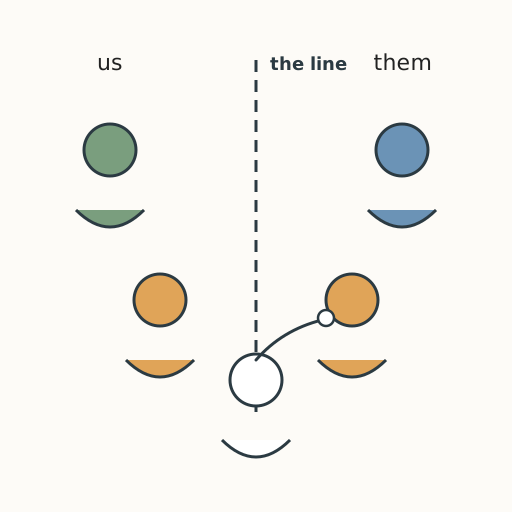
Lesson 9 — Who’s In, Who’s Out, and Why
Summary
Learners analyze how belonging draws a line between “us” and “them” — often unintentionally — and weigh loyalty to the in-group against obligation to those left outside. They meet the minimal-group finding that even arbitrary groups trigger in-group favoritism, analyze real cases of inclusion and exclusion, and argue how the line could be redrawn.
Objectives
- Weigh belonging, loyalty, and collective responsibility, analyzing who a community draws in and who it leaves out. (D02.S3.12.02)
Connection
Every “we” has an edge. A nation has a border; a club has a membership; even a friend group has an inside and an outside. Often the line is drawn without anyone deciding to be cruel — it just forms, and people on the far side of it quietly pay a cost. Research found something striking: even when people are sorted into groups by nothing — a coin flip, a made-up label — they start favoring their own group within minutes. That means the “us/them” line is not only built by bad intentions; it is built by habit. Naming the line — and who pays it — is the first step toward drawing it more fairly.
Materials
- Belonging-line organizer
- Community case cards
- Paper and pencil (low-tech)
- In-group and out-group page (enriched)
Preparation
- Copy or draw the belonging-line organizer; prepare the case cards, kept factual.
- Retrieval: from Lesson 8, the nested rings; from Grade 6 (D02.S3.06.01), how belonging can include and exclude. Today we weigh the line.
- Prepare plain definitions (model once: Kirschner, Sweller & Clark, S-011): an in-group is the “us”; an out-group is the “them.” In-group favoritism is the tendency to favor our own group even when the group is arbitrary — the minimal-group finding (Tajfel, S-232). Solidarity and collective responsibility are the question: what do I owe the people my “we” leaves out?
Facilitator note
This lesson is written to the learner (“you”). The idea to land: belonging has a line, often drawn by habit rather than malice, and maturity means seeing the line and weighing loyalty against obligation to those outside it. The minimal-group finding is real and well replicated (Tajfel, S-232); hold it as description of how minds work, not as a claim that groups are bad or that belonging is wrong. Belonging is a human good; the question is whose belonging is paid for by whose exclusion.
The ethics lens: loyalty to “us” is a real value — and so is the claim of the person standing outside the line; ethics is the weighing. The egalitarianism lens: the line is not neutral — it is drawn by the powerful and paid by the excluded; noticing who draws and who pays is the egalitarian move. The global lens: every human group draws lines differently — by kinship, language, faith, place, or state — and no single way is the default. The technology lens: online communities draw lines too — algorithmic sorting, moderation, and gatekeeping can make an “us” feel seamless while quietly excluding people whose access, language, or ability differs (World Bank digital divide, S-281; Britannica, S-481). The critical-thinking lens: ask who drew this line, when, and for what purpose before you accept it as natural. Preview: Lesson 10 turns the weighing into a decision about solidarity and the common good.
Safeguarding: cases are about groups, never a learner’s identity; no one is asked to defend exclusion of a group they or their loved ones belong to.
Procedure
- Recall (5 min). From Lesson 8: your nested rings. Today we look at the edges of a ring — where “we” stops.
- Meet the minimal-group finding (10 min). Work a model example (S-011): people sorted into two arbitrary groups — by a coin flip — soon favor their own group in small choices (Tajfel, S-232). Name the takeaway: the us/them line forms by habit, not only by cruelty.
- Analyze a real line (15 min). In a group, take a case card. On the organizer, name who the community draws in, who it leaves out, and what the line costs — in dignity, access, or opportunity — and who pays it.
- Weigh loyalty against obligation (12 min). Argue — aloud or in writing: what does this “we” owe the people outside its line — nothing, something, or a great deal? Use one example from the case, and be ready to say where the obligation ends and why.
- Redraw the line (8 min). In your care journal, draw the line as it is, then draw it as it could be — wider, lower, or gone — and write one sentence on what the change would cost and what it would buy.
- Close (4 min). Say (or write, sign, type, or gesture) why seeing the line is different from pretending it is not there — and which one lets you draw it more fairly.
Differentiation
- Support: Name one “we” and one person it leaves out, and one thing the “we” could do to include them.
- Extension: Investigate one real community that redrew its line (a country, a club, a platform), and write a short account of who gained and who lost.
- Communication access: Arguing from each side of the line can be spoken, written, signed, typed, gestured, or AAC; a written or signed position is complete. Learners who are non-speaking, d/Deaf, hard-of-hearing, or AAC users complete every step in their preferred mode.
Assessment
- Formative (peer + self): Can the learner name in-group/out-group and the minimal finding, analyze who a real community includes and excludes, and weigh loyalty against obligation with reasons?
- Portfolio artifact (unit): The belonging-line organizer with the redrawn line, in the care journal.
Home connection
Notice one “we” in your own life — a team, a friend group, a household — and ask who sits at its edge. Write one sentence on what you noticed and one on what could change.
Resources
- On the minimal-group finding and in-group favoritism: Tajfel (1970/1971) (S-232).
- On the digital divide and online gatekeeping: World Bank, World Development Report 2016: Digital Dividends (S-281); Encyclopaedia Britannica, “Social media” (S-481).
- On worked examples for a new analytical skill: Kirschner, Sweller & Clark (2006) (S-011); on spaced retrieval: Dunlosky et al. (2013) (S-039).