Lesson 03 — Clarity, Care, and Integrity in Public Speech
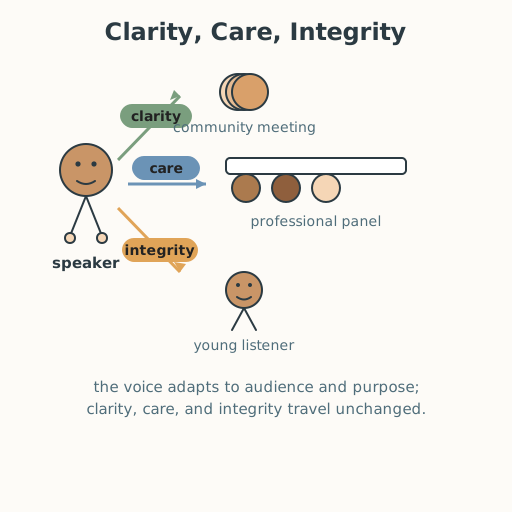
Learners plan and deliver one message adapted to different audiences and purposes, naming the three commitments that travel unchanged — clarity, care, and integrity — and the register shifts that must change. They learn that adapting a voice is not losing a self, but that adaptation without integrity becomes manipulation.
Objectives
Objectives
- D04.S1.12.02 Speak with clarity, care, and integrity in public and professional settings, adapting to diverse audiences and purposes.
Essential question
How do I speak with clarity, care, and integrity, adapting my voice to different audiences and purposes without becoming someone else?
Key vocabulary
Materials
Standard materials
- Audience-and-purpose map · 1 per learner A two-axis organizer — audience (who) by purpose (what for) — to plan one message said several ways
- Deliberation journal · 1 per learner Continuing the unit-long log
Low-tech / no-cost
- Paper and pencil To draw the audience-and-purpose map by hand
- Speaking slips One message and several settings (a village meeting, a job interview, a radio announcement, a text to a younger sibling) to adapt the same idea to
Enriched / lab & device
- One short recorded speech · 1 per group A public or professional address in any language, to analyze for clarity, care, and integrity — and for where adaptation crossed into distortion
Works in different contexts
- large-group Have three learners deliver the same message adapted to three different audiences — aloud, or in writing, sign, or AAC — and the class names what changed and why
- multi-age Younger learners say — or write, sign, or type — the same idea to a friend and to an elder; older learners analyze register shifts and integrity across the two
- self-directed A learner fills the map for one message, then records or writes themselves delivering it to two different audiences and compares
- level-grouped A ready group also debates where "adapting" becomes "misleading," and where the line sits for them
- outdoor-only Deliver the same message — aloud, or in writing, sign, or AAC — across a wide open space (projecting) and up close (conversation), noticing how distance changes delivery
Lesson 3 — Clarity, Care, and Integrity in Public Speech
Summary
Learners plan and deliver one message adapted to different audiences and purposes, naming three commitments that travel unchanged — clarity, care, and integrity — and the register shifts that must change. Adapting a voice is not losing a self; but adaptation without integrity becomes manipulation, and this lesson draws that line.
Objectives
- Speak with clarity, care, and integrity, adapting register, formality, and delivery to different audiences and purposes. (D04.S1.12.02)
Connection
You already do this daily: you do not tell a younger sibling what you tell an employer, and you do not speak to a room the way you speak to one friend. That shifting is not fakeness — it is register, the way any skilled speaker tunes voice to audience and purpose. The danger is not that the voice changes; it is that something in the message changes in order to please or to win. The skill is to hold three things steady — say it clearly, say it with care for the people it affects, and say what you actually believe — while everything else about the delivery adapts.
Materials
- Audience-and-purpose map
- Deliberation journal
- Speaking slips (low-tech: paper)
Preparation
- Copy or draw the audience-and-purpose map; prepare the speaking slips.
- Retrieval: from Lesson 2, the parts of a reasoned position; from Grade 11 (D04.S1.11.02), a persuasive speech that anticipates counterarguments. Today we add the capstone turn: adaptation with integrity (worked example first: Kirschner, Sweller & Clark, S-011).
- Prepare a plain definition: register is the level and style of language a setting calls for (formal to informal, technical to everyday); delivery is how the voice and body carry it. The classical Greek tradition named three means of persuasion — character (ethos), emotion (pathos), and argument (logos) (Aristotle, S-346) — as one tradition among many.
Facilitator note
This lesson is written to the learner (“you”). The idea to land, held as description: public speech is a craft — word choice, tone, and delivery are analyzed and practiced — and one ancient tradition named three appeals (ethos, pathos, logos) as the means of persuasion (Aristotle, S-346). Hold that tradition as one among many: other cultures have their own arts of public speaking, and no single one is the default. The lesson’s three commitments — clarity, care, integrity — are values, not facts; the craft of register-shifting is a describable skill.
The ethics lens: integrity is the line between adapting a message and distorting it; care asks who is affected by what we say. The egalitarianism lens: public speech is not reserved for the fluent or the formally educated — clarity is a form of respect for every listener, including those for whom the language is not their first. The global lens: what counts as respectful or persuasive delivery differs across cultures (eye contact, volume, directness), so no single style is the default. The technology lens: a microphone, a recording, a livestream all amplify — they carry one voice to many, and they change how care and integrity must be exercised because the audience can no longer be seen. The environment lens: use an environmental announcement as one purpose (a warning, a stewardship appeal) so speech is practiced on questions where clarity can matter for safety and for the living world. The critical-thinking lens: ask of any speaker, “what is being said clearly, and what is being smoothed over?” Preview: Lesson 4 turns from speaking to reading across registers.
Procedure
- Recall (5 min). From Lesson 2: what parts hold a reasoned position together? A speech is that position, delivered — today we work on the delivery and its limits.
- Meet register (10 min). Work a model example first (S-011): one message — a dangerous storm is coming; fill water now — said three ways: to a village meeting (loud, direct, repeated), to a professional briefing (calm, technical, cited), and to a young child (gentle, concrete, reassuring). Name what changed (register, delivery) and what did not (clarity, care, integrity).
- Map one message (12 min). With a partner, take a speaking slip and fill the audience-and-purpose map: the same core message adapted to three audiences and three purposes. Write the one sentence that stays true in every version.
- Deliver and listen (12 min). Each partner delivers one version — aloud, or in writing, sign, typing, or AAC — and the other receives it in their preferred mode. The other checks it against the three commitments: Is it clear? Is it careful about who it affects? Does it say what you actually believe?
- Draw the line (8 min). Discuss: at what point does adapting become misleading? Write one sentence stating where the line sits for you, and why.
- Close (5 min). Say — or write, sign, type, or use AAC for — in one sentence, what changes when you adapt a voice, and what must never change.
Differentiation
- Support: Adapt the message to only two audiences and check it against one commitment (clarity) before adding the others.
- Extension: Analyze a recorded public address for where adaptation served the audience and where it served the speaker’s own interest instead.
- Communication access: “Delivering” a message here means conveying it — aloud, in writing, in sign, or via AAC. Learners who are non-speaking, d/Deaf, hard-of-hearing, or who use AAC plan, adapt, and deliver in their preferred mode, and receive partners’ versions in written or signed form. The performance assessment is the adaptation and its integrity — not the voice that carries it.
Assessment
- Formative (peer + self + performance): Can the learner adapt one message across audiences and purposes while keeping it clear, careful, and honest — and name the line where adaptation becomes distortion? The performance may be delivered aloud, in writing, in sign, or via AAC; what is assessed is the adaptation and its integrity, not the voice that carries it.
- Portfolio artifact (unit): The completed audience-and-purpose map with the one-sentence “unchanging core,” filed in the deliberation journal.
Home connection
Tell — or write to, sign to, or type to — someone at home about this lesson and ask how they change the way they speak to different people. Write one sentence about what they change and one about what they keep the same.
Resources
- On word choice, tone, and delivery as persuasive craft (one classical tradition among many): Aristotle, Rhetoric (S-346).
- On the argument structure a speech carries: Toulmin, The Uses of Argument (S-236).
- On worked examples for a new skill: Kirschner, Sweller & Clark (2006) (S-011); on feedback as a strong influence on learning: Hattie, Visible Learning (S-012).