Lesson 04 — Reading Across Registers
Learners read one idea expressed in three registers — scholarly, technical, and literary — and name what each register is *for*, how each is *structured*, and what each *asks of a reader*. They begin the unit's reading strand by learning to shift lenses, so that a scholarly claim, a technical procedure, and a literary image are each read on their own terms and then held together.
Objectives
Objectives
- D04.S2.12.01 Read, evaluate, and integrate scholarly, technical, and literary texts across registers and disciplines.
Essential question
How do I read scholarly, technical, and literary texts with the right lens for each — and for the same idea across all three?
Key vocabulary
Materials
Standard materials
- Three-register reading organizer · 1 per learner A three-column organizer — scholarly, technical, literary — with rows for purpose, structure, evidence, and what each asks of the reader
- Deliberation journal · 1 per learner Continuing the unit-long log
Low-tech / no-cost
- Paper and pencil To draw the three-register organizer by hand
- Short text trio One idea (water scarcity, a disease outbreak, a migration) written three ways: a paragraph of scholarship, a set of technical instructions or a data table, and a poem or story
Enriched / lab & device
- One real scholarly, technical, and literary excerpt on the same topic · 1 per group Three authentic passages in any language, to compare register against register
Works in different contexts
- large-group Read the three passages aloud in three voices — or read them silently, listen to them read back, or hear them via text-to-speech — then fill the organizer whole-class
- multi-age Younger learners match each passage to its register; older learners analyze what each register makes easy and hard to understand
- self-directed A learner reads the trio, fills the organizer, and writes one sentence on what each register asks of a reader
- level-grouped A ready group also evaluates each passage's evidence and notes what is asserted versus shown
- outdoor-only Post the three passages in three places; learners move from station to station, gathering what each register makes visible
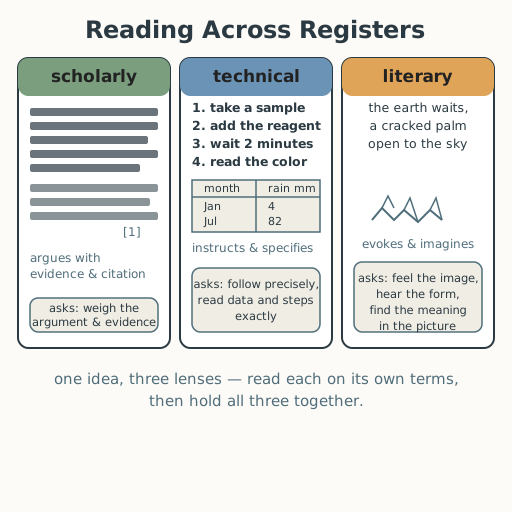
Lesson 4 — Reading Across Registers
Summary
Learners read one idea expressed in three registers — scholarly, technical, and literary — and name what each register is for, how each is structured, and what each asks of a reader. They learn to shift lenses so that a scholarly claim, a technical procedure, and a literary image are each read on their own terms, then held together as one fuller understanding.
Objectives
- Read, evaluate, and integrate scholarly, technical, and literary texts by recognizing each register’s purpose, structure, and demands. (D04.S2.12.01)
Connection
The same truth arrives in different clothes. “Water is scarce here” can come as a scholar’s measured claim with citations, as a technician’s steps for testing a well and a table of rainfall, and as a poet’s image of cracked earth waiting. If you read all three the same way — hunting only for a fact, or only for a feeling — you misread at least one of them. Mature reading is knowing which lens each register calls for, and then holding all three together to understand the thing fully.
Materials
- Three-register reading organizer
- Deliberation journal
- Short text trio (low-tech: paper)
Preparation
- Copy or draw the three-register organizer; prepare the short text trio.
- Retrieval: from Grade 11 (D04.S2.11.01), comparing texts across languages and translations; from Grade 10 (D04.S2.10.02), reading extended complex texts. Today we add the capstone turn: registers across disciplines (worked example first: Kirschner, Sweller & Clark, S-011).
- Prepare a plain definition: a register is a variety of language tied to a setting and purpose — here scholarly (argues with evidence and citation), technical (instructs or specifies with precision), and literary (evokes and imagines through form and image). Explicit comprehension-strategy and text-structure instruction is evidence-supported for adolescent readers (IES, S-170; Duke & Pearson, S-172).
Facilitator note
This lesson is written to the learner (“you”). The idea to land, held as description: texts differ by register, and reading each on its own terms — recognizing its structure and purpose — is a teachable, evidence-supported comprehension skill (IES, S-170; Duke & Pearson, S-172). The three registers here are one useful map, not the only one; other traditions sort texts differently, and no single culture’s categories are the default. Emphasize that a learner may meet all three registers in any language — their home language first.
The ethics lens: reading a text on its own terms, rather than forcing it into the reader’s, is a form of fairness to the author. The egalitarianism lens: scholarly registers can exclude by jargon; a mature reader notices who a register lets in and who it shuts out. The global lens: what counts as “scholarly” or “literary” differs across cultures and times — none is the default. The technology lens: the technical register is the language of manuals, specifications, and interfaces — the written form of technology itself — and reading it is a technical skill. The environment lens: use an environmental idea (water, disease, migration) as the shared topic, so the three registers are practiced on questions where the living world is at stake. The critical-thinking lens: for each register ask “what is asserted, what is shown, and what is left out?” Preview: Lesson 5 integrates several such texts into one position.
Procedure
- Recall (5 min). From Lesson 3: what stays the same when a speaker adapts their voice? Reading has registers too — today we name and shift among three.
- Meet the three registers (10 min). Work a model example first (S-011). Read three short passages on one idea — water scarcity. Name each: scholarly (a claim with evidence and a citation), technical (steps to test a well, a rainfall table), and literary (a two-line image of cracked earth). For each, say — or write, sign, type, or use AAC for — its purpose, its structure, and what it asks of you as a reader.
- Read the trio (15 min). With a partner, read your own text trio on one idea and fill the organizer: for each register, the purpose, structure, evidence, and the reader’s task.
- Compare the lenses (10 min). Discuss — aloud, or in writing, sign, typing, or AAC: what did the technical register make visible that the poem hid, and the reverse? Write one sentence on what you understand about the idea only because you read all three.
- Name the demand (8 min). For one register, write what a reader must do to read it well — and what a reader who lacks that skill would miss or misunderstand.
- Close (5 min). Say — or write, sign, type, or use AAC for — why “reading” is not one skill but several, and which register you find hardest and why.
Differentiation
- Support: Match each passage to its register and name one purpose each, leaving comparison for later.
- Extension: Bring one authentic scholarly, technical, and literary excerpt on the same topic (any language) and analyze the register of each in depth.
- Communication access: Every spoken step — saying, discussing, or closing aloud — can be completed in writing, signing, typing, or AAC instead. Learners who are non-speaking, d/Deaf, hard-of-hearing, or who use AAC read and respond in their preferred mode; no step requires producing or hearing sound.
- Reading access (dyslexia, low-vision, decoding difficulty): Reading may be done by listening — a partner or screen reader reads a passage, or the learner uses text-to-speech where a device exists — with the same texts available in the learner’s home script or as audio when possible (low-tech fallback: a peer or facilitator reads aloud, or the text is traced finger-by-finger and heard syllable by syllable). Spelling and decoding difficulty is distinct from comprehension and thinking: a learner who decodes slowly may fully understand and evaluate a register, and no “correct penmanship” or standard spelling is required — what is assessed is understanding of each register, not the letter forms.
Assessment
- Formative (peer + self): Can the learner name the three registers, state each one’s purpose and structure, and describe what each asks of a reader?
- Portfolio artifact (unit): The completed three-register organizer, filed in the deliberation journal.
Home connection
Find three things at home about the same topic — a label or manual (technical), a story or song (literary), and something informative (scholarly). Name which is which and what each is for, in one line each.
Resources
- On explicit comprehension-strategy and text-structure instruction for adolescents: IES practice guide, Improving Adolescent Literacy (S-170); Duke & Pearson (2002) (S-172).
- On the reading components this builds on: National Reading Panel (2000) (S-040).
- On worked examples for a new analytical skill: Kirschner, Sweller & Clark (2006) (S-011); on retrieval and spacing: Dunlosky et al. (2013) (S-039).