Lesson 05 — Integrating Texts Across Disciplines
Learners build a synthesis matrix — sources as rows, key questions as columns — and weave several texts from different disciplines and registers into one supported position. They learn to corroborate across sources, to name where sources agree and disagree, and to notice whose voice is missing, so that integration is honest rather than a mere stack of quotations.
Objectives
Objectives
- D04.S2.12.01 Read, evaluate, and integrate scholarly, technical, and literary texts across registers and disciplines.
Essential question
How do I weave several texts — from different disciplines and registers — into one supported position without letting any one voice drown out the others?
Key vocabulary
Materials
Standard materials
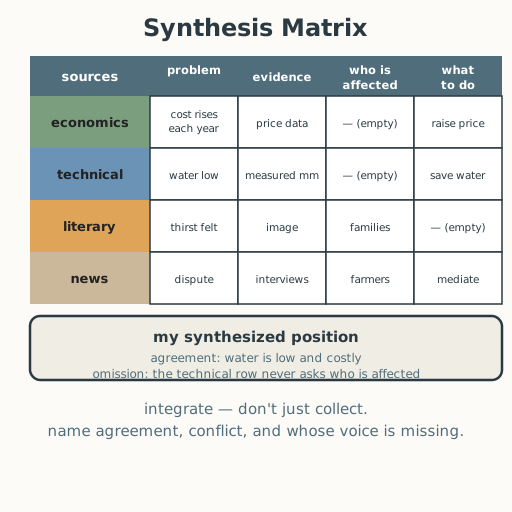
- Synthesis matrix · 1 per learner A grid — sources as rows, key questions or themes as columns — with a final row for the learner's own synthesized position
- Deliberation journal · 1 per learner Continuing the unit-long log
Low-tech / no-cost
- Paper and pencil To draw the synthesis matrix by hand
- Source card set Four to six short source excerpts on one contested issue from different disciplines (an economic note, a technical measurement, a literary account, a news report), each labeled with its author and purpose
Enriched / lab & device
- One digital search exercise · 1 per group Locate two additional sources on the same issue and add them to the matrix, noting where they agree and disagree with the existing set
Works in different contexts
- large-group Build the matrix on a large board, each pair contributing one source's row, then synthesize the position together
- multi-age Younger learners sort sources by discipline; older learners fill the matrix and write the synthesized position
- self-directed A learner fills the matrix alone and writes a two-sentence synthesis that names agreement, disagreement, and what is missing
- level-grouped A ready group also flags which source is missing (whose perspective is absent) and how that omission shapes the position
- outdoor-only Lay source cards on the ground in discipline clusters, then physically gather from each cluster into one shared "position" circle
Lesson 5 — Integrating Texts Across Disciplines
Summary
Learners build a synthesis matrix — sources as rows, key questions as columns — and weave several texts from different disciplines and registers into one supported position. They learn to corroborate across sources, name where sources agree and disagree, and notice whose voice is missing, so that integration is honest rather than a stack of quotations.
Objectives
- Integrate several scholarly, technical, and literary texts across disciplines into one supported position, corroborating evidence and noting omission. (D04.S2.12.01)
Connection
Any real question is answered by more than one kind of text: an economist counts the cost, a technician measures the water, a poet names what the drought feels like, and a reporter asks who is affected. Read alone, each is partial — true but thin. The mature reader does not just read them all; she integrates them, noticing where they reinforce each other, where they conflict, and whose voice never made it onto the page. That integration is the difference between collecting quotes and understanding.
Materials
- Synthesis matrix
- Deliberation journal
- Source card set (low-tech: paper)
Preparation
- Copy or draw the synthesis matrix; prepare the source card set.
- Retrieval: from Lesson 4, the three registers and what each asks of a reader. Today we add the capstone turn: integration across disciplines (worked example first: Kirschner, Sweller & Clark, S-011).
- Prepare a plain definition: synthesis is combining sources into a new, supported position; corroboration is checking one source against another; omission is what a set of sources leaves out. Source evaluation — asking who created a text and with what purpose — is a core media- and information-literacy habit (UNESCO MIL, S-217; Center for News Literacy, S-278; Common Sense Education, S-063).
Facilitator note
This lesson is written to the learner (“you”). The idea to land, held as description: integrating across texts is a teachable comprehension-and-synthesis skill (IES, S-170; Duke & Pearson, S-172), and honest integration requires asking where each source comes from and what it is for (UNESCO MIL, S-217; Center for News Literacy, S-278; Common Sense Education, S-063). Hold “weigh evidence from many sources” as a method, while “every voice deserves to be heard” is a value — the two are distinct and both matter.
The ethics lens: fair integration means not letting the loudest or most convenient source drown out the others, and naming your own position as yours. The egalitarianism lens: ask whose voice is missing from the source set — often the people most affected — and whether a “complete” picture can be built without them. The global lens: sources come from specific places and positions; a source set that draws from only one region or one tradition is not neutral. The technology lens: search engines and databases shape which sources you find, so the tool itself influences the synthesis — notice that. The environment lens: use a contested environmental issue (a dam, a forest road, a drought) as the shared question, so integration is practiced where ecological and human evidence must be weighed together. The critical-thinking lens: a synthesis matrix is a machine for spotting agreement, conflict, and absence rather than for smoothing them over. Preview: Lesson 6 turns from integrating texts to how writing systems themselves encode meaning.
Procedure
- Recall (5 min). From Lesson 4: what does each register — scholarly, technical, literary — ask of a reader? Today we hold several such texts together.
- Meet the matrix (10 min). Work a model example first (S-011). Lay out a small matrix: sources as rows (an economic note, a technical measurement, a literary account, a news report), key questions as columns (what is the problem, what is the evidence, who is affected, what should be done). Fill one row together, naming how each source answers each question — or stays silent on it.
- Fill the matrix (15 min). With a partner, read — or listen to read back, or hear via text-to-speech — the source card set and fill your matrix. Mark cells where sources agree, where they conflict, and where a cell is empty because no source speaks.
- Notice the omission (8 min). Look at the empty cells and the missing rows. Write one sentence naming whose voice or what kind of evidence is absent, and how that shapes the picture.
- Synthesize (10 min). Write a two-to-three-sentence synthesized position that names the agreement, the conflict, and the omission — and states your own position as “my position,” not “the facts.”
- Close (5 min). Say — or write, sign, type, or use AAC for — in one sentence, the difference between collecting sources and integrating them.
Differentiation
- Support: Use only three sources and two questions, and write one sentence of synthesis that names agreement alone.
- Extension: Add two digital sources to the matrix and revise the synthesis to account for what they add or contradict.
- Communication access: Every spoken step — discussing, naming, or closing aloud — can be completed in writing, signing, typing, or AAC instead. Learners who are non-speaking, d/Deaf, hard-of-hearing, or who use AAC read, sort, and synthesize in their preferred mode; no step requires producing or hearing sound.
- Reading access (dyslexia, low-vision, decoding difficulty): Sources may be read by listening — a partner or screen reader reads them, or the learner uses text-to-speech where a device exists — with sources available in the learner’s home script or as audio when possible (low-tech fallback: a peer or facilitator reads aloud, or the text is traced finger-by-finger). Spelling and decoding difficulty is distinct from comprehension and thinking: a learner who decodes slowly may still weigh, compare, and synthesize sources fully, and no “correct penmanship” or standard spelling is required — what is assessed is the synthesis and the noticing of omission, not the letter forms.
Assessment
- Formative (peer + self): Can the learner fill a synthesis matrix, name agreement, conflict, and omission, and state a synthesized position marked as their own?
- Portfolio artifact (unit): The completed synthesis matrix and the synthesized position, filed in the deliberation journal.
Home connection
Ask two people at home the same question and notice where they agree, where they conflict, and what neither mentions. Write one line for each of the three.
Resources
- On comprehension and synthesis across texts: IES practice guide, Improving Adolescent Literacy (S-170); Duke & Pearson (2002) (S-172).
- On evaluating where a source comes from and what it is for: UNESCO Media and Information Literacy (S-217); Center for News Literacy (S-278); Common Sense Education (S-063).
- On worked examples for a new skill: Kirschner, Sweller & Clark (2006) (S-011); on retrieval and spacing: Dunlosky et al. (2013) (S-039).