Lesson 06 — How Writing Systems Encode Meaning
Learners sort four ways writing encodes language — alphabet, abjad, abugida, and character script — and learn, with live examples from real scripts, how each maps marks to sound and meaning differently. They reason that no writing system is "better" or more "logical" than another; each is a different, complete solution to the same problem of holding spoken language in visible form.
Objectives
Objectives
- D04.S2.12.02 Reason across multiple writing systems and languages, recognizing how each encodes meaning differently.
Essential question
How do different writing systems — alphabets, abjads, abugidas, and character scripts — encode sound and meaning differently, and what does each make easy or hard?
Key vocabulary
Materials
Standard materials
- Writing-systems reference sheet · 1 per learner A four-type chart — alphabet, abjad, abugida, character — with a live example of each and how it encodes sound and meaning
- Deliberation journal · 1 per learner Continuing the unit-long log
Low-tech / no-cost
- Paper and pencil To copy the four writing-system examples by hand, tracing each shape
- Script sample cards A few words each in several scripts (e.g., Devanagari, Arabic, Chinese characters, Greek or Cyrillic) to sort into the four types
Enriched / lab & device
- One Unicode reference · 1 per group A short page on how computers encode different scripts (Unicode), to connect the four types to how they are stored and rendered digitally
Works in different contexts
- large-group Display the four types on the board and have learners sort script samples whole-class, then each trace one script by hand
- multi-age Younger learners match a script sample to its type; older learners explain *how* each type encodes sound versus meaning
- self-directed A learner sorts the script samples and writes one sentence on what each type makes easy and hard for a reader
- level-grouped A ready group also explains why Chinese characters are morphosyllabic (meaning + syllable), not "pictures of ideas" (DeFrancis)
- outdoor-only Trace the four types in sand or soil with a stick, and mark how each shows sound (letters) or meaning (characters)
Lesson 6 — How Writing Systems Encode Meaning
Summary
Learners sort four ways writing encodes language — alphabet, abjad, abugida, and character script — and learn, with live examples from real scripts, how each maps marks to sound and meaning differently. The load-bearing idea: no writing system is “better” or more “logical” than another; each is a different, complete solution to the same problem of holding spoken language in visible form.
Objectives
- Reason across multiple writing systems, recognizing how alphabet, abjad, abugida, and character script each encode sound and meaning differently. (D04.S2.12.02)
Connection
Look at a word you read every day and ask: what does each mark stand for? In some scripts a mark stands for a single sound, and vowels are written out. In others a mark stands for a consonant and vowels ride along invisibly or as small add-ons. In still others a mark stands for a whole syllable and a meaning at once. None of these is the “natural” way — writing was invented more than once, independently, in different places (S-204), and each invention solved the problem its own way. Understanding the options is how you stop thinking of your own script as the default and start seeing all scripts as peers.
Materials
- Writing-systems reference sheet
- Deliberation journal
- Script sample cards (low-tech: paper)
Preparation
- Copy the writing-systems reference sheet; prepare the script sample cards.
- Retrieval: from Grade 11 (D04.S2.11.01), comparing texts across languages and translations; from Grade 5 (D04.S4.05.01), naming that many writing systems exist. Today we add the capstone turn: how each system encodes meaning (worked example first: Kirschner, Sweller & Clark, S-011).
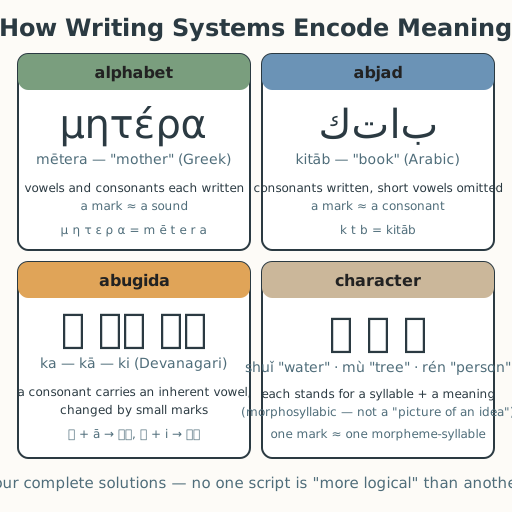
- Prepare the four-type classification from the canonical scholarly reference (Daniels & Bright, S-165): alphabet (vowels and consonants each written), abjad (consonants written, short vowels often omitted), abugida (a consonant with an inherent vowel, modified by diacritics), and character (logographic) script (each character stands for a syllable plus a meaning, i.e., a morpheme — DeFrancis, S-166).
Facilitator note
This lesson is written to the learner (“you”). The idea to land, held as description: the four-type classification — alphabet, abjad, abugida, character — is the canonical scholarly typology (Daniels & Bright, S-165), and Chinese characters are best described as morphosyllabic (each stands for a syllable plus a meaning, a morpheme), not as “pictures of ideas” (DeFrancis, S-166). Writing emerged independently in more than one place (Mesopotamia, Egypt, China, Mesoamerica) (S-204). Guard the value explicitly: the word “abjad” and “abugida” are technical terms coined in one scholarly tradition — use them as a map, not as a ranking. No script is more “logical” than another (a value commitment, distinct from the descriptive typology). Present each example script with care and correctness; learners who read a script natively are experts, not novices.
The ethics lens: how we describe another people’s script can dignify or diminish them — calling a script “complicated” or “backward” is a value judgment, not a description. The egalitarianism lens: every script is a complete system, and a learner whose home script is not the classroom’s majority script is a resource, not a gap. The global lens: the four types map onto scripts across many languages and continents — Arabic (abjad), Devanagari (abugida), Chinese (character), Greek and Cyrillic (alphabets) — none is the default. The technology lens: the tools of writing shaped the scripts (a wedge in wet clay gives cuneiform; a brush gives flowing strokes), and today computers encode all scripts in one standard (Unicode) so they can share a screen. The environment lens: writing’s earliest surfaces came from the living world — clay, papyrus, bark, bamboo, animal skin, paper — so a script’s look is partly an environmental story. The critical-thinking lens: “what does this mark stand for — a sound, or a sound-plus-meaning?” is a precise question that replaces vague ideas of “foreign letters.” Preview: Lesson 7 places one idea across many scripts at once.
Procedure
- Recall (5 min). From Lesson 5: what does it mean to integrate sources rather than collect them? Today we go deeper than texts — to the scripts the texts are written in.
- Meet the four types (12 min). Work a model example first (S-011). On the reference sheet, read — or listen to read back, or hear via text-to-speech — the four types with a live example each: alphabet (Greek μητέρα mētera, “mother” — every vowel written); abjad (Arabic كتاب kitāb, “book” — the consonants k-t-b written, the short vowels not); abugida (Devanagari क ka, का kā, कि ki — one consonant, its vowel changed by small marks); character (Chinese 水 shuǐ “water,” 木 mù “tree,” 人 rén “person” — each a syllable plus a meaning). For each, say — or write, sign, type, or use AAC for — what a mark stands for.
- Sort the samples (15 min). With a partner, sort the script sample cards into the four types. For each, argue — aloud or in writing, sign, typing, or AAC — why it fits: does the mark stand for a sound, a consonant, a consonant-plus-vowel, or a meaning?
- Trace one script (10 min). Choose a script that is not your home script and trace its marks by hand. Notice what your hand must do differently, and what that tells you about how the script was made.
- Name the trade-off (8 min). Write one sentence on what your chosen script makes easy for a reader and one on what it makes hard — remembering that “hard for me” is not “worse.”
- Close (5 min). Say — or write, sign, type, or use AAC for — why no writing system is more “logical” than another, using one of the four types as evidence.
Differentiation
- Support: Sort only two types (alphabet vs. character) and trace one mark each, leaving the others for later.
- Extension: Explain, using DeFrancis’s morphosyllabic account, why Chinese characters are “syllable + meaning,” not “pictures of ideas” (S-166).
- Communication access: Every spoken step — saying, arguing, or closing aloud — can be completed in writing, signing, typing, or AAC instead. Learners who are non-speaking, d/Deaf, hard-of-hearing, or who use AAC sort, trace, and explain in their preferred mode; no step requires producing or hearing sound.
- Reading access (dyslexia, low-vision, decoding difficulty): The reference sheet may be read by listening — a partner or screen reader reads it, or the learner uses text-to-speech where a device exists — with examples also shown in the learner’s home script (low-tech fallback: a peer or facilitator reads the labels aloud, or the learner traces each mark finger-by-finger). Tracing a script by hand is already a tactile pathway: a learner who finds letter forms hard to decode can still reason about how each script encodes sound and meaning. Spelling and decoding difficulty is distinct from comprehension and thinking, and no “correct penmanship” or standard spelling is required — what is assessed is the reasoning about encoding, not the neatness of the traced marks.
Assessment
- Formative (peer + self): Can the learner name the four types, sort real script samples with reasons, and explain how each encodes sound versus meaning?
- Portfolio artifact (unit): The completed writing-systems reference sheet with the learner’s traced example, filed in the deliberation journal.
Home connection
Ask someone at home to write a word in any script they know, and ask them what each mark stands for. Write the word and one sentence on how its script encodes sound or meaning.
Resources
- On the alphabet/abjad/abugida/character classification: Daniels & Bright (eds.), The World’s Writing Systems (S-165).
- On Chinese characters as morphosyllabic, not “pictures of ideas”: DeFrancis, The Chinese Language (S-166).
- On writing emerging independently in more than one place: Smithsonian Institution (S-204).
- On worked examples for a new analytical skill: Kirschner, Sweller & Clark (2006) (S-011); on retrieval and spacing: Dunlosky et al. (2013) (S-039).