Lesson 07 — One Idea, Many Scripts
Learners place one idea — "mother," and a cup of tea — across many languages and scripts, distinguishing a *shared root* (words that descend from one older word) from *borrowing* (words that traveled along a route). They encounter the moderate idea of linguistic relativity: languages sort the world differently, so translation always gains and loses — and a word is a small map of history.
Objectives
Objectives
- D04.S2.12.02 Reason across multiple writing systems and languages, recognizing how each encodes meaning differently.
Essential question
What do I see when one idea — "mother," or a cup of tea — appears across many languages and scripts, and how do languages sort the world differently?
Key vocabulary
Materials
Standard materials
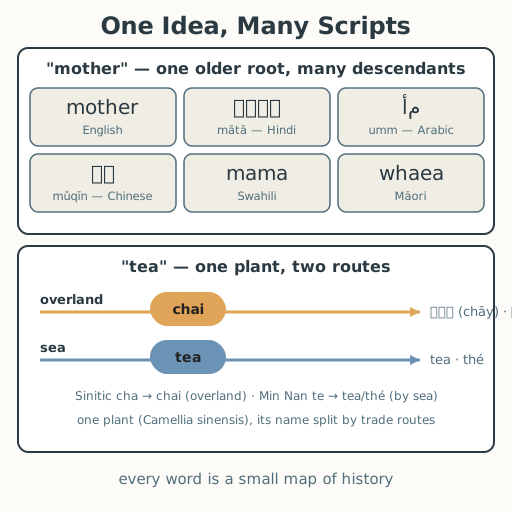
- Many-scripts organizer · 1 per learner Two panels — 'one idea, many scripts' (mother) and 'one drink, two routes' (tea/chai) — to annotate with what is shared and what differs
- Deliberation journal · 1 per learner Continuing the unit-long log
Low-tech / no-cost
- Paper and pencil To draw the many-scripts organizer by hand and copy the words
- Word family cards Sets of related words across languages (mother, tea, rice, moon) to sort into 'shared root' versus 'borrowed along a route'
Enriched / lab & device
- One etymological dictionary or online word-origin reference · 1 per group To trace a chosen word across its family and see where it traveled
Works in different contexts
- large-group Build a wall map: pin each word to where it is spoken and draw the routes (overland chai, sea tea) between them
- multi-age Younger learners match words that look alike; older learners explain shared roots versus borrowing and the routes behind each
- self-directed A learner fills both panels, then writes one sentence on what a shared root and a borrowed word each reveal about history
- level-grouped A ready group also discusses linguistic relativity in its moderate form — languages sort the world differently — and tests it with one example
- outdoor-only Stand at two "ports" and two "caravan" spots, and pass a word (written on a card) along the sea route and the land route, watching it change
Lesson 7 — One Idea, Many Scripts
Summary
Learners place one idea — “mother,” and a cup of tea — across many languages and scripts, distinguishing a shared root (words that descend from one older word) from borrowing (words that traveled along a route). They meet the moderate idea of linguistic relativity: languages sort the world differently, so translation always gains and loses — and a single word is a small map of history.
Objectives
- Reason across languages and writing systems, tracing how one idea appears in many scripts through shared roots and borrowing, and how languages sort the world differently. (D04.S2.12.02)
Connection
The word you use for your mother is not random. Across Europe and South Asia, “mother,” “madre,” “mère,” “Mutter,” and “mātā” all descend, through centuries, from one older word — a word so old it was spoken before writing (S-103). And the word for that warm drink in your cup split two ways: it spread by land as “chai” and by sea as “tea” (S-169). Every word you speak is like this — a small, folded map of where your language has been and whom its speakers met. Reading that map is a kind of literacy all its own.
Materials
- Many-scripts organizer
- Deliberation journal
- Word family cards (low-tech: paper)
Preparation
- Copy the many-scripts organizer; prepare the word family cards.
- Retrieval: from Lesson 6, the four writing-system types. Today we add the capstone turn: one idea across many scripts and languages (worked example first: Kirschner, Sweller & Clark, S-011).
- Prepare the two core examples with their sources: the Proto-Indo-European root *méh₂tēr “mother” and its reflexes — English mother, Spanish madre, French mère, German Mutter, Hindi mātā (via Sanskrit mātár-) — an inferred scientific reconstruction, held as a story not a revealed truth (Fortson, S-103). And the word for tea: Sinitic cha → chai (overland) versus Min Nan te → tea/thé (by sea) (WALS, S-169). The moderate idea that languages “sort the world differently” is linguistic relativity, held in its moderate, well-supported form (Sapir & Whorf, S-168; Everett, S-167).
Facilitator note
This lesson is written to the learner (“you”). The idea to land, held as description: words descend from older words (shared roots) or travel between languages (borrowing). The “mother” set descends from the reconstructed Proto-Indo-European root *méh₂tēr — an inference, marked honestly as such (Fortson, S-103). The tea/chai split is a real, mapped isogloss: Sinitic cha traveled overland (→ chai), while Min Nan te traveled by sea (→ tea/thé) (WALS, S-169). Linguistic relativity is held only in its moderate, well-supported form — languages sort the world differently and shape habitual thought — not the strong determinism form, which is largely rejected (Sapir & Whorf, S-168). Treat “language shapes thought” as a description to weigh, and “every language is a complete system, a wealth” as a value.
The ethics lens: describing a language as a “dialect” or “broken” version of another is a value claim dressed as a fact; the honest description is that every variety is a complete system. The egalitarianism lens: whose word for “mother” or “tea” is treated as the “real” one is a question of power, not of linguistics. The global lens: the tea/chai map is a miniature of world trade — overland caravans and sea routes — and no single route is the default. The technology lens: digital type and Unicode let all these scripts share one screen, and machine translation tries (imperfectly) to carry the meaning across — both are technologies that shape how languages meet. The environment lens: the tea plant (Camellia sinensis) is itself a botanical story — one plant, domesticated in one region, spread by human trade until its name marks two hemispheres; language here carries an environmental history. The critical-thinking lens: “does this similarity show a shared ancestor or a borrowed word?” is a precise historical question, not a guess. Preview: Lesson 8 turns from reading to writing — planning a sustained piece.
Procedure
- Recall (5 min). From Lesson 6: what does a mark stand for in an abugida? In a character script? Today we zoom out to whole words traveling across languages.
- Meet a shared root (10 min). Work a model example first (S-011). Read — or listen to read back, or hear via text-to-speech — the “mother” set — mother, madre, mère, Mutter, mātā. What they share is not chance: they descend from one older word, *méh₂tēr, reconstructed by comparing them. Note the honesty: the older word is inferred, not found written anywhere.
- Meet a borrowed word (10 min). Read — or listen to read back, or hear via text-to-speech — the “tea” set — tea, thé, chai, चाय (chāy), 茶 (chá). These did not descend from one ancestor; the drink and its word spread along two routes: overland as cha → chai, by sea as te → tea. Sort the words onto the two routes.
- Sort the cards (12 min). With a partner, sort the word family cards into “shared root” and “borrowed along a route,” arguing — aloud or in writing, sign, typing, or AAC — for each. What clue tells them apart?
- Name what languages sort differently (8 min). Choose one idea — snow, rice, time, or kinship — and note how different languages cut it up differently. Write one sentence on what translation would gain and one on what it would lose.
- Close (5 min). Say — or write, sign, type, or use AAC for — in one sentence, what a single borrowed word can tell you about the people who met and traded.
Differentiation
- Support: Match the clearly similar “mother” words only, and trace one route (tea) on a map, leaving the relativity step for later.
- Extension: Trace a chosen word through an etymological reference and present its root or route to a partner, marking what is documented versus reconstructed.
- Communication access: Every spoken step — reading, arguing, or closing aloud — can be completed in writing, signing, typing, or AAC instead. Learners who are non-speaking, d/Deaf, hard-of-hearing, or who use AAC sort, trace, and explain in their preferred mode; no step requires producing or hearing sound.
- Reading access (dyslexia, low-vision, decoding difficulty): Word sets may be read by listening — a partner or screen reader reads them, or the learner uses text-to-speech where a device exists — with words also shown in the learner’s home script (low-tech fallback: a peer or facilitator reads the words aloud, or the learner traces each word finger-by-finger). Spelling and decoding difficulty is distinct from comprehension and thinking: a learner who finds written word forms hard to decode can still reason about shared roots and borrowing, and no “correct penmanship” or standard spelling is required — what is assessed is the historical reasoning, not the letter forms.
Assessment
- Formative (peer + self): Can the learner distinguish a shared root from a borrowed word, sort examples with reasons, and state what translation gains and loses?
- Portfolio artifact (unit): The completed many-scripts organizer, filed in the deliberation journal.
Home connection
Ask someone at home for a word in their language and a similar word in a neighboring language. Find out together whether it is a shared root or a borrowed word, and write one sentence about what you found.
Resources
- On the Proto-Indo-European *méh₂tēr root and its reflexes: Fortson, Indo-European Language and Culture (S-103).
- On the tea/chai land-versus-sea routes: WALS Online, Dahl, “Tea” (S-169).
- On languages sorting the world differently (moderate form) and words carrying culture: Sapir & Whorf (S-168); Everett, Language: The Cultural Tool (S-167).
- On worked examples for a new analytical skill: Kirschner, Sweller & Clark (2006) (S-011); on retrieval and spacing: Dunlosky et al. (2013) (S-039).