Lesson 08 — Planning a Sustained, Polished Piece
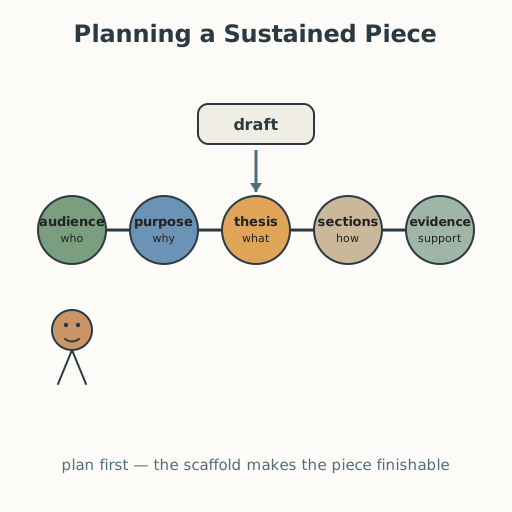
Learners plan a sustained, polished piece before drafting a word: choosing an audience and purpose, stating a thesis, mapping sections, and listing the evidence they will need. They learn that planning is not a delay but a form of care — the difference between a pile of thoughts and a piece with a spine.
Objectives
Objectives
- D04.S3.12.01 Produce a sustained, polished piece of writing that demonstrates command of structure, style, and evidence for a chosen audience.
Essential question
How do I plan a long piece of writing — choosing an audience, a purpose, a structure, and the evidence I will need — before I draft a single page?
Key vocabulary
Materials
Standard materials
- Writing plan organizer · 1 per learner A one-page planner — audience, purpose, thesis, structure (sections), evidence needed, and scope — for the unit's sustained piece
- Deliberation journal · 1 per learner Continuing the unit-long log
Low-tech / no-cost
- Paper and pencil To draw the writing plan organizer by hand
- Topic slips A spread of real topics (a contested local decision, a language you love, a technology's effect on a place) to choose from or adapt
Enriched / lab & device
- One short writing-process guide · 1 per pair A plain-language summary of the plan-draft-revise-edit-publish process with strategy prompts, for reference
Works in different contexts
- large-group Model one plan on the board, then pairs each plan their own piece and trade organizers for a peer check
- multi-age Younger learners choose an audience and write one sentence of purpose; older learners build the full plan with thesis and evidence needs
- self-directed A learner completes the planner alone, then writes a one-paragraph "contract" stating audience, purpose, and structure
- level-grouped A ready group also writes the scope — what the piece will *not* cover — and argues why leaving things out is a plan, not a failure
- outdoor-only Lay the plan's parts on the ground in order — audience, purpose, thesis, sections, evidence — and walk the path the piece will take
Lesson 8 — Planning a Sustained, Polished Piece
Summary
Learners plan a sustained, polished piece before drafting a word: choosing an audience and purpose, stating a thesis, mapping sections, and listing the evidence they will need. Planning is framed not as delay but as care — the difference between a pile of thoughts and a piece with a spine.
Objectives
- Plan a sustained, polished piece of writing by choosing audience and purpose, stating a thesis, and mapping structure and evidence. (D04.S3.12.01)
Connection
A long piece of writing is not one big act; it is a small act repeated many times, and the hardest problem is not filling pages but keeping a direction. A writer who plans — who knows the audience, the purpose, the one-sentence spine, and the evidence needed — writes faster, revises better, and finishes more often. The plan is not the piece; it is the scaffold the piece is built on, and it is a skill you can learn and reuse for a lifetime of writing.
Materials
- Writing plan organizer
- Deliberation journal
- Topic slips (low-tech: paper)
Preparation
- Copy the writing plan organizer; prepare the topic slips.
- Retrieval: from Lesson 5, integrating sources into a synthesized position; from Lesson 2, the parts of a reasoned position. Today we begin the writing strand with planning (worked example first: Kirschner, Sweller & Clark, S-011).
- Prepare the writing-process frame: plan → draft → revise → edit → publish, with explicit strategy instruction, which is evidence-supported for adolescent writers (Graham & Perin, S-102; IES secondary writing guide, S-171).
Facilitator note
This lesson is written to the learner (“you”). The idea to land, held as description: the writing process — plan, draft, revise, edit, publish — with explicit strategy instruction is a well-supported pedagogy for adolescent writers (Graham & Perin, S-102; IES, S-171). Hold the process as evidence-based practice, and the audience-first ethic as a value. Emphasize that the plan serves the writer, not the reverse — a plan that outlives its usefulness is to be revised, not obeyed.
The ethics lens: choosing an audience is a promise — the piece owes that audience clarity and honesty, not just style. The egalitarianism lens: a plan makes a long piece doable in steps, which means sustained writing is not reserved for the naturally fluent. The global lens: what counts as a well-structured piece differs across cultures and traditions — a plan can honor many structures, not one. The technology lens: digital outlines and citation tools are scaffolds, but the thinking (what to say, to whom, why) is not automatable — the tool serves the plan. The environment lens: invite topics that weigh human and ecological goods, and note that a piece’s form (paper, screen, spoken) carries a small environmental footprint worth choosing deliberately. The critical-thinking lens: “what evidence will I need, and where will it come from?” is a question of rigor asked before the writing, where it is cheap. Preview: Lesson 9 turns the plan into a draft.
Procedure
- Recall (5 min). From Lesson 2: what six parts hold a reasoned position together? A sustained piece is a longer version of that position — today we plan it.
- Meet the plan (10 min). Work a model example first (S-011). Watch a plan take shape for one topic: audience (a community deciding about a local resource), purpose (to inform a decision), thesis (one sentence stating the position), sections (three or four), and evidence needed (which sources, which kinds). Name each part and what it does.
- Choose and plan (15 min). Choose a topic (or adapt one) and fill your own writing plan: audience, purpose, thesis, sections, evidence needed. Be specific — name the audience as real people, not “everyone.”
- Peer-check the plan (10 min). Trade plans with a partner. Ask — aloud, or in writing, sign, typing, or AAC: is the thesis one sentence and arguable? do the sections follow from it? is the evidence listed enough, and does any part need a source you do not yet have?
- Write the contract (8 min). Write a one-paragraph “contract”: this is my audience, this is my purpose, this is my thesis, this is my structure. Mark it as a plan you may revise.
- Close (5 min). Say — or write, sign, type, or use AAC for — why a plan makes a long piece more likely to be finished, not just started.
Differentiation
- Support: Plan with a single audience, a one-sentence purpose, and two sections, leaving thesis refinement for later.
- Extension: Write the scope — what the piece will deliberately not cover — and explain how that choice strengthens rather than weakens the piece.
- Communication access: Every spoken step — asking, checking, or closing aloud — can be completed in writing, signing, typing, or AAC instead. Learners who are non-speaking, d/Deaf, hard-of-hearing, or who use AAC plan, peer-check, and present in their preferred mode; no step requires producing or hearing sound.
- Writing access (dyslexia, low-vision, spelling difficulty): The plan may be produced by voice — dictated to a scribe or recorded with speech-to-text where a device exists — or built with drawings and word cards instead of fluent sentences (low-tech fallback: plan aloud and have a partner or facilitator write it down, or trace key words finger-by-finger). Spelling and decoding difficulty is distinct from planning and thinking: a learner who spells non-standardly may plan superbly, and no “correct penmanship” or standard spelling is required — what is assessed is the audience, purpose, thesis, and structure, not the letter forms.
Assessment
- Formative (peer + self): Can the learner state an audience, purpose, and one-sentence thesis, map sections, and list the evidence needed?
- Portfolio artifact (unit): The completed writing plan (the “contract”), filed in the deliberation journal as the seed of the sustained piece.
Home connection
Tell — or write to, sign to, or type to — someone at home what you plan to write, and ask them one question they would want your piece to answer. Add that question to your plan.
Resources
- On the writing process and explicit strategy instruction: Graham & Perin, Writing Next (S-102); IES practice guide, Teaching Secondary Students to Write Effectively (S-171).
- On worked examples for a new skill: Kirschner, Sweller & Clark (2006) (S-011); on retrieval and spacing: Dunlosky et al. (2013) (S-039).