Lesson 11 — Writing Across Disciplines, Ethically and Precisely
Learners restate one factual claim for four different audiences and disciplines — scientific, civic, technical, and everyday — choosing words that are both *precise* and *ethical*. They learn that clarity is a form of care, that precision without kindness can confuse, and that care without precision can mislead; mature writing holds both at once.
Objectives
Objectives
- D04.S3.12.02 Write with clarity and care across disciplines and registers, using language ethically and precisely in a multilingual world.
Essential question
How do I write with clarity and precision across different disciplines and registers, using language ethically — so my words neither confuse nor harm?
Key vocabulary
Materials
Standard materials
- Cross-discipline writing organizer · 1 per learner One claim written for four audiences/disciplines (scientific, civic, technical, everyday), with a column for the ethical and precise word choices each demands
- Deliberation journal · 1 per learner Continuing the unit-long log
Low-tech / no-cost
- Paper and pencil To draw the cross-discipline organizer by hand
- Claim cards One factual claim (a health finding, an environmental measurement, a civic rule) to restate precisely and ethically for four audiences
Enriched / lab & device
- One plain-language guide · 1 per pair A short page on writing clearly for readers who may not share your specialty or your first language, with before-and-after examples
Works in different contexts
- large-group Restate one claim for four audiences on the board, then pairs each take a claim card and do the same
- multi-age Younger learners restate a claim for two audiences; older learners also mark the ethical word choices and where precision risks confusing
- self-directed A learner restates one claim for four audiences and writes one sentence on the precise-versus-ethical tension they met
- level-grouped A ready group also rewrites a jargon-heavy sentence into plain language without losing accuracy, and checks it against a reader
- outdoor-only Post four "audience" stations; learners carry one claim from station to station and restate it — aloud, or in writing, sign, or AAC — adjusting register at each
Lesson 11 — Writing Across Disciplines, Ethically and Precisely
Summary
Learners restate one factual claim for four different audiences and disciplines — scientific, civic, technical, and everyday — choosing words that are both precise and ethical. Clarity is a form of care; precision without kindness can confuse, and care without precision can mislead. Mature writing holds both at once.
Objectives
- Write with clarity, precision, and ethical care across disciplines and registers, adapting to diverse audiences in a multilingual world. (D04.S3.12.02)
Connection
The same fact must be said four ways to be understood by four different people: a scientist needs the exact measurement, an official needs the rule and its reason, a technician needs the steps, and a neighbor — who may read your language as a second language — needs the plain truth. Say it only one way and you either confuse the scientist or lose the neighbor. The skill is not dumbing down or dressing up; it is choosing, each time, the words that are accurate and fair to the person reading.
Materials
- Cross-discipline writing organizer
- Deliberation journal
- Claim cards (low-tech: paper)
Preparation
- Copy the cross-discipline organizer; prepare the claim cards.
- Retrieval: from Lesson 10, revision as re-seeing; from Lesson 4, the three registers. Today we add the capstone turn: precision and ethics across disciplines (worked example first: Kirschner, Sweller & Clark, S-011).
- Prepare the frame: precision and register are teachable writing skills (IES, S-171; Graham & Perin, S-102); accessibility — writing so people with different languages, abilities, and backgrounds can read it — is a standard worth teaching (WCAG, S-280).
Facilitator note
This lesson is written to the learner (“you”). The idea to land, held as description: register and precision are teachable writing skills (IES, S-171; Graham & Perin, S-102), and accessibility — making text understandable to people with different languages, abilities, and backgrounds — is a documented standard (WCAG, S-280). Hold “clarity is care” and “using language ethically” as values; hold “register shifts with audience” as a skill. In a multilingual classroom, honor that a learner may write most precisely in their home language, and that writing in a second or third language is a strength, not a deficit.
The ethics lens: language can confuse or harm — jargon excludes, euphemism hides, and a careless word can mislead a reader who trusts you; ethical writing asks “who will read this, and what do they need?” The egalitarianism lens: plain language is an equalizer — it lets a neighbor, a non-specialist, and a second-language reader stand on the same ground as an expert. The global lens: what is “clear” differs across languages and cultures, so precision is re-negotiated in every language, not imported from one. The technology lens: technical writing is the written form of technology, and digital text can be made accessible — structured headings, captions, readable type — so the tool itself is a site of care. The environment lens: environmental claims (measurements, risks, predictions) are exactly where precision and honesty matter most, because overstatement or vagueness can misdirect decisions about the living world. The critical-thinking lens: “is this both accurate and fair?” is a two-part test run on every sentence. Preview: Lesson 12 turns from writing to advocacy — language justice.
Procedure
- Recall (5 min). From Lesson 4: what does each register ask of a reader? Today we write for those readers, precisely and ethically.
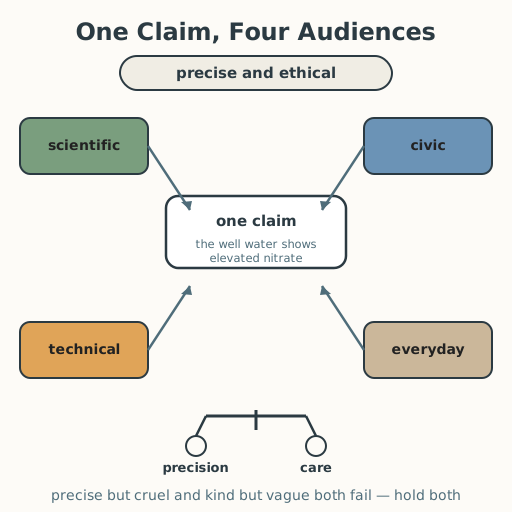
- Meet the tension (10 min). Work a model example first (S-011). Take one claim — the well water shows elevated nitrate — and restate it four ways: scientific (the measured concentration), civic (the rule and what it means for families), technical (how to test and treat), and everyday (plain truth for a neighbor). Notice where precision risks confusion, and where care risks vagueness.
- Restate a claim (15 min). Take a claim card and fill the organizer: restate the claim for the four audiences. Under each, mark the one word choice that is most precise and the one that is most caring.
- Test for understanding (10 min). Read — or present in writing, sign, typing, or AAC — your “everyday” version to a partner as if they were the neighbor. Ask — aloud or in writing, sign, typing, or AAC: did you understand it? is anything still jargon? does it say exactly what is true?
- Rewrite the jargon (8 min). Take one jargon-heavy sentence (your own or a given one) and rewrite it into plain language without losing accuracy. Mark what you kept and what you traded.
- Close (5 min). Say — or write, sign, type, or use AAC for — why “precise but cruel” and “kind but vague” are both failures, and what mature writing does instead.
Differentiation
- Support: Restate the claim for only two audiences (everyday and one other), and focus on the plain-language version.
- Extension: Rewrite a real technical or legal sentence into plain language, then check the rewrite with a reader and note any accuracy that was lost or kept.
- Communication access: Every spoken step — reading, testing, or closing aloud — can be completed in writing, signing, typing, or AAC instead. Learners who are non-speaking, d/Deaf, hard-of-hearing, or who use AAC restate, test, and share in their preferred mode; no step requires producing or hearing sound.
- Writing access (dyslexia, low-vision, spelling difficulty): Restatements may be produced by voice — dictated to a scribe or recorded with speech-to-text where a device exists — and read back by a partner or screen reader (low-tech fallback: a partner or facilitator reads the claim and scribes the restatement, or the learner traces key words finger-by-finger). Spelling and decoding difficulty is distinct from precision and thinking: a learner who spells non-standardly may restate a claim with exact, ethical care, and no “correct penmanship” or standard spelling is required — what is assessed is the precision and care of the wording, not the letter forms.
Assessment
- Formative (peer + self): Can the learner restate a claim across four audiences with precision and care, and rewrite jargon into plain language without losing accuracy?
- Portfolio artifact (unit): The completed cross-discipline organizer, filed in the deliberation journal.
Home connection
Find one sentence at home that is hard to understand — a label, a notice, a form — and rewrite it in plain language. Read both versions to someone — or share them in writing, sign, or AAC — and see which they understand.
Resources
- On register, precision, and the writing process: IES, Teaching Secondary Students to Write Effectively (S-171); Graham & Perin, Writing Next (S-102).
- On writing accessibly for people with different languages and abilities: W3C WCAG (S-280).
- On worked examples for a new skill: Kirschner, Sweller & Clark (2006) (S-011); on feedback: Hattie, Visible Learning (S-012).