Lesson 10 — Revision as Re-Seeing
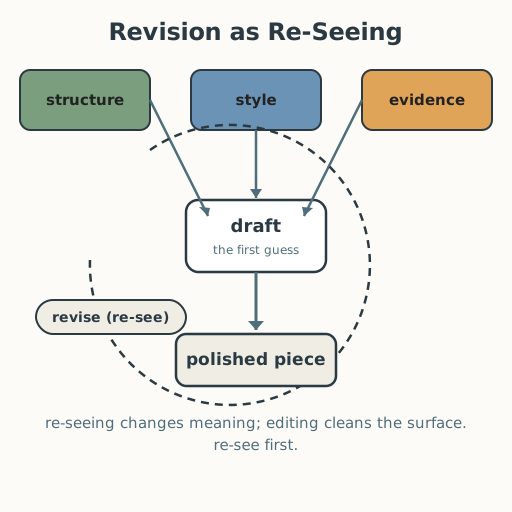
Learners run three revision passes over their draft — structure, style, and evidence — and give and use peer feedback that serves the *work*, not the writer's feelings. They learn that revision is *re-seeing* (changing what the piece says and how it is built), distinct from editing (correcting surface errors), and that feedback is one of the strongest levers for improving writing.
Objectives
Objectives
- D04.S3.12.01 Produce a sustained, polished piece of writing that demonstrates command of structure, style, and evidence for a chosen audience.
Essential question
How do I revise a draft by *re-seeing* it — tightening structure, sharpening style, and testing evidence — so the piece becomes what I actually meant to say?
Key vocabulary
Materials
Standard materials
- Revision checklist · 1 per learner A three-pass checklist — structure, style, evidence — with a space for one concrete change under each
- Deliberation journal · 1 per learner Continuing the unit-long log
Low-tech / no-cost
- Paper and pencil To mark up a printed or handwritten draft with three different marks (one per pass)
- Colored marks (three pens or three symbols) One mark each for structure, style, and evidence passes
Enriched / lab & device
- One collaborative editor with comments and track changes · 1 per pair To practice leaving margin comments and accepting or rejecting suggestions
Works in different contexts
- large-group Model the three-pass revision on a shared draft, then pairs revise each other's work with the checklist
- multi-age Younger learners do the evidence pass (does each claim have support?); older learners do all three passes and write a revision memo
- self-directed A learner runs all three passes on their own draft and writes one sentence per pass on what changed and why
- level-grouped A ready group also distinguishes revision (re-seeing) from editing (correcting) and does each as a separate pass
- outdoor-only Read the draft aloud — or silently, via screen reader, or with a partner reading it — while walking; stop wherever the argument stalls, and mark those spots for revision
Lesson 10 — Revision as Re-Seeing
Summary
Learners run three revision passes over their draft — structure, style, and evidence — and give and use peer feedback that serves the work, not the writer’s feelings. Revision is re-seeing (changing what the piece says and how it is built), distinct from editing (correcting surface errors), and feedback is one of the strongest levers for improving writing.
Objectives
- Revise a sustained draft for structure, style, and evidence, using and giving feedback that serves the work. (D04.S3.12.01)
Connection
The first version of anything you write is a first guess at what you meant. Revision is not punishment for a bad guess; it is the chance to make the piece say what you actually intended. Skilled writers expect to revise, and they know the difference between re-seeing — does this paragraph belong here? is this the right word? does the evidence hold? — and editing — is this spelled right, is the punctuation clean? Both matter, but re-seeing comes first, because there is no point polishing a sentence you are about to cut.
Materials
- Revision checklist
- Deliberation journal
- Colored marks (low-tech: three pens or three symbols)
Preparation
- Copy the revision checklist; prepare the three-pass marks.
- Retrieval: from Lesson 9, the paragraph-as-argument; from Grade 11 (D04.S3.11.01), extended original writing. Today we add the capstone turn: revision as re-seeing (worked example first: Kirschner, Sweller & Clark, S-011).
- Prepare the revision frame from the writing process (IES, S-171; Graham & Perin, S-102): revision (structure, style, evidence) precedes editing (surface correctness). Feedback is among the strongest documented influences on learning (Hattie, S-012).
Facilitator note
This lesson is written to the learner (“you”). The idea to land, held as description: revision — changing structure, style, and evidence — is a distinct, teachable stage of the writing process, preceding editing (IES, S-171; Graham & Perin, S-102), and feedback is among the strongest documented influences on learning (Hattie, S-012). Hold “feedback serves the work” as a value and a skill, not a personal verdict. Be explicit that a peer’s first duty is to describe what the piece does, then to suggest — and that the writer keeps the final say.
The ethics lens: honest feedback is a form of respect — soft-pedaling a real problem does the writer a quiet harm; so does cruelty. The egalitarianism lens: peer revision means every learner is both author and editor, which distributes the power of the red pen rather than concentrating it in one teacher. The global lens: what counts as “clear” or “well-structured” differs across traditions — a peer should ask what the writer was aiming for, not impose one shape. The technology lens: comments and track changes let feedback happen asynchronously and across distance, and let the writer accept or reject each suggestion — but the judgment of what to change remains human. The environment lens: revising on a screen before printing is a low-waste choice, and precise language matters most when a piece describes environmental evidence where overstatement misleads. The critical-thinking lens: “would the evidence still support the claim if I removed my weakest source?” is the rigor a reviser applies. Preview: Lesson 11 writes across disciplines and registers with precision.
Procedure
- Recall (5 min). From Lesson 9: what four parts make a paragraph an argument? Today we re-see the whole draft, not just its parts.
- Meet the three passes (10 min). Work a model example first (S-011). On a shared draft, run three passes with three marks: structure (does each section earn its place? does the order build?), style (is each sentence doing work? is any word imprecise?), evidence (does every claim carry support? is any source weak or overused?). Name what each pass changes.
- Peer review (15 min). Trade drafts with a partner. Using the checklist, mark the three passes on their draft — describing first, then suggesting. Be specific: name the paragraph, the sentence, the claim.
- Revise your own (12 min). Take back your draft and act on what serves the work. Make at least one real change in each pass, and note why you made it.
- Distinguish revision from editing (8 min). List the changes you made as either “re-seeing” (structure, style, evidence) or “editing” (spelling, punctuation). Which changed the meaning, and which only cleaned the surface?
- Close (5 min). Say — or write, sign, type, or use AAC for — in one sentence, what your piece says now that it did not say before you revised.
Differentiation
- Support: Run only the evidence pass and one editing pass, leaving structure and style for later.
- Extension: Write a short “revision memo” stating what changed, why, and what you chose not to change despite feedback.
- Communication access: Every spoken step — giving feedback, or closing aloud — can be completed in writing, signing, typing, or AAC instead. Learners who are non-speaking, d/Deaf, hard-of-hearing, or who use AAC give and receive feedback in written or signed form and revise in their preferred mode; no step requires producing or hearing sound.
- Writing access (dyslexia, low-vision, spelling difficulty): The draft may be read back by a partner or screen reader, and revisions made by voice — dictated to a scribe or recorded with speech-to-text where a device exists (low-tech fallback: a partner or facilitator reads the draft and scribes the changes, or the learner traces key lines finger-by-finger). Spelling and decoding difficulty is distinct from revision and thinking: a learner who spells non-standardly may re-see structure, style, and evidence superbly, and no “correct penmanship” or standard spelling is required — what is assessed is the re-seeing of the work, not the surface of the letters.
Assessment
- Formative (peer + self): Can the learner run three revision passes, give specific feedback that serves the work, and act on feedback with reasons?
- Portfolio artifact (unit): The marked draft and the revised version, filed in the deliberation journal to show the arc from draft to revision.
Home connection
Ask someone at home to read one paragraph of your revised piece and tell you the one place it is still unclear. Decide whether to change it, and why.
Resources
- On revision as a distinct stage of the writing process: IES, Teaching Secondary Students to Write Effectively (S-171); Graham & Perin, Writing Next (S-102).
- On feedback as among the strongest influences on learning: Hattie, Visible Learning (S-012).
- On worked examples for a new skill: Kirschner, Sweller & Clark (2006) (S-011); on retrieval and spacing: Dunlosky et al. (2013) (S-039).